
Blog
2026 Medicare Home Health Care Guide for Families
By Medicare Mentors ·

What if the most effective way to recover after a hospital stay isn't in a clinical facility, but right in your own living room? For many families in Raleigh, understanding medicare coverage for home health care feels like trying to solve a puzzle with missing pieces. You likely want to protect your loved one's independence while keeping costs low, but the fear of a denied claim or an unexpected bill can be paralyzing. It's easy to feel overwhelmed by the difference between medical home health and general home care, especially when you're already managing a health crisis or a major life transition.
We believe you deserve clear, objective advice that puts your family's needs first. In this guide, we'll explain the four strict eligibility rules you must meet for a $0 copay and clarify the often misunderstood "homebound" status. You'll learn how Part A and Part B work together, the 2026 deductible amounts, and how to find a plan that supports your recovery right here in North Carolina. By the end, you'll have a simple, actionable plan to secure the care you need without the paperwork headache.
Key Takeaways
- Medicare covers skilled nursing and therapy not just for recovery, but also to maintain your health or slow a decline under the latest 2026 guidelines.
- You'll learn the four specific criteria required to qualify for medicare coverage for home health care, including the "homebound" certification and the need for a doctor's plan.
- We'll show you how to access many home health services at a $0 copay while preparing for the 20% coinsurance costs on durable medical equipment.
- Understand how your choice between Original Medicare and a Medicare Advantage plan affects your access to local home health agencies in the Raleigh-Durham area.
- Get a simple, two-step path to starting a conversation with your physician so you can secure the support you need without the stress of paperwork.
What is Medicare Home Health Care? Defining the Benefit
Medicare home health care is a specific benefit designed to bring professional medical services to your front door when leaving home is difficult. It's not just a convenience; it's a clinical program focused on treating an illness or injury in the comfort of your own home. When we look at Defining Home Health Care, we focus on services that are "goal-oriented." This means the care is intended to help you get better, maintain your current health, or slow down a decline. This last point is vital; thanks to the Jimmo v. Sebelius settlement, you don't always have to show "improvement" to keep your coverage as long as the care is needed to prevent your condition from worsening.
Many families in the Raleigh area assume this benefit covers general help around the house, but medicare coverage for home health care is strictly tied to medical necessity. A Medicare-certified Home Health Agency (HHA) coordinates this care, sending professionals like nurses or therapists to your residence. This agency acts as the bridge between your doctor's orders and the daily support you receive, ensuring every visit follows a specific plan of care.
To better understand this concept, watch this helpful video:
Skilled Care vs. Personal Care: The Critical Difference
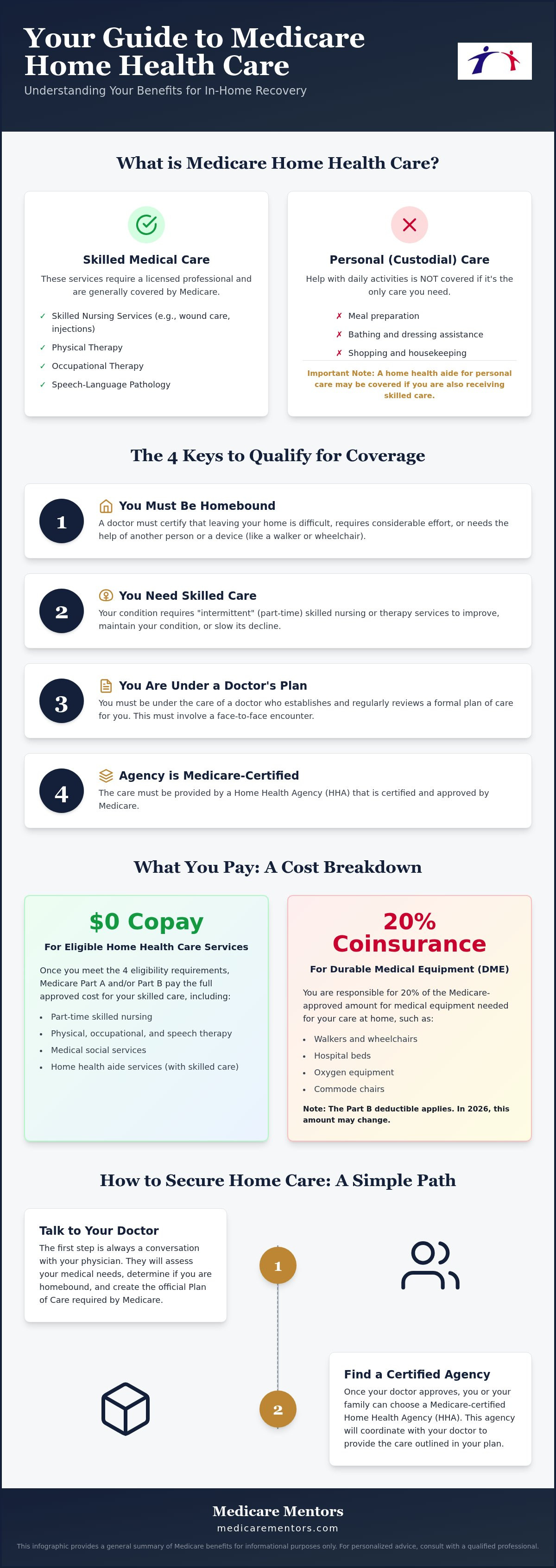
Understanding the line between "skilled" and "personal" care is the best way to avoid a denied claim. Skilled care requires the expertise of a licensed professional. Examples include wound care for a post-surgical incision, IV therapy, or physical therapy to regain mobility. On the other hand, personal care, often called custodial care, involves help with bathing, dressing, or preparing meals. Medicare won't pay for personal care if it's the only service you need.
However, if you're already receiving skilled nursing, you might qualify for a home health aide to help with these daily tasks. Caregiver Tip: Keep a detailed log of medical symptoms and recovery milestones. When you document specific medical needs rather than just difficulty with chores, you help your HHA prove to Medicare that the medicare coverage for home health care remains essential for your recovery.
Short-Term vs. Long-Term Home Care Expectations
This benefit is designed to be "intermittent," meaning it's part-time rather than 24/7. For 2026, Medicare defines this as up to 28 hours per week of combined nursing and aide services, though it can extend to 35 hours in specific medical situations. It's often structured in a "60-day episode of care," which is the period your doctor certifies you need support. If you're transitioning from a hospital stay back to your home in Durham or Charlotte, this 60-day window is your primary recovery period. While the care can be renewed if a doctor recertifies the need, it's not a permanent long-term care solution. If you're looking for a way to bridge these gaps, reviewing your medicare planning options can help you identify supplemental coverage that picks up where Original Medicare leaves off.
The 4 Strict Eligibility Requirements for Home Health Coverage
Qualifying for medicare coverage for home health care isn't automatic; it requires meeting four specific criteria at the same time. Think of these as the four pillars that hold up your benefits. If one is missing, the coverage won't stand. While the rules might seem designed to keep people out, they're actually in place to ensure you receive the specific level of professional care your condition demands. These Official Medicare Coverage Rules are the foundation for any home-based recovery plan in 2026.
- Doctor's Certification: You must be under the care of a physician who creates and regularly reviews a formal plan of care. This isn't a one-time note; it's a living document that guides your recovery.
- Homebound Status: A doctor must certify that you are "homebound," meaning leaving your residence is difficult and requires significant effort.
- Skilled Care Need: You must require intermittent skilled nursing care or therapy services, such as physical, speech, or occupational therapy. Medicare defines "intermittent" as needing care at least once every 60 days and at most 28 to 35 hours per week.
- Medicare-Certified Agency: The company providing your care must be approved by Medicare. If you use an agency that isn't certified, you'll likely be responsible for the full cost.
If you're feeling a bit lost in these requirements, you're not alone. Many families find that a quick chat with an independent Medicare expert can help clarify which local agencies in the Raleigh-Durham area meet these standards.
What Does 'Homebound' Actually Mean?
The term "homebound" is often misunderstood. It doesn't mean you're a prisoner in your own house. Legally, it means that leaving your home requires a "considerable and taxing effort." This usually involves needing a wheelchair, walker, or the physical assistance of another person to get out the door. You can still leave for specific reasons without losing your medicare coverage for home health care. Permitted absences include attending religious services, going to a licensed adult day care, or visiting a doctor. Occasional short trips for unique events, like a family funeral or a graduation, generally won't disqualify you either. The key is that these outings must be infrequent or short in duration.
The Face-to-Face Encounter Requirement
To keep everything compliant for 2026, Medicare requires a "face-to-face" encounter with your doctor. This meeting must happen no more than 90 days before your home care starts, or within 30 days after it begins. The purpose is to ensure your doctor has personally evaluated your condition and agrees that home care is the right path. Fortunately, telehealth has become a permanent fixture in this process. If you can't easily make it to a clinic in North Carolina, a video visit with your primary care physician can often satisfy this requirement. Simply put, a doctor must physically or virtually see you to certify that your medical condition truly requires skilled care at home.
What Medicare Pays For (and the Hidden Gaps)
One of the most reassuring aspects of medicare coverage for home health care is the cost of the actual visits. For 2026, if you meet the four eligibility requirements we discussed earlier, you pay a $0 copay for covered home health services. This means the visits from nurses, physical therapists, and speech-language pathologists are fully covered. However, while the care itself is covered at 100%, there are financial "gaps" and specific rules about which part of Medicare pays the bill. Following the Official Medicare Home Health Coverage Guidelines ensures you don't get caught off guard by these nuances.
The billing usually depends on whether you've recently been in the hospital. If your home care starts after a stay of at least three days in a hospital or skilled nursing facility, Medicare Part A typically covers the first 100 days. If you haven't been hospitalized, Medicare Part B takes the lead. In 2026, the Part B annual deductible is $283. While the home health visits themselves don't require you to meet this deductible, other related services might. It's also vital to know what Medicare does not cover. You'll be responsible for the full cost of 24-hour care at home, meal delivery services, and "homemaker services" like laundry or shopping if these are the only things you need.
Durable Medical Equipment (DME) at Home
While the nursing visits cost you nothing, the tools used for your recovery often do. Medicare covers "Durable Medical Equipment" such as walkers, wheelchairs, or hospital beds at 80% of the approved amount. You are responsible for the remaining 20% coinsurance. This is a common area of confusion for families in North Carolina who expect everything to be free. To manage these out-of-pocket costs, many of our clients use Medicare Supplement Insurance to bridge that 20% gap. Just be sure your equipment provider is "enrolled" in Medicare. If they aren't, Medicare won't pay its share, and you could be stuck with the entire bill.
North Carolina Specifics: The Review Choice Demonstration
If you live in Raleigh, Durham, or the surrounding areas, you should know about the Review Choice Demonstration (RCD). North Carolina is one of only a few states where Medicare requires home health agencies to participate in a pre-claim review process. This means your agency must submit documentation to Medicare early on to prove the care is medically necessary. While this program is designed to prevent fraud, it can sometimes affect how quickly your care is approved. Working with a local, reputable agency that understands these NC-specific rules is essential in 2026. They know how to navigate the paperwork so your recovery isn't delayed by administrative hurdles.
Medicare Advantage vs. Original Medicare for Home Care
When you're choosing between Original Medicare and a Medicare Advantage plan, the rules for medicare coverage for home health care stay legally the same, but your daily experience will feel very different. By law, all Medicare Advantage plans must provide the same level of coverage as Original Medicare. This is known as the "equivalency rule." However, the way you access these benefits depends on your specific plan's structure. While Original Medicare allows you to work with any Medicare-certified agency in the country, Advantage plans usually restrict you to a specific network of providers in areas like Durham or Charlotte. If your favorite local agency isn't in that network, you could face much higher costs or a total denial of coverage.
The most significant difference involves how care is approved. With Original Medicare, your doctor and the home health agency generally decide when care starts based on medical necessity. In contrast, most Medicare Advantage plans require "prior authorization." This means the insurance company must review the agency's request and give the green light before a nurse or therapist ever knocks on your door. For families in North Carolina navigating a sudden hospital discharge, this extra administrative step can create a stressful waiting period during a time when every day of recovery counts.
Managing Prior Authorizations in Part C
Handling delays in care approval requires patience and a bit of advocacy. If your insurance carrier is slow to respond to a prior authorization request, it can stall your recovery progress. This is exactly why many local families choose to work with an independent Medicare advisor who can help you understand your plan's specific rules. We can look at how different Medicare Advantage Plans in the Raleigh area handle these approvals so you aren't caught off guard. Having a partner to explain the "fine print" ensures you can focus on getting well instead of fighting with an insurance company over medicare coverage for home health care.
Extra Home Benefits in 2026 Plans
One advantage of Part C is that many 2026 plans offer "supplemental benefits" that Original Medicare simply doesn't provide. These are often called "flex" benefits or support for the chronically ill. Depending on your specific North Carolina plan, you might have access to non-medical transport for follow-up doctor visits or even limited grocery delivery services while you're homebound. During the Annual Enrollment Period, it's a great idea to compare these ancillary benefits alongside your medical coverage. You might also find plans that bundle in extra Dental, Vision, and Hearing support, which can be a huge financial relief when you're on a fixed income. If you want to see which 2026 plans offer these extra layers of support in your zip code, contact our team today for a no-cost plan comparison.
How to Secure Home Care: The Medicare Mentors Path
Securing medicare coverage for home health care doesn't have to be a source of stress for your family. While the rules are strict, following a methodical path ensures you don't miss out on the benefits you've earned. We've helped hundreds of Raleigh families navigate this process by breaking down complex insurance requirements into simple, actionable steps. Our goal is to move at your pace, providing the education you need to make a confident decision for your loved one's recovery.
- Step 1: Talk to your doctor early. Your physician is the gatekeeper for this benefit. Start the conversation about home care needs before a hospital discharge or during a routine wellness visit to ensure the 90-day face-to-face requirement is met.
- Step 2: Review your plan's network and costs. Check if your current plan has a robust network of agencies in the Triangle area. Remember that while visits may have a $0 copay, you'll still need to account for the $283 Part B deductible if you require medical equipment or other outpatient services.
- Step 3: Get an unbiased comparison. Not all plans handle home care the same way. We provide a side-by-side look at local NC plans to see which ones offer the best access to the agencies you trust.
- Step 4: Let us handle the coordination. We take the "insurance speak" off your plate. Our team coordinates with carriers to clarify authorization rules so you can focus on what matters most: healing.
Why an Independent Broker is Your Best Advocate
We believe the relationship between a broker and a client should be a teacher-student dynamic. Our role isn't to sell you a product; it's to protect your interests. Because we're an independent brokerage, we don't work for the insurance companies. We work for you. This independence allows us to provide objective advice on medicare coverage for home health care without any carrier bias. Whether you're moving to North Carolina or transitioning from employer coverage to retirement, we act as a local ally to ensure your plan matches your evolving health needs. We've seen how health changes can cause anxiety, and we're here to lower that pressure with reliable, long-term support.
Next Steps: Your No-Cost Coverage Review
Planning for the future is like assembling a multi-piece construction task; every part must fit perfectly to provide stability. We invite you to schedule a one-on-one consultation at our Raleigh office or via a simple phone call. During this session, we'll review your current medications, your preferred doctors, and your potential need for home-based support. Please bring your current red, white, and blue Medicare card and a list of any specific health concerns you have for 2026. This is a low-friction way to gain peace of mind and ensure your coverage is ready when you need it most. Start your Medicare Planning today and let us help you secure the care your family deserves.
Take the Next Step Toward Confident Home Care
Understanding the rules for medicare coverage for home health care is the first step in protecting your loved one's independence. We've explored how the 2026 "homebound" rules work and why the difference between medical and personal care matters for your wallet. Securing the right support is about more than just finding a nurse; it's about ensuring your insurance works exactly when you need it most. We've seen how strict eligibility rules can feel like a barrier, but with a clear plan of care and the right doctor's certification, you can unlock vital services right at home.
You don't have to solve this puzzle alone. As a family-run business with nearly 300 Five-Star reviews, we provide independent advice at no cost to you. We're here to serve as your local ally in Raleigh, Durham, and across North Carolina. Schedule your free Medicare coverage review with a local expert today to verify your benefits and skip the stress of paperwork. Your recovery should be your only focus; let us handle the rest.
Frequently Asked Questions
Does Medicare cover 24-hour home health care?
Medicare does not cover 24-hour-a-day care at your residence. The benefit is strictly for "intermittent" skilled care, which means part-time visits from a nurse or therapist rather than constant supervision. If you require around-the-clock assistance, you'll likely need to explore private pay options or long-term care insurance, as medicare coverage for home health care is built for medical recovery rather than full-time companionship.
Will Medicare pay for a caregiver to cook meals and clean my house?
Medicare won't pay for a caregiver if your only needs are "custodial" tasks like cooking, cleaning, or laundry. These are considered homemaker services and don't meet the clinical requirements for coverage. However, if you're already receiving skilled nursing or therapy, a home health aide might be allowed to provide limited help with personal care, such as bathing, during their scheduled medical visits.
How do I find a Medicare-certified home health agency in Raleigh, NC?
You can find a certified agency in the Raleigh area by using the "Care Compare" tool on the official Medicare website. It's also a great idea to ask for recommendations from your primary care physician at local systems like WakeMed or Duke Raleigh. Using a certified agency is a non-negotiable requirement; if the provider isn't approved by Medicare, you'll be responsible for the entire bill yourself.
Is there a limit to how many home health visits Medicare will pay for?
There isn't a fixed limit on the total number of visits you can receive, but the care must be medically necessary. Medicare coverage for home health care is typically authorized in 60-day "episodes" of care. As long as your doctor continues to certify that you're homebound and require skilled medical services, these episodes can be renewed for as long as you need them.
Does Medicare cover physical therapy at home after a knee replacement?
Yes, Medicare will cover home-based physical therapy after a knee replacement if your surgeon certifies that you're homebound. If traveling to an outpatient clinic in Durham or Raleigh would be a "taxing effort" during your initial recovery, a therapist can come to your house. This allows you to regain your mobility in a safe environment before transitioning to a traditional gym or clinic.
What happens if my home health coverage is denied?
If your coverage is denied or being terminated, you have the legal right to a fast appeal. You'll receive a "Notice of Medicare Non-Coverage" at least two days before your services are set to stop. You can then contact the Quality Improvement Organization for North Carolina to request an immediate review. They'll look at your medical records to decide if the care is still necessary.
Do Medicare Supplement (Medigap) plans cover home health care?
Medigap plans don't pay for the home health visits themselves because Original Medicare already covers those at 100% with no copay. However, a Supplement plan is incredibly helpful for covering the 20% coinsurance for Durable Medical Equipment. If you need to rent a hospital bed or a lift for your home, your Medigap plan ensures you aren't stuck with a large out-of-pocket bill for that equipment.
Can I get home health care if I am not completely bedridden?
You don't have to be bedridden to qualify for home health services. Being "homebound" simply means that leaving your home is difficult and requires significant effort or the help of a supportive device like a walker. You're still allowed to leave for doctor visits, religious services, or unique family events without losing your status, provided those absences are infrequent and short.