
Blog
Best Cancer Insurance Plans in Charlotte, NC
By Medicare Mentors ·
If Medicare covers cancer treatment, what would Cancer Insurance actually add? The answer depends on the policy. It may pay a benefit for a covered diagnosis or treatment, while Medicare pays for eligible medical care under its rules.
It’s understandable to wonder whether that extra protection is useful or overlaps with coverage you already have. With Original Medicare, Part B generally leaves you responsible for 20% of the Medicare-approved amount for covered services, without an annual out-of-pocket limit. Medicare Advantage plans have plan-specific limits on your costs for covered services. A cancer policy works differently, so review what it pays, when benefits apply, and which exclusions or waiting periods may affect coverage.
This guide explains how to compare policy details, consider possible out-of-pocket and nonmedical expenses, and review how a policy could fit alongside your Medicare coverage in Charlotte. It also covers questions to consider if you’re turning 65, retiring, or reviewing coverage after a change in doctors or health needs. Medicare Mentors provides independent, education-first Medicare guidance to help you understand your options and weigh your priorities without feeling rushed.
Key Takeaways
- Cancer Insurance is supplemental coverage. The policy contract determines what benefits may be payable and when.
- Read the benefit schedule and claim rules to distinguish diagnosis benefits from treatment, service, or expense benefits.
- Compare policy terms with your current coverage, savings, household responsibilities, and comfort with financial risk before deciding.
- Review Medicare-covered care separately from supplemental policy benefits to see where protection may overlap or leave gaps.
- Medicare Mentors offers independent, no-cost Medicare education and plan guidance to help you understand your current coverage.
What Is Cancer Insurance and the Financial Gap It Fills?
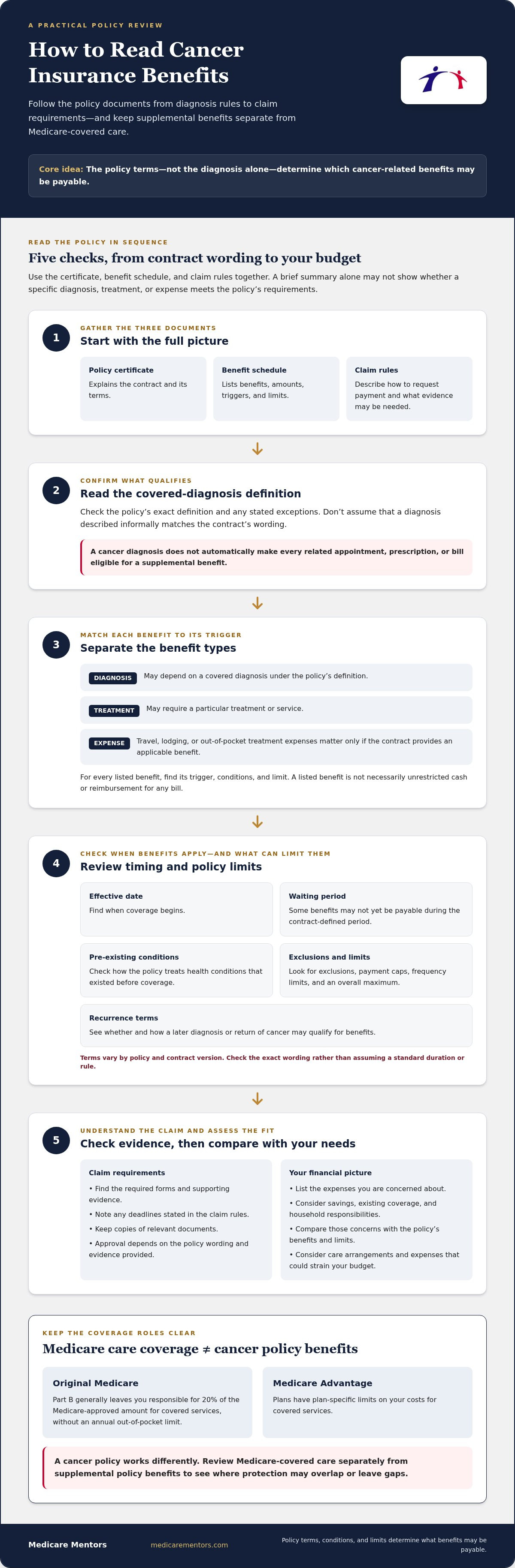
Cancer Insurance is supplemental coverage, and its benefits depend on the policy contract. It doesn’t replace health insurance: medical coverage may pay for eligible care under its rules, while a cancer policy may pay a separate benefit when its stated conditions are met. Put simply, the policy terms, not the diagnosis alone, determine which cancer-related benefits may be payable.
That distinction matters when you’re comparing coverage. A cancer diagnosis doesn’t automatically mean every related appointment, prescription, or bill qualifies for a supplemental benefit. A policy may define which diagnoses count, when coverage begins, and what event or service triggers payment. For a general overview of the product and its limitations, see What is Cancer Insurance? Then use the actual policy documents to understand a specific plan.
How Cancer Insurance Benefits Are Generally Structured
Policies may list several specified benefits, but their structure and conditions vary by contract. One benefit might be tied to a covered diagnosis, while another may depend on receiving a particular treatment or service. The policy may also limit how often or under what circumstances a benefit is payable. The benefit schedule summarizes amounts and triggers, but it doesn’t replace the full contract.
Before deciding what a policy could pay, read its certificate and benefit schedule together. Look for the covered-diagnosis definition, treatment or service requirements, waiting period, exclusions, and claim instructions. A listed benefit isn’t necessarily unrestricted cash or reimbursement for any bill. Claim rules explain what documentation may be needed and how the insurer determines whether the policy’s conditions have been met.
Which Costs Might Prompt Someone to Explore Supplemental Coverage?
Some people consider supplemental coverage because cancer care can affect more than medical bills. Depending on the policy’s terms, travel to appointments, lodging, or out-of-pocket treatment expenses may be relevant to their planning. For example, a Charlotte resident who needs care away from home might want to account for travel and lodging in the household budget. That example doesn’t mean a policy will pay those costs. The contract must specifically provide an applicable benefit.
Your own financial picture matters. Savings, existing health coverage, household responsibilities, and care arrangements can all shape which expenses feel manageable and which could strain your budget. Start by listing the costs you’re concerned about, then compare them with the benefits and limits written in the policy. This helps you see whether the coverage addresses a real financial concern or overlaps with protection you already have.
How Cancer Insurance Works: Benefits, Waiting Periods, and Policy Limits
To understand what a policy may pay, read more than its summary. The policy document explains the contract, the benefit schedule lists specific benefits and limits, and the claim rules describe how to request payment. These documents work together. A brief description or list of possible benefits can’t tell you whether a particular diagnosis, treatment, or expense meets the policy’s requirements.
Before enrolling, review the covered-diagnosis definition, benefit schedule, waiting-period and effective-date provisions, exclusions, limits, recurrence terms, and claim requirements. The National Association of Insurance Commissioners’ Evaluating Cancer Insurance Policies also offers consumer-focused guidance for comparing policy terms.
What to Check About Diagnosis, Treatment, and Claims
Start with the policy’s definition of a covered cancer diagnosis. Read any stated exceptions closely, and don’t assume that a diagnosis described informally will match the contract’s definition. Then separate diagnosis benefits from benefits tied to treatment, services, or specific expenses. Each category may have its own trigger, conditions, and limit.
Next, find the claim instructions. They may specify which forms, medical records, or other evidence to submit. Approval depends on whether the claim meets the policy wording and the evidence provided. Keep copies of the relevant documents and note any deadlines stated in the claim rules.
Waiting Periods, Exclusions, and Benefit Limits
A waiting period is a contract-defined span of time when some benefits may not yet be payable. Effective-date language explains when coverage begins, while pre-existing-condition provisions address how the policy treats health conditions that existed before coverage. Terms vary, so read the exact wording rather than assuming a standard duration or rule applies.
Exclusions identify situations or conditions the policy doesn’t cover. Benefit limits may cap a payment, restrict how often a benefit can be used, or set an overall maximum. Recurrence provisions explain whether and how a later diagnosis or return of cancer may qualify for benefits. Exclusions, caps, and recurrence terms differ across policies and contract versions.
- Diagnosis: Identify the policy’s definition and exceptions.
- Benefits: Match each payment to its diagnosis, treatment, service, or expense trigger.
- Timing: Review the effective date, waiting period, and pre-existing-condition language.
- Limits and claims: Check exclusions, caps, recurrence terms, and required documentation.
Mark the relevant pages and compare them with the expenses you’re trying to plan for. If you’re also reviewing how your Medicare coverage handles eligible care, Medicare planning guidance can help clarify that separate part of the decision. Keeping the two reviews distinct makes it easier to see what each policy may contribute.
Cancer Insurance vs. Medicare: Understand What Each Type of Coverage Does
Medicare and a cancer policy serve different purposes. Medicare helps pay for eligible health care under federal coverage rules or the terms of your Medicare Advantage plan. A supplemental cancer policy may pay a benefit when its contract conditions are met. Having one doesn’t change what Medicare considers covered care, and Medicare coverage doesn’t determine whether a separate policy benefit is payable.
Original Medicare, Medicare Advantage, and Cancer-Related Care
Original Medicare is Part A hospital insurance and Part B medical insurance. You can also choose Medicare Advantage, or Part C, which provides Medicare-covered Part A and Part B benefits through a private plan. Plans can differ in provider networks, costs, and coverage rules. For a closer look at the distinction, see this guide to Medicare planning.
With Original Medicare, you generally pay your share of covered care, and there’s no annual out-of-pocket limit for Part A and Part B services. Medicare Advantage plans have an annual limit on your costs for covered Part A and Part B services, but the amount and plan rules vary. Neither option means every cancer-related service, provider, or expense will be covered.
In Charlotte and elsewhere in North Carolina, use current documents for your specific plan and service area. Check the Summary of Benefits and Evidence of Coverage for covered services, provider access, cost-sharing, and any authorization rules. If you’re comparing Medicare Supplement coverage with Original Medicare, review how the Supplement works alongside Parts A and B. It doesn’t replace Medicare.
| Coverage type | Primary purpose | What determines payment |
|---|---|---|
| Original Medicare | Helps pay for eligible Part A and Part B care | Medicare coverage rules and your cost-sharing |
| Medicare Advantage | Provides Part A and Part B benefits through a private plan | Plan coverage, network, and cost-sharing documents |
| Cancer policy | May provide separate, policy-defined benefits | Contract terms and claim requirements |
What a Supplemental Cancer Policy May Add, and What It Doesn’t Replace
A supplemental policy may add a benefit for a defined diagnosis, treatment, or service, depending on its contract. That benefit doesn’t automatically pay every cancer-related bill, and it doesn’t replace medical insurance. Review the policy wording separately from your Medicare documents to see which protections apply to care and which depend on a supplemental claim.
Prescription coverage is another separate piece to review. Original Medicare doesn’t include most outpatient prescription drug coverage. That is generally obtained through a standalone Part D plan or, when offered, included with a Medicare Advantage plan. Check your plan’s current drug list and cost-sharing for your medications. Keeping the Medicare and supplemental-policy questions separate makes it easier to spot gaps, overlaps, and terms that deserve a closer look.
How to Evaluate Cancer Insurance for Your Health Needs and Budget
A careful review can help you decide whether supplemental coverage addresses a concern you actually have. Don’t start with a benefit amount or an illustrative story. First map out the insurance and financial resources already in place, then compare them with the policy’s written terms and your household priorities.
Use this decision path to keep the review manageable:
- Review your current coverage. Gather your Medicare plan documents, any Medicare Supplement policy, prescription drug coverage, employer or retiree insurance, and other supplemental policies. Note what each covers and how you share costs. If you’re turning 65, retiring, or losing employer coverage, review documents for your upcoming coverage as well as your current one.
- Identify your financial exposure. List expenses that could affect your household if care disrupted your routine, such as transportation, lodging, or time away from work. Then consider what savings, income, existing insurance, or family support could help address them. The goal is to identify a specific concern, not assume every possible cost will arise.
- Read the policy terms. Compare stated benefits with diagnosis definitions, exclusions, waiting periods, limits, recurrence provisions, and claim requirements. Note what triggers each benefit and what evidence a claim may require. If a benefit doesn’t match an expense or situation you care about, don’t count it as protection for that concern.
- Compare priorities and trade-offs. Consider household responsibilities, available savings, current insurance, and your comfort with financial risk. Weigh the premium obligation against the benefits and limits in the contract. A benefit that overlaps with protection you already have may add less value than understanding how your existing coverage works.
A Practical Checklist Before Considering a Policy
Put the documents side by side. Record the expenses you want to plan for and which existing resources could help with each one. Then compare those needs with the policy’s actual benefit triggers, exclusions, caps, and claim rules. This simple worksheet can reveal whether the policy addresses a meaningful gap or mainly repeats protection already in place.
When to Pause and Reassess the Decision
Revisit your review if your health needs, coverage, income, or household support changes. A move, retirement, a change in employer coverage, or a shift in family responsibilities can alter your priorities. Avoid deciding from fear or one person’s story. Use your current policy documents and official Medicare information to understand your own coverage before weighing another premium.
If you’d like help understanding the Medicare side of your review, Medicare Mentors provides independent, no-cost education and plan guidance. Explore Medicare planning guidance to make your existing coverage easier to assess before considering additional protection.
Get Clear on Medicare Coverage Before Making a Cancer Insurance Decision
Before weighing a supplemental policy, make sure you understand the medical coverage you already have. Medicare plan questions and cancer-policy questions are related, but they aren’t the same: one concerns eligible care and plan rules, while the other concerns benefits defined by a separate contract. Sorting them out separately can help you spot what needs attention without assuming a new policy will fill every gap.
Prepare for a Helpful Medicare Coverage Conversation
A little preparation can make a coverage review more useful. Gather your current Medicare plan information and write down what you want clarified. If you’re turning 65, retiring soon, continuing to work past 65, or losing employer coverage, include those details because a transition may affect which coverage questions are most pressing.
- Your current plan name and documents, including any Medicare Advantage or Medicare Supplement materials.
- A list of prescriptions, doctors, and hospitals you want to keep in mind during the review.
- Recent or upcoming changes in health needs, work or retirement status, income, or household support.
- Questions about covered services, plan costs, provider access, and prescription coverage.
For North Carolina residents in Raleigh, Durham, Chapel Hill, Greensboro, Fayetteville, Wilmington, Charlotte, Winston-Salem, High Point, and Greenville, plan choices and provider networks depend on location and current plan materials. Use documents for your service area rather than relying on an old summary or information meant for another county. If a doctor or prescription is important to you, make it a specific question for the review.
How Independent, Education-First Guidance Can Help
Medicare Mentors offers independent Medicare education and plan guidance at no cost to the client. Because independent brokers aren’t tied to one insurance carrier, the conversation can focus on helping you understand your Medicare choices and how plan documents apply to your priorities. Guidance can include comparing Medicare Advantage and Medicare Supplement options or reviewing Part D coverage.
Medicare coverage can also deserve another look as life changes. Annual reviews and ongoing support can help you revisit plan details when your health needs or prescriptions change. That review is distinct from evaluating a cancer policy: it helps clarify your Medicare coverage rather than determine what a separate policy might pay.
Medicare Mentors highlights almost 300 Five-Star Reviews. If you’d like help getting clear on your Medicare coverage before making a supplemental-policy decision, explore Medicare planning guidance. Bring your questions and take the conversation at a pace that feels comfortable. A clearer view of your current coverage can help you weigh whether additional protection fits your needs, budget, and existing resources.
Turn Your Coverage Questions Into a Confident Next Step
You don’t have to make a decision about Cancer Insurance in one sitting. Give yourself room to compare the protection you already have with the financial concerns you want to address. A useful outcome isn’t automatically another policy. It’s a decision you can explain in your own words, based on your coverage, priorities, and comfort with the trade-offs.
Before moving forward, write down what still feels unclear. Which Medicare questions need answers? Which concerns relate to a separate policy? Keeping those questions distinct can make your next conversation more focused and help you avoid deciding based only on worry or a sales illustration.
If you’d like support understanding your Medicare choices, schedule a no-cost Medicare conversation with Medicare Mentors. Bring your questions and take the discussion at your pace. You deserve to feel informed and comfortable with the path you choose.
Frequently Asked Questions
Does Medicare cover cancer treatment?
Yes, Medicare may cover cancer-related care when the service meets its coverage requirements and applicable plan rules are followed. Hospital care and outpatient care fall under different parts of Medicare, so check the documents for the coverage you use and the service being recommended. A treatment plan from your clinician doesn’t, by itself, guarantee that every service or related expense will be covered.
Can cancer insurance pay benefits if Medicare also covers my treatment?
Yes, a Cancer Insurance policy may pay a benefit even if Medicare covers the treatment, provided the policy’s benefit trigger and claim conditions are met. The Medicare claim and supplemental-policy claim are separate decisions. Keep the policy’s claim instructions and relevant Medicare paperwork together so you can track what each payment relates to. Medicare’s approval of care doesn’t automatically qualify a separate policy claim.
How much does cancer insurance pay?
There’s no single payment amount that applies to every policy. Check the benefit schedule for the amount tied to each eligible event or service, how often a benefit may be paid, and any overall caps. Then compare those terms with a realistic situation you want to plan for. Don’t estimate a payout from a headline benefit alone; the contract’s definitions and claim conditions also matter.
Can I get cancer insurance after a cancer diagnosis?
You may be able to apply, but a previous diagnosis can affect eligibility or policy terms, and there’s no universal answer for every insurer or contract. Check the application requirements, effective-date provisions, and any language about prior conditions before relying on possible benefits. Answer application questions accurately. If you already have a policy, review its terms separately from a new application, since existing coverage and new coverage may be treated differently.
What happens to my Medicare coverage if I am diagnosed with cancer?
A diagnosis alone doesn’t mean your Medicare plan automatically changes. Continue checking your plan’s rules as care is arranged, including provider access, referrals or approvals where applicable, and coverage for recommended services. For residents in Charlotte, Raleigh, Durham, Chapel Hill, Greensboro, Fayetteville, Wilmington, Winston-Salem, High Point, and Greenville, plan details depend on the specific plan and service area. Keep your plan information handy as treatment needs develop.
Is cancer insurance the same as critical illness insurance?
No, the names generally refer to different types of supplemental coverage, but the contract defines the conditions and benefits for each policy. A cancer-focused policy centers on its stated cancer-related triggers, while a critical illness policy may list several serious conditions. Their covered conditions can overlap, but don’t assume they pay the same way. Compare each policy’s definitions, exclusions, benefit triggers, and claim rules before deciding how they fit together.