
Blog
Best Dental Insurance Plans in Raleigh and Charlotte, NC
By Medicare Mentors ·
The Medicare plan with the biggest dental benefit may not be the best fit for your teeth. If you’re comparing Dental Insurance in Raleigh or Charlotte, it’s understandable to focus on advertised benefits, especially when you’re unsure what Medicare covers and what you could pay yourself.
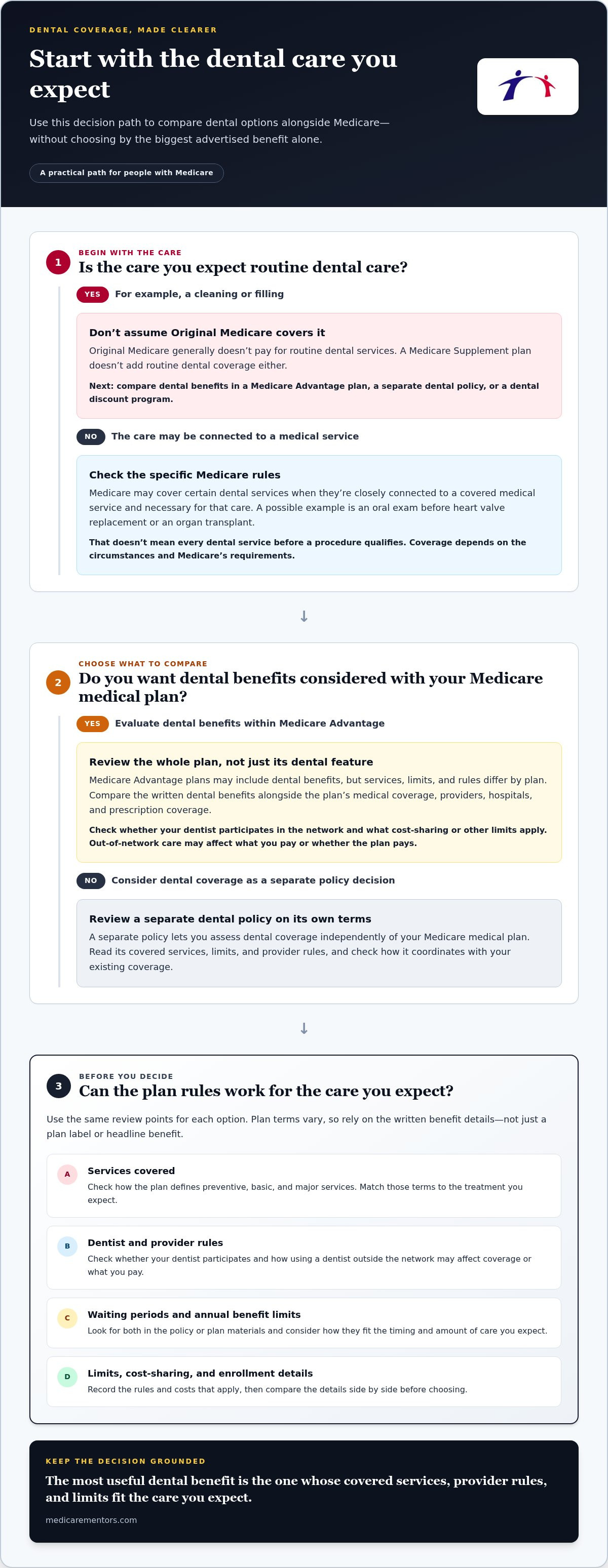
Original Medicare generally doesn’t cover routine dental care, and a Medicare Supplement plan doesn’t add routine dental coverage. You can compare dental benefits included in some Medicare Advantage plans, a separate dental policy, or a dental discount program. Start with the care you expect, not just a benefit headline.
This guide explains how these options fit alongside Medicare and what to compare, including covered services, provider networks, waiting periods, and annual benefit limits. You’ll learn how to weigh plan rules against realistic needs, such as routine cleanings or more involved treatment. Medicare Mentors offers independent, education-first guidance at no cost to help North Carolina residents understand their options. Whether you’re comparing coverage in Raleigh, Durham, Chapel Hill, Greensboro, Fayetteville, Wilmington, Charlotte, Winston-Salem, High Point, or Greenville, the same practical steps can help you review plan details with confidence.
Key Takeaways
- Compare coverage based on the care you expect, not just the benefit that looks largest.
- Dental Insurance terms vary by plan, so review how each policy defines preventive, basic, and major services.
- Use a checklist to compare plan rules, dentist networks, and enrollment details before choosing.
- If you’re nearing retirement or turning 65, consider how dental coverage will fit with your Medicare choices and changing needs.
- Medicare Mentors offers independent, no-cost guidance to help you understand your options without pressure.
Dental Insurance and Medicare: What Coverage Should You Expect?
It’s easy to assume health coverage includes a dental checkup, especially when both relate to your overall well-being. But medical and dental benefits follow different rules. Dental Insurance is governed by the policy’s terms: which services it covers, how much it pays, where you can receive care, and what limits or conditions apply. This overview of dental insurance explains the general idea, but your plan documents determine your actual benefits.
If you’re approaching 65, retiring, or changing coverage, separate routine dental needs from dental services connected to certain medical care. This helps you avoid assuming that a Medicare card or a separate medical plan will pay for a cleaning or filling.
What does Original Medicare generally cover for dental care?
Original Medicare, meaning Part A hospital insurance and Part B medical insurance, generally doesn’t pay for routine dental services such as cleanings, fillings, tooth extractions, dentures, or implants. Medicare may cover certain dental services when they’re closely connected to a covered medical service and necessary for that care. For example, Medicare guidance describes an oral examination before a heart valve replacement or organ transplant as a possible covered situation. That doesn’t mean every dental service before a procedure qualifies. Coverage depends on the circumstances and Medicare’s requirements.
Other limited situations can include dental treatment related to certain cancer therapies or jaw reconstruction after an accidental injury. These aren’t everyday dental benefits. If dental care is part of a larger medical treatment, the relevant Medicare coverage rules and details of the situation matter.
Original Medicare generally doesn’t cover routine dental care, such as cleanings and fillings.
How can Medicare Advantage include dental benefits?
Medicare Advantage plans are offered by private insurers and can include extra benefits, including dental coverage. Benefits differ among individual plans. One plan may cover certain preventive services, while another may have different covered services, limits, or rules for using a dentist. Don’t assume an advertised dental benefit applies to every treatment you might need.
Look beyond the word “dental” and read the plan’s benefit details. Check which services are included, whether your dentist participates in the network, and what limits or cost-sharing apply. A network is the group of dentists that has arrangements with a plan. Depending on the plan’s rules, using a dentist outside the network may affect what you pay or whether the plan pays.
Dental coverage is only one part of a Medicare Advantage decision. Your medical providers, hospitals, prescription coverage, and other plan terms matter too. Our Medicare planning guidance can help put those pieces in context. Review each plan’s written benefits to compare options in Raleigh, Charlotte, or elsewhere in North Carolina.
Dental Insurance Options for People With Medicare
Start by deciding what role dental coverage needs to play in your overall coverage. You can compare dental benefits included in a Medicare Advantage plan or consider a separate dental policy. The first route ties dental benefits to a broader Medicare plan choice; the second treats dental coverage as its own policy decision. Neither is automatically the better fit. Compare the terms against your priorities, and use Medicare’s guidance on dental services to understand what Original Medicare covers.
| Coverage route | What to inspect | May suit someone who |
|---|---|---|
| Dental benefits within a Medicare Advantage plan | Which dental services the plan lists, provider rules, limits, and how the benefit fits with the plan’s medical coverage | Wants to evaluate dental benefits alongside Medicare medical coverage |
| Separate dental coverage alongside Medicare | Covered services, policy limits, provider rules, and how the policy coordinates with your existing coverage | Wants to consider dental benefits separately from a Medicare plan choice |
Dental benefits through a Medicare Advantage plan
Start with the plan’s current benefit materials, not a general description of Medicare Advantage. Compare the dental terms alongside the medical coverage, providers, and other features that matter to you. A dental benefit may look appealing on its own, but it’s only one part of the plan decision. Our Medicare planning guidance offers context for weighing the full picture.
Separate dental insurance alongside Medicare
A separate policy lets you assess dental coverage independently of your Medicare medical plan. Its policy documents set out the services, limits, and provider rules. Review those terms as their own package rather than assuming they mirror a Medicare Advantage benefit. This route may suit you if you want to keep your medical coverage decision distinct from your dental coverage decision, and full-service providers like The Lewis Agency can help you explore how standalone personal coverage fits into a broader insurance portfolio.
To make the differences concrete, consider what you want to prioritize. If coordinating dental and medical benefits under one plan matters to you, examine the Medicare Advantage option as a whole. If you’d rather evaluate dental benefits separately, focus on the standalone policy’s terms and how they fit with your current Medicare coverage. In either case, compare written benefits, not just the label or a headline feature.
Keep a side-by-side record of what each route covers, its provider rules and limits, and how it fits your broader coverage. This makes trade-offs easier to see and helps you identify plan details to review before deciding.
How to Compare Dental Insurance Benefits Before You Choose
A useful comparison starts with your likely care, not a benefit headline. Two plans may use labels such as preventive, basic, and major, but each policy defines which services fall into those categories and what it pays. Ask the same questions of every option, then compare the answers with your needs.
Match covered services to the dental care you expect
Make a short list of the care you expect to need. Include routine visits, follow-up care, and any treatment your dentist has discussed. If you want to review how standard preventive and oral health services are structured, discover Blue Ridge Family Dentistry to see examples of regular exams and cleanings. Then find each service in the policy’s benefit details. A filling, for example, might be listed as basic care in one policy, while another may describe it differently or apply different payment rules. Don’t assume the categories are universal.
An annual maximum is the most a plan will pay toward covered dental care during a plan year. It isn’t necessarily the most you can spend, since you may also owe costs the policy doesn’t pay.
As you review plan documents, compare these terms:
- Premium: The amount you pay to keep the policy in force.
- Deductible: The amount you may need to pay for covered care before the plan starts paying, as defined by the policy.
- Coinsurance: The share of a covered service’s cost you pay after any applicable deductible.
- Annual limit: The plan’s maximum payment for covered dental services during the plan year.
- Exclusions and waiting periods: Services the policy doesn’t cover, and any stated period before coverage applies to certain services.
These terms work together. A plan with a lower premium, for instance, may have different deductibles, service limits, or exclusions than another plan. Compare the full set of rules rather than judging one feature in isolation.
Check dentists, networks, and plan limits
If you want to keep seeing a particular dentist, look up the practice in the plan’s current provider directory and review the policy’s network rules. A network is the group of providers that participates in a plan. Depending on the policy, seeing an in-network or out-of-network dentist can affect your access, costs, or the plan’s payment. Don’t assume a dentist who participates in one plan participates in another.
Use this checklist for each option:
- Write down the care you expect and the dentist you prefer.
- Find those services in the plan’s current benefit and policy documents.
- Record the premium, deductible, coinsurance, annual maximum, exclusions, and any waiting period.
- Check the provider directory and note the plan’s rules for using dentists outside its network.
- Mark each detail as verified in the documents or still unknown. Don’t fill gaps with assumptions.
This side-by-side review makes trade-offs easier to see. For details that could change your decision, rely on current plan documents rather than a general description. Medicare Mentors can explain policy language and help you compare options based on the care you anticipate.
Dental Insurance Scenarios: Match Coverage to Your Next Steps
A change in age, work, location, or dental health can alter which plan details matter most. Use this sequence to turn that change into a practical review:
- Identify expected care. Note upcoming visits, treatments already discussed, and any dentist you hope to keep seeing.
- Compare policy terms. Look at how each option addresses that care and what costs or limits may apply.
- Check provider access. Review the current directory and the plan’s rules for your preferred dentist.
- Review enrollment details. Read the applicable materials for how to make a change and when coverage would begin.
This process works whether you’re selecting coverage for the first time or reviewing an existing policy. A change in circumstances is a prompt to review the terms, not a reason to assume your benefits will automatically adjust to match.
If you are turning 65 or retiring soon
Think of Medicare medical coverage and dental benefits as related but separate decisions. Before comparing plans, write down your current dental needs, any care you expect, and the dentists you’d like to continue seeing. Then assess the medical coverage options on their own merits and consider how you’ll address dental care alongside them. Broader Medicare planning can help put those choices in context as you approach retirement or Medicare eligibility.
If employer coverage is ending, gather its dental benefit details while they’re available. Note which providers and services it includes, then compare those terms with the options you’re considering. This gives you a reference point for identifying what may change without assuming new coverage will work the same way.
If you are moving or your dental needs change
Moving to North Carolina, whether to Raleigh, Charlotte, Durham, Chapel Hill, Greensboro, Fayetteville, Wilmington, Winston-Salem, High Point, or Greenville, can make provider access an important part of your review. Check the plan’s current directory for your new area and read any service-area rules in its materials. A dentist you saw before moving may not participate in a new plan, so don’t rely on an old directory or assume the relationship will carry over.
A new treatment recommendation, a change in dentist, or a shift in your current coverage can also signal that it’s time to revisit your policy. Review the updated terms for the care you expect and the providers you prefer. Evaluate Dental Insurance against your current situation, remembering that coverage for a specific service or provider depends on the plan.
Once you’ve identified a change, write down what needs to be resolved before making a decision: an upcoming appointment, a preferred dentist, or a treatment you’re planning. Use that list to focus your comparison on your actual needs.
Get Clear, Personal Help Choosing Dental Insurance
A useful coverage conversation can turn a stack of plan documents into a comparison you can act on. Bring the options you’re considering and focus on what matters most to you, such as a planned service, a preferred dentist, or a term you’re unsure how to interpret. The goal is to leave with a clearer picture of the differences and any questions that still need answers.
What to prepare for a dental coverage conversation
A few notes are enough to get started. You might bring:
- A short list of dental visits or treatments you expect.
- The names of dentists you’d like to keep seeing.
- Current coverage documents and the plan summaries you’re comparing, if available.
- Questions about unfamiliar terms, limits, or provider rules.
You don’t need to gather detailed medical history for a coverage discussion. Keep the focus on the services you’re planning for and the policy language that affects your comparison. If a benefit description is unclear, mark the exact wording so you can discuss it rather than trying to interpret it from memory.
Why ongoing support matters after enrollment
Keep your plan documents and enrollment information together after you choose coverage. If a question comes up later, having the benefit description, provider information, and relevant correspondence in one place can make it easier to explain the situation and identify what needs clarification. Revisit your notes if your dentist or expected care changes, so you can see which plan terms may need another look.
Medicare Mentors provides one-on-one guidance to help you talk through the details at a comfortable pace. Learn more about Medicare Mentors and its personal approach to helping people understand coverage choices.
Make Your Next Coverage Decision with Confidence
You don’t have to predict every dental need years from now to make a thoughtful choice today. Start with what matters for your care now, and revisit the decision if your dentist, treatment needs, or coverage changes. That approach can make Dental Insurance feel less like a permanent guess and more like a choice you can keep in step with your life.
If you’d value a conversation about your options, Medicare Mentors can help you understand the details at your own pace. The family-run team of Dave and Michele Johnson offers a personal place to bring your questions and think through what fits. Services are provided at no cost, with no pressure to have every detail figured out before you talk.
Schedule a no-cost conversation about your coverage options and take your next step with a clearer understanding of the choices ahead.
Frequently Asked Questions
Does Medicare cover routine dental care?
Generally, no. Original Medicare doesn’t cover routine services such as regular cleanings, though limited dental services may be covered in specific circumstances connected to covered medical care. A dental service alone doesn’t establish coverage. If you’re considering dental care tied to a medical procedure, review current Medicare guidance and how its rules apply to your situation before relying on coverage. Dental benefits in Medicare Advantage plans are separate and vary by plan.
Can I have dental insurance while enrolled in Medicare?
Yes. You can explore dental benefits through a Medicare Advantage plan or consider separate dental coverage while enrolled in Medicare. Dental Insurance isn’t automatic with Medicare, so consider what you need it to do. For example, if you’re keeping Original Medicare and a Medicare Supplement plan, remember that the Supplement covers Medicare-approved services, not routine dental care. Review the specific dental policy or plan benefit before deciding how it fits your coverage.
Are dental implants covered by dental insurance?
It depends on the policy. Implant coverage may be affected by how the plan defines the procedure, its exclusions, and its benefit limits. Review how the policy classifies the specific treatment your dentist is considering rather than relying on a general summary. If the plan documents describe a pre-treatment estimate process, check whether it applies to your proposed care. Your dental professional can explain the treatment; the policy determines insurance benefits.
Do dental insurance plans have waiting periods?
Some policies apply waiting periods to certain services, but the rules differ by policy and type of care. Before enrolling when you already have treatment planned, read the effective date and waiting-period language for that service, along with any exclusions. A policy’s start date doesn’t necessarily mean every benefit is available immediately. If the wording is unclear, review the plan’s explanation of how it applies to the service you expect to receive.
Can I keep my dentist if I get dental insurance?
Possibly, depending on the plan’s provider rules and whether your dentist participates in its network. Search the plan’s current directory using the dentist’s name and practice location, since listings can be specific to a location. Then review the plan’s process for confirming participation and its rules for out-of-network care, if applicable. A dentist’s acceptance of one plan doesn’t establish participation in another.
Can I change dental coverage after I enroll?
You may be able to change coverage, but the timing and process depend on the policy and enrollment rules for that coverage. Don’t assume a separate dental policy follows the same dates as Medicare plan enrollment. Before ending one policy, review its renewal and cancellation terms, and compare the new policy’s effective date with care you already have planned. This helps you understand whether a change could affect access or benefits during the transition.