
Blog
Best Vision Plans for Seniors on Medicare: Your 2026 Guide to Clearer Coverage
By Medicare Mentors ·

Most seniors assume that "having Medicare" means their next pair of bifocals is covered, only to be met with a surprising bill at the checkout counter. It's a common frustration because while Original Medicare is excellent for major health issues, it leaves a significant gap for routine eye exams and prescription lenses. You've worked hard for your retirement, and you shouldn't have to choose between clear sight and your monthly budget. We understand how confusing it is to separate what Part B covers from what it doesn't, especially with the 2026 Part B deductible rising to $283. Finding the best vision plans for seniors on medicare doesn't have to be a headache when you have the right teacher to guide you.
In this guide, we'll help you navigate these gaps by breaking down the differences between medical eye care and routine vision perks. Our goal is to provide you with a clear framework so you can choose between the convenience of Medicare Advantage plans or the flexibility of standalone policies. We'll show you how to manage rising costs and ensure you can still visit your favorite local eye doctor in Raleigh or Durham without any unexpected financial surprises.
Key Takeaways
- Understand the difference between medical vision care for diseases like cataracts and routine care for glasses, as Original Medicare only covers the former.
- Compare bundled Medicare Advantage options with standalone policies to find the best vision plans for seniors on medicare based on your specific eye health needs.
- Calculate your "break-even point" to make sure your monthly premiums are actually saving you money on your prescription lenses and frames.
- Identify the right coverage strategy if you have a Medigap plan, as these supplements typically do not include routine vision benefits.
- Learn how to check provider networks so you can keep seeing your trusted local eye doctor in the Raleigh/Durham area.
Understanding the Medicare Vision Gap in 2026
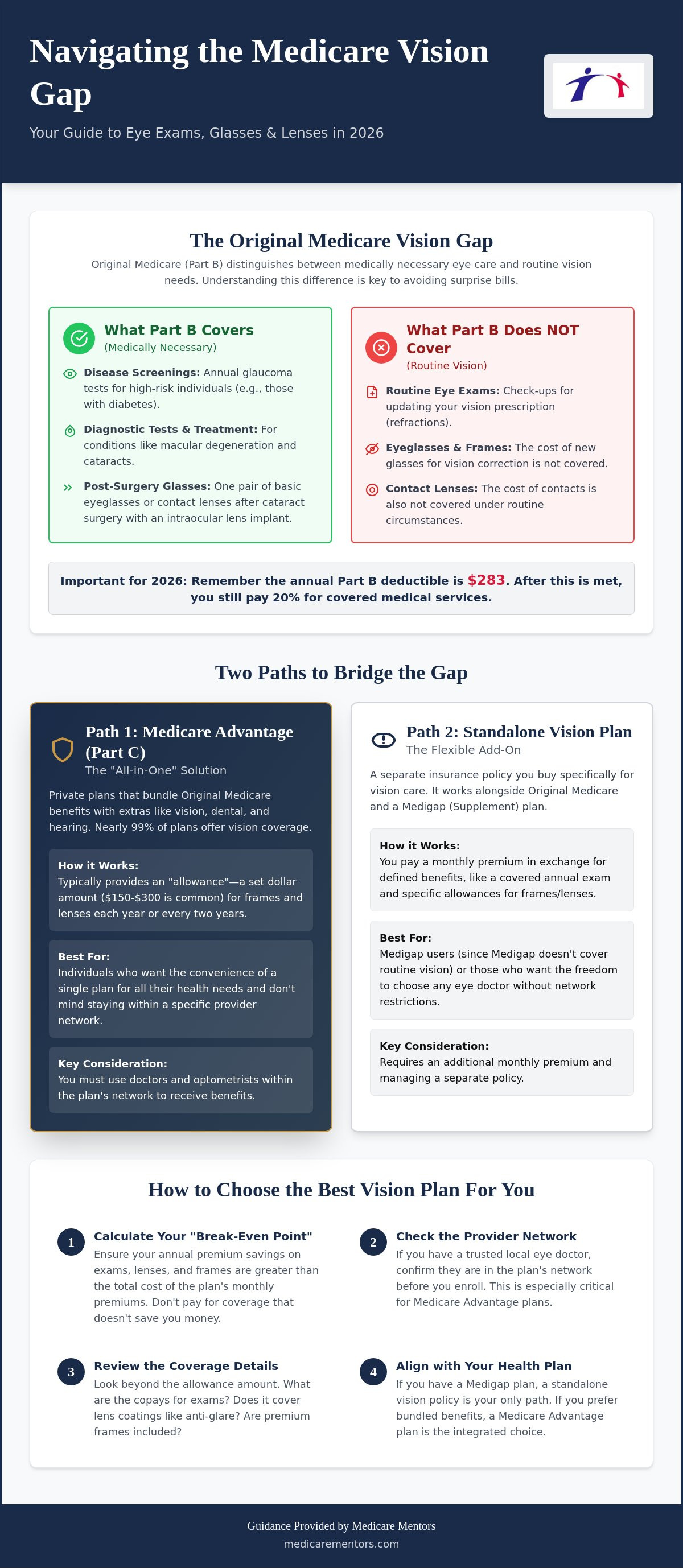
Many seniors are surprised to find that Original Medicare treats their eyes differently than the rest of their body. While Part B covers a doctor's visit for a broken arm, it doesn't typically cover the visit to update your bifocals. This is what we call the "vision gap." It's the space between what you need to see clearly every day and what the government actually pays for. Finding the best vision plans for seniors on medicare starts with understanding that Original Medicare was never designed to be a comprehensive vision solution.
To understand your options, you first need to distinguish between medical and routine care. Medical vision care is the treatment for injuries or diseases like cataracts, macular degeneration, or glaucoma, which Part B does cover under its medical benefits. Routine care, on the other hand, includes things like "refractions," which is the test to see if your prescription has changed, and the physical cost of frames and lenses. Because these annual necessities fall outside of Part B, many people look toward Medicare Advantage (Part C) or standalone policies to manage these costs.
To better understand this concept, watch this helpful video:
What Medicare Part B Covers (Medical Vision)
Medicare Part B is quite reliable when your actual eye health is at stake. For 2026, after you meet your $283 deductible, Medicare generally pays 80% of the cost for specific medical services. This includes annual glaucoma screenings for those at high risk, such as people with diabetes or a family history of the disease. It also covers diagnostic tests and treatments for age-related macular degeneration. One of the most significant benefits is coverage for one pair of eyeglasses or contact lenses after you have cataract surgery that involves an intraocular lens implant.
What Part B Does Not Cover (Routine Vision)
The list of exclusions is where most seniors feel the financial pinch. Part B does not cover your annual eye exam if the purpose is simply to check your prescription. It also leaves you responsible for the full cost of frames, lenses, and contact lenses under normal circumstances. If you aren't in a high-risk category, routine screenings for eye diseases aren't covered either. These out-of-pocket expenses can add up quickly, which is why we often help our clients explore Medicare planning strategies that include supplemental vision coverage to protect their budget.
Medicare Advantage (Part C): The 'All-in-One' Vision Solution
If you are looking for a simple way to combine your health and vision needs, Medicare Advantage might be the answer. These plans are offered by private companies and are designed to provide everything Original Medicare does, plus those missing routine benefits. In 2026, nearly 99% of these plans include vision coverage. This makes them a strong contender when searching for the best vision plans for seniors on medicare because you get your medical, hospital, and vision care all under one roof.
Most of these Medicare Advantage Plans provide a specific dollar amount, or "allowance," to help pay for your frames and lenses. While the official Medicare coverage for eyeglasses is extremely restricted to post-cataract care, an Advantage plan might give you between $150 and $300 every year or two for any glasses you choose. It's a convenient setup. You carry one ID card, deal with one insurance company, and often pay no additional monthly premium for these extra perks. When we sit down with clients to compare the best vision plans for seniors on medicare, we always start by checking if a bundled plan covers your specific eye doctor.
How Vision Allowances Work in Part C
Understanding how you get paid is just as important as the allowance amount itself. Some plans use a "reimbursement" model. This means you pay the eye doctor upfront and then submit a receipt to the insurance company to get your money back. Other plans work with "in-network" providers where the discount is applied right at the register. If you have a favorite local eye doctor in Raleigh or Durham, you must verify they are in the plan's network before signing up. Also, remember that these benefits are usually "use it or lose it." If your plan offers a 2026 allowance and you don't buy glasses by December 31, that money typically doesn't roll over to the next year.
Pros and Cons of Bundled Vision
Bundling your vision into a health plan has clear advantages, but there are trade-offs to consider. The most obvious benefit is the cost. Since about 75% of enrollees are in plans with no premium other than their Part B payment, you are often getting vision coverage without a separate bill. You also benefit from integrated care coordination. If your eye doctor notices a health issue, it is easier for that information to stay within your health carrier's system. However, the downside is often the network. Tighter restrictions mean you might have fewer choices for boutique frames or specific specialists compared to a standalone policy. If you feel stuck between these choices, we can help you compare your options through our personalized Medicare planning approach.
Standalone Vision Plans: The Best Choice for Medigap Users
If you chose a Medicare Supplement plan to keep your freedom of choice for doctors, you likely noticed a missing piece in your coverage. While these plans are excellent for picking up the 20% coinsurance left by Part B, they do not include routine vision benefits. This is a deliberate choice in how Medicare is structured. To get coverage for your annual eye exam or new lenses, you need a separate policy. For many, this path leads to the best vision plans for seniors on medicare because standalone insurance often offers higher frame allowances and broader doctor networks than bundled plans. You aren't restricted by the health carrier's specific HMO or PPO list, which is vital if you have a trusted local optician you've seen for years.
As the National Eye Institute points out regarding Medicare coverage for eye health, the government focuses on disease and injury rather than the preventative care most of us need to see clearly. This is why we help our clients identify the specific gaps in their current strategy. You can read more about these specific shortfalls in our Complete Guide to Medigap. By adding a standalone vision plan, you ensure that your preventative care is just as robust as your medical coverage.
Top Standalone Vision Carriers for 2026
When we look at the market for the best vision plans for seniors on medicare, three carriers often stand out for different reasons. We recommend looking at these options based on your specific lifestyle:
- VSP: This carrier is known for having the largest network of independent doctors. If you prefer a small, local boutique over a big-box store, VSP is usually the right fit.
- EyeMed: This is a popular choice for those who value retail chain access. If you enjoy the convenience of places like LensCrafters, Target Optical, or Pearl Vision, EyeMed plans often provide the best value.
- Ameritas/Direct Vision: These plans are excellent for seniors who need new glasses immediately. They often provide high "day one" allowances for frames, which can range from $150 to $200 depending on the specific policy you select.
The "DVH" Bundle Strategy
Many of our neighbors in Raleigh and Durham find that buying three separate policies for dental, vision, and hearing is both expensive and hard to track. A more efficient way to manage this is through a combined Dental, Vision, and Hearing (DVH) policy. Bundling these three services can often lower your overall monthly premium compared to buying them individually. It also simplifies your life by giving you one point of contact and one ID card for all your ancillary health needs. To see how these pieces fit together, explore our Dental Vision and Hearing Insurance guide, where we break down the benefits of this "all-in-one" approach for Medigap users.
How to Evaluate the Best Vision Plans for Your Eye Health Needs
Finding the best vision plans for seniors on medicare isn't about picking the brand with the flashiest commercials. It's about doing a bit of kitchen table math. To find your "Break-Even Point," add up your annual premiums and compare that total to what you usually spend on an eye exam and a new pair of glasses. For example, if a standalone plan costs $12.40 per month, your yearly investment is roughly $149. If that same plan offers a $150 frame allowance and a $10 exam copay, you've effectively paid for your hardware through your premiums and received your professional exam for a fraction of the retail cost. If your insurance costs more than the service itself, it isn't a plan; it's just a pre-payment strategy with extra steps.
You also need to look closely at the "Frame Allowance" and "Lens Enhancements." Many plans offer a $150 allowance, but if the designer frames you actually like cost $250 at a local shop in Durham, you'll still be responsible for the difference. Don't forget to check coverage for progressives, anti-reflective coatings, or polycarbonate lenses. If you have a strong prescription, these "extras" can easily add $200 to your bill if they aren't covered by a flat copay. You should always verify that your preferred North Carolina eye clinic is "In-Network" before you commit to any enrollment.
The Network Check: NC Provider Access
Your coverage is only as good as the doctors who accept it. Whether you live in Raleigh, Charlotte, or Greensboro, you should use the carrier’s online search tool to see which local professionals are on the list. There is a big difference between "In-Network" and "Out-of-Network" benefits. Staying in-network usually means a small, predictable copay. Going out-of-network might only get you a small reimbursement, leaving you to cover the rest of the bill. Think about your preference: do you like the convenience of a retail chain near SouthPark Mall, or do you prefer a private practice in a neighborhood setting? Your choice here will dictate which carrier offers the best value for your lifestyle.
Waiting Periods and Effective Dates
Timing is everything when you are transitioning to Medicare or moving to North Carolina. Most of the best vision plans for seniors on medicare have no waiting periods for routine exams, but some hardware benefits for frames or lenses might vary by carrier. We recommend coordinating your vision plan start date with your Medicare Part B effective date to avoid any gaps in care. This is especially important if you are losing employer-provided coverage. Avoid the mistake of waiting until your glasses break to buy a policy. Most plans won't cover a "pre-existing" need for hardware if you purchase the plan the day before your appointment. If you need help calculating these costs, we can help you find the right fit through personalized Medicare planning at no cost to you.
Finding Your Clear View: Why Expert Guidance Matters
Choosing a vision plan shouldn't feel like a high-pressure transaction where you're rushed into a decision. It should be an educational experience that leaves you feeling confident about your future care. Finding the best vision plans for seniors on medicare is easier when you have an advocate in your corner who understands the local landscape in North Carolina. At Medicare Mentors, we act as your teacher to help you see how vision fits into your larger Medicare puzzle. We look at the whole picture, from your medical needs to your monthly budget, ensuring no piece is left out.
Our team provides unbiased comparisons between standalone policies and Advantage plan bundles. We don't just stop at your eyes. A truly secure retirement plan also addresses the "what-ifs" that Original Medicare often leaves behind. During our review, we can show you how to protect your savings from the high costs of treating a heart attack, stroke, or cancer. We also help families look ahead by discussing final expense coverage, ensuring your legacy remains a gift rather than a burden. You can discover how we help with Medicare Planning at no cost to you, as our services are designed to lower your anxiety and simplify your choices.
The Medicare Mentors Advocacy Advantage
Our independence is our greatest strength. Because we represent multiple carriers rather than just one, we have the flexibility to shop the entire market for you. This ensures you get a plan that fits your life, not just a carrier's sales quota. Our "Student-Teacher" approach means we take the time to explain the fine print before you sign anything. We want you to understand your copays, your allowances, and your network rules. Since we are based right here in Raleigh, we know the doctors and networks in your neighborhood. We can tell you which plans are accepted by the most popular clinics in the Triangle area, saving you the frustration of picking a plan your doctor doesn't take.
Next Steps: Get Your Personalized Vision Quote
If you're ready to clear up the confusion, the next step is simple. You can schedule a low-pressure consultation with Dave or Michele Johnson to review your options. We move at your pace, never pushing you toward a decision before you're ready. To make the most of our time together, please have your current eye prescription and the name of your preferred doctor ready. We will use that information to filter through the best vision plans for seniors on medicare to find your perfect match. We are here to ensure you see the road ahead with total clarity. Schedule your free Medicare vision review with Medicare Mentors today and let us help you complete your coverage puzzle.
Secure Your Vision for 2026 and Beyond
You now have the tools to bridge the gap between what Medicare Part B covers and what you need to see clearly every day. It is essential to remember that while medical eye health is protected by Original Medicare, the routine exams and frames you rely on require a thoughtful supplemental strategy. Whether you prefer the simplicity of a bundled Medicare Advantage plan or the broad network of a standalone policy, the right choice is the one that protects both your eyes and your monthly budget.
Let us help you find the right vision coverage—Schedule your free consultation today! We look forward to helping you find the perfect fit for your vision, dental, and hearing needs so you can enjoy your retirement with total confidence and clarity.
Common Questions About Medicare Vision Coverage
Does Medicare Part B cover routine eye exams in 2026?
Original Medicare (Part B) does not cover routine eye exams for the purpose of checking your prescription in 2026. It only provides coverage for medical issues, such as annual glaucoma screenings for high risk individuals or tests for macular degeneration. For these medical services, you are responsible for the Part B deductible, which is $283 in 2026, followed by a 20% coinsurance payment.
How much does vision insurance for seniors typically cost per month?
Monthly costs for vision coverage vary depending on whether you choose a standalone policy or a bundled plan. Many seniors find that standalone vision premiums are quite modest, often fitting easily into a fixed retirement budget. When looking for the best vision plans for seniors on medicare, it is important to weigh the annual premium against the frame allowance to ensure you are getting true value for your investment.
Can I get vision insurance if I already have a Medigap plan?
Yes, you can absolutely purchase a standalone vision plan if you have a Medigap policy. Since Medicare Supplement plans are designed to cover the gaps in Original Medicare's medical coverage, they don't include routine vision, dental, or hearing. Adding a separate vision policy is the most common way our neighbors in Raleigh and Durham ensure they have comprehensive coverage for their annual eye care needs.
Are glasses covered by Medicare Advantage plans?
Most Medicare Advantage plans in 2026 include an allowance for glasses or contact lenses. These allowances typically range from $150 to $300 and are often "use it or lose it" benefits that reset every year or two. It is a convenient way to get your medical and vision needs met with a single ID card, provided your preferred local eye doctor in North Carolina is in the plan's network.
What is the best vision plan if I need cataract surgery?
Original Medicare is actually your strongest ally for cataract surgery. Medicare Part B covers the surgery itself and provides one pair of corrective lenses following the procedure if an intraocular lens is implanted. For ongoing care or high end frames beyond that initial pair, we can help you identify the best vision plans for seniors on medicare that provide the extra frame allowances you might need for your lifestyle.
Is there a waiting period for senior vision insurance?
Most vision plans for seniors do not have a waiting period for routine eye exams. You can often schedule your appointment as soon as your policy's effective date begins, which is helpful if you are currently facing a life transition like retirement. While some hardware benefits for frames or lenses can occasionally have a short wait, many modern plans offer "day one" coverage for your glasses.
Can I use my vision plan at retail stores like LensCrafters or Walmart?
You can use your vision plan at many retail locations, but it depends entirely on the specific network. Plans that use the EyeMed network are specifically designed for retail chains such as LensCrafters or Target Optical. If you prefer a private practice or an independent doctor in your neighborhood, a plan with a VSP network might be a better fit to ensure you receive in-network discounts.
Do vision plans for seniors cover LASIK or other elective surgeries?
Vision plans typically do not cover the full cost of elective surgeries like LASIK. Instead, most policies offer a contracted discount if you use a provider within their network. Since LASIK is considered elective rather than medically necessary, it isn't covered by Original Medicare either, making these insurance discounts a valuable way to reduce your personal out-of-pocket expenses.