
Blog
Dental, Vision & Hearing Insurance: 2026 Senior Guide
By Medicare Mentors ·
Original Medicare doesn't cover your teeth, your eyes, or your hearing. Not a routine cleaning, not a new pair of glasses, and not the hearing aids your audiologist has been recommending for the past two years. For millions of seniors, that silence in the coverage is where retirement savings quietly disappear.
If you've ever winced at the cost of a dental crown or put off replacing worn-out hearing aids because the price felt impossible, you already know this pain firsthand. The good news is that dental vision and hearing insurance exists specifically to fill these gaps, and the right bundled plan can make these essential services genuinely affordable without forcing you to give up the local North Carolina providers you already trust.
In this guide, we'll walk you through exactly how these plans work alongside Original Medicare, what to watch for with waiting periods on major services like implants and crowns, and how to compare your options without feeling pressured into the wrong fit. Think of it as a calm, honest conversation with someone who works for you, not for an insurance carrier.
Key Takeaways
- Original Medicare was never designed to cover routine dental, vision, or hearing care — understanding exactly where that coverage stops is the first step toward protecting your retirement savings.
- Bundled dental vision and hearing insurance plans can fill those gaps affordably, but annual maximums, deductibles, and waiting periods vary widely — and the details matter more than the premium.
- Medicare Advantage plans may include built-in dental and vision benefits, but those benefits are often limited to preventive care only, which may not be enough if you need a crown, implants, or hearing aids.
- Choosing the right plan starts with two simple steps: knowing which North Carolina providers you want to keep and estimating what care you're likely to need in the next 12 months.
- Working with an independent broker — one who isn't tied to a single carrier — means you get a side-by-side comparison of real options, not a sales pitch dressed up as advice.
Why Original Medicare Leaves Your Dental, Vision, and Hearing Behind
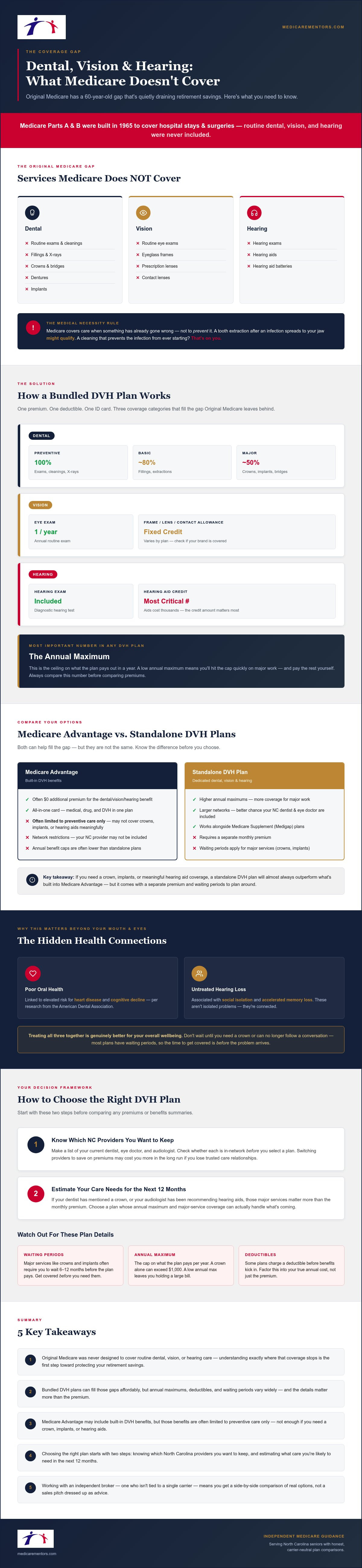
Here's something that surprises a lot of people when they first enroll in Medicare: Parts A and B were built in 1965 to cover hospital stays, surgeries, and doctor visits. Routine wellness care, the kind that keeps you healthy before something goes wrong, was never part of the original design. That's not a flaw someone forgot to fix. It's a structural gap that's been in place for six decades, and it affects tens of millions of seniors every single year.
The rule that governs most Medicare coverage decisions is called medical necessity. In plain terms, Medicare will step in when you need emergency treatment or a medically required procedure. But it generally won't pay for care that prevents problems from developing in the first place. A tooth extraction after an infection spreads to your jaw? That might qualify. A cleaning that prevents the infection from ever starting? That's on you.
The Gap in Medicare Part A and Part B
To make this concrete, here's a list of services that Original Medicare does not cover under standard circumstances:
- Routine dental exams, cleanings, fillings, and X-rays
- Dentures, crowns, bridges, and implants
- Routine eye exams for glasses or contact lenses
- Eyeglass frames, lenses, or contact lenses
- Hearing exams performed for the purpose of fitting hearing aids
- Hearing aids and the batteries that power them
The Original Medicare Gap is simply the term for this uncovered territory, and it's the primary reason that standalone and bundled dental vision and hearing insurance plans exist.
Why Bundling Dental, Vision, and Hearing Makes Sense
Buying three separate policies for dental, vision, and hearing care is like paying three different contractors to work on the same house when one experienced crew could handle everything. A bundled plan typically means one monthly premium, one deductible, and one ID card to hand over at any provider's front desk. That simplicity matters when you're managing multiple health appointments already.
There's also a deeper health reason to take all three seriously at once. Research published by the American Dental Association and other health organizations has consistently linked poor oral health to elevated risks for heart disease and cognitive decline. Untreated hearing loss has been associated with social isolation and accelerated memory loss. These aren't isolated problems. They're connected, and treating them together is genuinely better for your overall wellbeing.
Waiting until you need a crown or can no longer follow a conversation in a noisy restaurant before you look into coverage is a costly mistake. Most plans have waiting periods for major services, which means the time to get covered is before the problem arrives, not after.
Understanding How Dental Vision and Hearing Insurance Bundles Work
Once you understand the gap that Original Medicare leaves behind, the next logical question is: how exactly does a bundled plan fill it? The short answer is that dental vision and hearing insurance works like most other insurance, but with a few structural quirks that are worth understanding before you sign anything. Get familiar with these mechanics now, and you'll be in a much stronger position to compare plans side by side.
Key Components of a DVH Policy
Every bundled plan is built around three coverage categories, each with its own benefit structure:
- Dental: Covers routine cleanings and X-rays, basic restorative work like fillings, and major services such as root canals, crowns, bridges, and implants. How much the plan pays toward each category depends heavily on the service tier.
- Vision: Typically includes one annual eye exam plus a fixed allowance toward frames, prescription lenses, or contact lenses. Allowances vary by plan, so if you prefer a specific brand of frames, it's worth checking whether the allowance covers your usual cost.
- Hearing: Usually includes a hearing exam and a credit toward hearing aids. Because hearing aids can run into the thousands, the size of that credit matters more than almost any other number on the benefits summary.
The single most important number in any DVH plan is the annual maximum, which is the total dollar amount the plan will pay toward your care in a given calendar year. Plans typically range from roughly $1,000 on the lower end to $5,000 or more on higher-tier options. Once you hit that ceiling, any additional costs fall to you until the new plan year begins. That's not a flaw in the design; it's just the reality of how these plans are priced, and it's why estimating your likely care needs for the year is so useful before you choose a plan.
Most plans also carry a small annual deductible, often somewhere in the $50 to $100 range, which you pay out of pocket before the plan starts covering services. It's a modest threshold, but it's worth factoring in when you're doing the math.
After the deductible, most plans follow what's commonly called a 100-80-50 structure:
- Preventive services (cleanings, exams, X-rays) are covered at 100%
- Basic services (fillings, simple extractions) are covered at roughly 80%
- Major services (crowns, root canals, implants, hearing aids) are covered at around 50%
That split explains why a plan with a $1,500 annual maximum can still leave you with a meaningful bill after a crown. Knowing the structure ahead of time prevents surprises.
Navigating Waiting Periods and Deductibles
Here's something carriers don't always highlight in their marketing: most plans impose a waiting period before they'll pay for major services. Typically six to twelve months, this waiting period exists to prevent someone from enrolling only when they already know they need an expensive procedure. Preventive care, your cleanings and annual eye exam, is almost always available from day one with no waiting period at all.
If you had prior dental or vision coverage through an employer or another plan, some carriers will waive the waiting period entirely. This is called a creditable coverage waiver, and it's absolutely worth asking about when you're comparing options. Don't assume it applies automatically; you'll typically need to document your prior coverage.
One more distinction that catches people off guard: the difference between in-network and out-of-network reimbursement. Seeing a provider inside the plan's network usually means the plan pays its stated percentage with no additional friction. Going out of network often means lower reimbursement rates and more paperwork on your end. If you have a dentist or audiologist you want to keep, confirming they're in-network before you enroll is one of the smartest moves you can make.
Sorting through these details across multiple carriers takes time, and the differences between plans aren't always obvious from a brochure. If you'd like a clear side-by-side comparison built around your specific providers and expected care needs, talking through your options with an independent broker is a practical place to start.
Medicare Advantage vs. Standalone DVH Plans: Which is Better?
This is one of the most common questions seniors face when they're sorting out coverage, and the honest answer is: it depends on what you actually need. Medicare Advantage plans can look like a great deal on paper, especially when the marketing materials highlight "included dental and vision benefits" in bold. But included doesn't always mean sufficient, and that distinction is worth understanding before you commit to a plan for the year.
Many Medicare Advantage plans do include some level of dental and vision coverage as a built-in feature. The catch is that these benefits are frequently limited to preventive care only. Think one or two cleanings per year, a basic eye exam, and a modest allowance toward frames. If your needs stop there, the built-in benefits may serve you just fine. But if you're looking at a crown, a bridge, implants, or hearing aids that run into the thousands, those same benefits can fall short quickly.
This is where the concept of a benefit cap becomes important. A benefit cap is the hard ceiling on what your plan will pay toward dental, vision, or hearing care in a single plan year. Once you hit it, every dollar beyond that limit comes out of your pocket. On many basic Medicare Advantage plans, that cap is low enough that a single major dental procedure can exhaust it entirely, leaving you unprotected for the rest of the year.
When Your Medicare Advantage Plan Isn't Enough
A few clear signals suggest your built-in benefits aren't pulling enough weight. You may need to look beyond your current Part C plan if:
- Your dentist has recommended implants, a crown, or a bridge in the near future
- Your audiologist has suggested hearing aids and the plan's hearing benefit doesn't cover the models you need
- You have a chronic dental condition, such as gum disease, that requires more frequent treatment than standard preventive care
- You've hit your plan's benefit cap before the year ended and paid the difference yourself
Some Medicare Advantage plans allow you to add supplemental dental vision and hearing insurance on top of your existing coverage, sometimes called "stacking." Whether that's permitted depends on the specific plan, so it's worth a direct call to your carrier before you assume it's an option. An independent broker can also help you sort through this quickly without the runaround.
Standalone Plans for Medigap Users
If you're enrolled in a Medicare Supplement (Medigap) plan rather than Medicare Advantage, this decision is simpler. Medigap policies are designed to cover your cost-sharing under Original Medicare, which means they handle things like hospital copays and coinsurance. What they don't cover is everything Original Medicare excludes in the first place, including dental, vision, and hearing care. You can learn more about how Medigap is structured in the Medicare Supplement Insurance: The Complete 2026 Guide to Medigap.
For Medigap users, a standalone DVH policy isn't optional if you want meaningful coverage for these services. It's the only path. The good news is that standalone plans typically offer higher annual maximums and broader provider flexibility than the dental and vision add-ons bundled into many Part C plans. That means more freedom to stay with the dentist or audiologist you already trust, and a higher ceiling before you're paying out of pocket.
The key to making this work smoothly is coordination. Know your plan's benefit structure before your next appointment, confirm your providers are in-network, and keep a clear record of what you've used toward your annual maximum. No surprises at the front desk. If you'd like help comparing standalone options that fit alongside your Medigap plan, connecting with an independent broker is a straightforward place to start.
How to Choose the Best DVH Plan for Your Retirement in North Carolina
Choosing the right dental vision and hearing insurance plan doesn't have to feel like solving a puzzle blindfolded. Break it into five concrete steps, and the decision becomes a lot more manageable. Here's how to work through it without wasting time on plans that won't actually serve you.
Step 1: List your current providers. Write down your dentist, optometrist, and audiologist by name. This list is your filter. Any plan that doesn't include them in-network moves to the bottom of your stack immediately, regardless of how attractive the premium looks.
Step 2: Estimate what you'll actually need in the next 12 months. Are you due for new glasses? Has your dentist mentioned a crown? Is your audiologist recommending hearing aids? Being honest about your likely care needs helps you match the right annual maximum to your real situation rather than guessing.
Step 3: Compare PPO vs. HMO network structures. A PPO gives you the flexibility to see out-of-network providers, usually at a lower reimbursement rate. An HMO typically requires you to stay in-network entirely. If provider flexibility matters to you, a PPO is almost always the better fit for retirement-age adults who have established relationships with specific doctors.
Step 4: Look closely at the major services coverage percentage. Preventive care percentages are fairly consistent across plans. Where plans diverge significantly is in how much they cover for crowns, implants, root canals, and hearing aids. A plan that covers major services at 50% with a $3,000 annual maximum is a very different product than one offering 50% with a $1,500 cap. That gap shows up in your wallet.
Step 5: Talk to an independent broker before you decide. A broker who works across multiple carriers can show you real options side by side, not just the plan a single company is trying to sell you.
Checking Local Provider Networks in Raleigh and Charlotte
Not every North Carolina dentist or audiologist accepts every plan, and this is especially true with lower-tier or discount-style coverage. Some providers in the Raleigh and Charlotte metro areas have opted out of certain networks entirely because the reimbursement rates don't work for their practice. Before you enroll, use the carrier's online provider search tool and then call the provider's office directly to confirm they're still accepting that plan. Network directories aren't always updated in real time, and a mismatch discovered at the front desk is a frustrating and expensive surprise. It's also worth repeating this verification each year during the Medicare Open Enrollment period, since network participation can change annually.
Calculating Your Real Out-of-Pocket Costs
Here's a simple math check worth doing before you commit to any plan. Add your annual premium to your deductible. Then subtract the realistic value of the preventive services you'll use, your cleanings, your eye exam, and your hearing check. What's left is your baseline cost before a single major service is covered. If that number is already close to what you'd pay out of pocket for those same preventive services without any insurance, the plan's value lives entirely in its major services coverage. That's where a higher-premium plan can actually save you significantly on a single root canal or a set of hearing aids.
Watch out for plans that look affordable on the surface but bury long exclusion lists in the fine print. If a plan excludes implants entirely, limits hearing aid credits to entry-level devices, or caps orthodontic work with language that quietly applies to adults, the sticker price isn't telling the whole story. Read the exclusions section the same way you'd read the fine print on anything else important.
If you'd like help running this math against real plan options available to North Carolina seniors in 2026, connecting with an independent broker at Medicare Mentors is a practical next step. You'll get a clear comparison built around your providers and your expected needs, not a generic quote from a carrier trying to sell you its own product.
Navigating Your Coverage Options with Medicare Mentors
At this point, you understand the gap Original Medicare leaves behind, how bundled dental vision and hearing insurance works, and what to look for when comparing plans. The harder part is actually sitting down and doing the comparison across a dozen carrier brochures, each written to make their own plan look like the obvious choice. That's where we come in.
Medicare Mentors is an independent brokerage. That one word, independent, changes everything about how we work with you. We don't represent Humana. We don't represent Cigna, Aflac, or any single carrier. We represent you. Our job is to show you what's actually available in North Carolina, explain the tradeoffs honestly, and help you choose the plan that fits your providers and your expected care needs, not the plan that earns the highest commission.
And here's something worth knowing: our guidance costs you nothing. Carriers pay us a standard commission when you enroll, so you receive the same education and comparison support you'd get from a paid advisor, without the bill at the end of the conversation.
The Benefit of an Independent Broker
When you call a carrier directly, you get one option. When you work with Medicare Mentors, you get access to more than ten different insurance companies through a single conversation. That breadth matters because no single carrier is the right fit for every senior in every situation. The plan that works beautifully for your neighbor in Cary might have a network that excludes your dentist in Chapel Hill entirely.
We walk through the pros and cons of each option without an agenda. If a plan has a waiting period that would affect you, we'll say so. If a lower-premium option has a benefit cap that won't cover the crown your dentist recommended, we'll show you the math. Whether you're turning 65, retiring soon, or losing employer coverage and need to act quickly, we'll meet you where you are and move at your pace.
Personalized Reviews for Seniors in North Carolina
Our roots are here. We work closely with seniors across Raleigh, Durham, and Charlotte, and we know which local providers participate in which networks. That local knowledge isn't something you'll get from a national carrier's call center.
Our support doesn't stop at enrollment either. If a billing issue comes up six months later or a claim gets denied unexpectedly, you have someone to call. That's the relationship we build with every client.
Hundreds of North Carolina seniors have trusted us with these decisions and taken the time to leave five-star reviews specifically because we made a complicated process feel clear and manageable. If you're ready to see your real options side by side, schedule a Medicare planning consultation with Medicare Mentors and let's find the right fit together.
Your Next Step Toward Confident Coverage
Dental, vision, and hearing care are not optional extras in retirement. They're connected to your heart health, your cognitive sharpness, and your quality of life. Original Medicare won't protect you there, but the right dental vision and hearing insurance plan will.
Here's what to carry forward from everything you've read: know which providers you want to keep, be honest about the care you're likely to need this year, and don't let a low premium distract you from a low annual maximum. Those three habits will steer you toward the right plan and away from costly surprises.
You don't have to sort through carrier brochures alone. Medicare Mentors is an independent brokerage with over 300 five-star reviews from North Carolina seniors who wanted honest guidance, not a sales pitch. Our local experts compare plans across more than ten carriers at no cost to you.
Get a free, unbiased comparison of the best DVH plans in North Carolina today. The right coverage is closer than you think, and we'll help you find it.
Frequently Asked Questions About Dental, Vision, and Hearing Insurance
Does Medicare Part B cover dental cleanings or eye exams?
No. Medicare Part B doesn't cover routine dental cleanings, fillings, dentures, or standard eye exams for glasses. The same applies to hearing exams performed for the purpose of fitting hearing aids. Part B was designed around medically necessary treatment, not preventive wellness care, so these services fall entirely outside its scope.
There are narrow exceptions worth knowing. Medicare may cover a dental exam before certain surgeries, or an eye exam if you've been diagnosed with diabetes or macular degeneration. But for the routine care most seniors need year to year, a separate dental vision and hearing insurance plan is the only reliable path to coverage.
Is there a waiting period for dental implants on these plans?
Yes, in most cases. Implants are classified as a major service, and most plans impose a waiting period of six to twelve months before they'll pay toward major procedures. This waiting period exists to prevent someone from enrolling right before a scheduled procedure and immediately drawing on the plan's benefits.
The good news is that if you had prior dental coverage through an employer or another plan, some carriers will waive the waiting period entirely through what's called a creditable coverage waiver. You'll typically need to document that prior coverage, so don't assume it applies automatically. Ask about this specifically when you're comparing plans.
Can I keep my current dentist if I buy a standalone DVH plan?
It depends on whether your dentist participates in the plan's network. Most standalone plans are structured as PPOs, which means you can see out-of-network providers, but you'll pay more and receive a lower reimbursement rate. Staying in-network almost always means better coverage and less paperwork on your end.
Before you enroll, use the carrier's online provider directory and then call your dentist's office directly to confirm they're still accepting that plan. Network directories aren't always current, and discovering a mismatch at the front desk is an avoidable headache. This verification is worth repeating each year, since network participation can change.
What is the average cost of dental, vision, and hearing insurance for seniors?
We don't quote specific premium figures here because plan pricing varies meaningfully based on your age, location, the carrier, and the benefit tier you choose. What we can tell you is that premiums, deductibles, and annual maximums are all part of the real cost calculation. A lower monthly premium paired with a low annual maximum can actually cost you more in a year where you need major work done.
The most useful thing you can do is run the full math: annual premium plus deductible, minus the value of the preventive services you'll realistically use. What remains tells you where the plan's true value lives. An independent broker can walk you through this calculation across multiple carriers at no cost to you.
Do these plans cover the full cost of hearing aids?
Rarely. Hearing aids are expensive, often running into the thousands for a quality pair, and most plans cover them partially rather than fully. Coverage typically takes the form of a fixed credit or a percentage of the cost, applied after your deductible. How far that credit stretches depends entirely on the plan's annual maximum and the specific models your audiologist recommends.
Entry-level hearing aids may fall within a plan's credit. Premium devices with advanced features often don't. Before you enroll, ask your audiologist which models they'd recommend and what those models cost. Then compare that number against each plan's hearing benefit. That single comparison can be the most important factor in your decision.
Can I change my dental and vision plan during the Medicare Annual Enrollment Period?
It depends on the type of plan you have. If your dental and vision coverage is built into a Medicare Advantage plan, then yes, the Annual Enrollment Period from October 15 to December 7 is when you can switch or drop that coverage. Changes take effect January 1 of the following year.
Standalone DVH policies that sit outside Medicare Advantage generally aren't tied to that enrollment window. You can often apply for or change a standalone plan at any time during the year, though a new waiting period may apply if you're switching carriers. If you're unsure which rules apply to your current coverage, a quick conversation with an independent broker can clear that up quickly.
Is a bundled plan better than buying three separate policies?
For most seniors, a bundled plan is the simpler and often more cost-effective choice. One premium, one deductible, and one ID card to manage is genuinely easier than juggling three separate policies with three different billing cycles. Bundled plans also tend to be priced competitively because carriers are offering a complete package.
That said, there are situations where separate policies make sense. If you have strong vision coverage through one carrier and only need dental and hearing elsewhere, forcing everything into one bundle might mean paying for benefits you don't need. The right answer depends on your specific care needs, which is exactly why comparing options with an independent broker rather than defaulting to one carrier's bundle is worth the time.
What happens if I need major dental work immediately after signing up?
If your plan has a waiting period for major services and you need a crown or root canal right after enrolling, you'll likely pay out of pocket for that procedure. Most plans won't cover major work until the waiting period has passed, typically six to twelve months from your effective date. Preventive care like cleanings is almost always available from day one.
This is exactly why timing matters. If your dentist has already flagged upcoming major work, enrolling as early as possible starts the clock sooner. And if you have prior coverage that qualifies for a creditable coverage waiver, that waiting period may be waived entirely. Don't wait until you're sitting in the dentist's chair to sort out your coverage. Getting ahead of it by even a few months can make a real difference.