
Blog
Enrolling in Medicare While Still Working: The Complete 2026 Guide
By Medicare Mentors ·

What if your "free" employer health plan is actually costing you more than a specialized Medicare setup? If you're approaching age 65 but aren't ready to retire, you're likely facing the high-stakes decision of enrolling in medicare while still working. It's completely natural to feel a bit of anxiety about this transition. You might worry about triggering a lifetime late enrollment penalty or wonder if your current coverage is even considered "creditable" by the government. We know these choices feel heavy because they impact both your health and your hard-earned savings.
In this 2026 guide, you'll learn exactly how to determine if you can safely delay Part B and how to navigate the strict HSA contribution rules, like the $4,400 individual limit. We'll also explain why it's vital to stop those contributions months before you sign up to avoid tax issues. You'll discover a simple way to compare your workplace plan against Medicare Supplement or Advantage options. We're going to provide a clear path forward so you can avoid penalties and keep your healthcare costs predictable as you continue your career.
Key Takeaways
- Check your employer's size to see if the "Rule of 20" allows you to delay Medicare without facing gaps in your healthcare coverage.
- Learn how to verify your current insurance is "creditable" to avoid permanent late enrollment penalties when enrolling in medicare while still working.
- Perform a side-by-side cost comparison to see if Medicare Advantage or a Supplement plan offers better value than your employer's premiums and deductibles.
- Protect your tax-advantaged savings by learning exactly when to stop HSA contributions before you transition to Medicare Part A or B.
- Master the timing of your Special Enrollment Period so you can switch from workplace coverage to Medicare without any stress or loss of benefits.
Medicare While Working: Do You Need to Sign Up at 65?
Deciding whether you need to sign up for benefits at age 65 can feel like a high-stakes guessing game. For many of our neighbors in North Carolina, the answer depends entirely on your specific employment situation. Are you the one still punching the clock, or are you covered as a spouse on someone else's plan? This distinction is the first step in enrolling in medicare while still working without triggering unnecessary costs or legal headaches.
For most people, Medicare Part A is a no-brainer. Since approximately 99% of beneficiaries qualify for premium-free Part A, there is usually no monthly cost to add this hospital insurance as secondary coverage. Even if you stay on your employer's plan, Part A can help cover the $1,736 inpatient hospital deductible for 2026 if your workplace insurance leaves a gap. However, Part B is where the decision requires more math and strategy. With the standard Part B premium rising to $202.90 in 2026, you don't want to pay for it unless you truly need the coverage or are legally required to have it.
The 7-Month Window: Your Initial Enrollment Period
The Initial Enrollment Period (IEP) is your first major deadline. This is a seven-month window that includes the three months before you turn 65, your birth month, and the three months following. Think of the IEP as the primary gateway to Medicare (United States) that allows you to secure coverage without answering health questions. If you ignore this window while employed at a small company, you might find yourself without primary insurance when you need it most. We often teach our students that missing this window without having "creditable" coverage is the fastest way to accrue lifetime penalties that never go away.
Company Size Matters: The 20-Employee Threshold
The "Rule of 20" is the most important regulation you need to understand. If your employer has 20 or more employees, your group health plan is generally considered primary. In this case, you can often delay Part B until you actually retire. But if your company has fewer than 20 employees, Medicare typically becomes your primary insurance the moment you're eligible. If you don't enroll, your small group plan might refuse to pay its portion of your medical bills, leaving you responsible for the bulk of the costs.
Don't assume your HR department has all the answers. While they mean well, they aren't always experts on the latest CMS coordination of benefits rules. We recommend looking into professional medicare planning to verify how your specific plan interacts with federal guidelines. Taking the time to learn these rules now protects your savings and ensures you have a safety net that actually works when you're ready to transition out of the workforce.
Understanding Part A and Part B When You Have Employer Coverage
Many people assume that Medicare and employer insurance are an "either/or" choice. In reality, they often work together through a process called coordination of benefits. If you are enrolling in medicare while still working for a company with 20 or more employees, your workplace plan typically remains your primary insurance. This means your job's plan pays first, and Medicare acts as a "secondary payer" to help cover remaining costs like deductibles or coinsurance. It's a helpful safety net, but it requires careful timing to avoid tax headaches. For a deeper look at the timelines involved, you might find The Complete 2026 Medicare Enrollment Guide useful for your planning.
The HSA Trap: Why You Must Stop Contributions
Medicare enrollment makes you ineligible for HSA contributions. This is a common point of confusion that can lead to unexpected tax penalties. If you decide to join any part of Medicare, including premium-free Part A, you must stop putting money into your Health Savings Account. The government applies a six-month "look-back" period when you apply for Medicare after age 65. To stay safe, we recommend stopping your contributions at least six months before you sign up. For 2026, the individual HSA contribution limit is $4,400, but that amount is prorated based on the months you were actually eligible. If you over-contribute, you could face a 6% excise tax on the excess funds every year they remain in the account.
Premium-Free Part A vs. The Part B Cost
Most workers qualify for premium-free Part A because they've paid Medicare taxes for at least 10 years (40 quarters). Because there's no monthly cost, adding Part A while you're still employed is often a smart move to lower your out-of-pocket hospital costs. However, Part B is a different story. In 2026, the standard Part B premium is $202.90 per month. You'll need to weigh that monthly cost against the benefits your employer plan already provides. If you decide the extra $202.90 doesn't offer enough additional value, you can often delay Part B without penalty, provided your company is large enough.
If your employer has fewer than 20 employees, Medicare usually becomes your primary insurance. In that scenario, you must sign up for Part B to avoid massive gaps in coverage. Knowing When to sign up for Medicare is the best way to protect your physical and financial health. If you're feeling overwhelmed by the math, reaching out for medicare planning can help you see which combination of plans makes the most sense for your wallet.
Avoiding Lifetime Penalties: Creditable Coverage and SEPs
The word "lifetime" is enough to make anyone pause. When you are enrolling in medicare while still working, your biggest financial risk isn't the monthly premium; it's the permanent late enrollment penalty. If you delay Part B or Part D without having what the government calls "creditable coverage," you'll face a price hike that sticks with you for as long as you have Medicare. Creditable coverage simply means your employer insurance is at least as good as Medicare's standard benefits. If your plan doesn't meet this bar, the government considers you "uninsured" in their eyes, even if you're paying for a workplace plan every month.
The Part B penalty is particularly steep. For every 12-month period you could have had Part B but didn't, your monthly premium increases by 10%. This isn't a one-time fine; it's a permanent increase added to your bill every single month. Prescription drug coverage has its own set of rules. If you go 63 days or more without creditable drug coverage, you'll owe a Part D penalty. To understand how these costs are calculated and how to choose the right plan, you can explore our guide on Medicare Part D Plans in 2026. Following the official Medicare rules for working past 65 is the only way to ensure these penalties don't take a bite out of your retirement budget.
The Special Enrollment Period (SEP) for Workers
Once you decide to stop working or your employer coverage ends, an 8-month Special Enrollment Period (SEP) begins. This window allows you to sign up for Part B without any late fees. However, don't wait until the eighth month to start the paperwork. We recommend beginning the process at least two months before you plan to retire to ensure there's no gap in your care. You'll need two specific forms to prove you had prior coverage: the CMS-40B (your application) and the CMS-L564, which your employer must sign to verify your group health insurance history. If you're unsure how to coordinate these forms, our team at Medicare Mentors can help you walk through the timeline at no cost.
Confirming Your Drug Coverage is Creditable
Every year, usually in September or October, your employer is required to send you a "Notice of Creditable Coverage." Keep this document in a safe place. It is your "get out of jail free" card that proves to Medicare you didn't need a Part D plan yet. If your employer's drug coverage isn't creditable, you should join a Part D plan during your initial 7-month window even if you keep your job. A major trap to avoid is COBRA. While COBRA might keep your doctor network intact, Medicare does not consider it creditable coverage for Part B. If you rely on COBRA and miss your SEP, you'll likely face those lifetime penalties we mentioned earlier.
How to Decide: Comparing Your Workplace Plan vs. Medicare Options
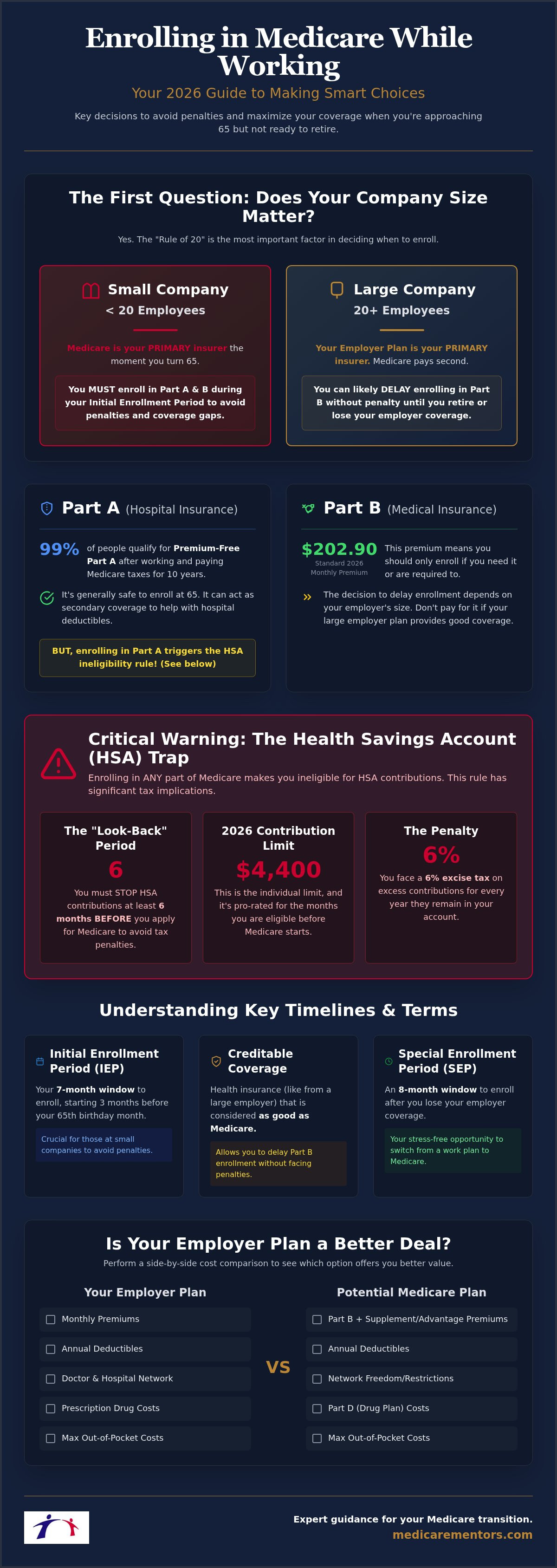
Once you understand the rules of enrolling in medicare while still working, the next step is a strategic side-by-side comparison. Many people stay on their workplace plan simply because it feels familiar, but familiarity can be expensive. To make an objective choice, you need to look at the total cost of ownership. This includes your monthly premiums, annual deductibles, and the maximum amount you could pay out-of-pocket in a worst-case scenario. In many cases, a Medicare setup provides more robust coverage for a lower overall price than a standard employer plan.
Network freedom is another critical factor for our neighbors in North Carolina. While your current job might restrict you to specific hospital systems in the Triangle or Charlotte, a Medicare Supplement plan is accepted by any provider in the country that takes Medicare. If you value having your choice of specialists without needing a referral, Medicare might offer more flexibility than your current HMO or PPO. We also look at "benefit extras" like dental, vision, and hearing coverage. While your job might offer these as separate deductions, many Medicare Advantage plans in 2026 include these ancillary benefits at no extra monthly cost.
The "Run the Numbers" Checklist
- Step 1: Compare your monthly payroll deduction for health insurance against the 2026 Part B premium of $202.90. Don't forget to include what you pay for your spouse if they are on your plan.
- Step 2: Look at your deductible. Many employer plans now feature "High Deductible" structures of $3,000 or more. The 2026 Medicare Part B deductible is significantly lower at $283.
- Step 3: Review your prescriptions. Use a formulary tool to see if your current medications are covered more affordably under a Part D plan or a Medicare Advantage plan.
Medicare Advantage vs. Medicare Supplement for Active Seniors
For those who travel for work or split their time between North Carolina and another state, a Medicare Supplement (Medigap) plan is often the gold standard. It provides predictable costs and nationwide access to care. Conversely, Medicare Advantage can be an excellent way for healthy workers to lower their monthly fixed costs while still enjoying perks like fitness memberships or over-the-counter allowances. The process of enrolling in medicare while still working is about finding the best value for your specific health needs. If the math feels complicated, our team can help you with medicare planning to see which path saves you the most money without sacrificing the quality of your care.
Navigating Your Transition with Medicare Mentors
Making the leap from a long-term employer plan to Medicare is a significant life transition that requires more than just a 1-800 number. While national call centers offer generic advice, many Raleigh residents prefer working with a local neighbor who understands the specific healthcare landscape of North Carolina. At Medicare Mentors, we view our relationship with you as a teacher-student dynamic. Our goal isn't to push a specific product, but to provide the clear, objective education you need so you can decide which path is right for your future. We also help clear up the common confusion surrounding the Annual Enrollment Period (AEP). Many of our students worry they must wait until the fall to make a change, but enrolling in medicare while still working often relies on your own retirement timeline rather than a specific calendar date.
As an independent brokerage, we act as your advocate by comparing every available option to find the one that protects your health and your wallet. We take the stress out of the "Employer Verification" paperwork by guiding you through exactly how to get your forms signed by HR. This hands-on support ensures your transition is processed without delays or coverage gaps. This professional guidance is provided at no cost to you, as we are compensated by the insurance companies only if you choose to enroll in a plan. This means you get expert advice without adding another expense to your retirement budget.
Moving to North Carolina or Retiring Soon?
If you are moving to the Triangle or planning to retire from a major employer in Raleigh, Durham, or Chapel Hill, your timing is critical. Dave and Michele Johnson founded Medicare Mentors in 2011 to help people just like you navigate these complex moves. We specialize in the "Losing Employer Coverage" transition, helping you piece together a coverage plan that feels like a custom-built safety net. Think of your healthcare like a multi-piece construction task. While Medicare is the foundation, we also help you evaluate if you need additional layers like dental, vision, and hearing. We can even explore specialized protection for cancer, heart attack, and stroke, or discuss final expense coverage to ensure your financial house is fully protected.
Next Steps: Your Medicare Checklist
The best time to start your planning is about six months before you intend to stop working. This lead time gives us plenty of space to "run the numbers" without any rush or pressure. To prepare for our conversation, try to gather a few key items:
- A current Summary of Benefits from your employer plan to compare deductibles and out-of-pocket maximums.
- A list of your current prescription medications and dosages to check against 2026 formularies.
- A list of your preferred doctors and specialists to verify they remain in-network for your new plan.
Taking these steps early ensures that enrolling in medicare while still working becomes a smooth, predictable part of your retirement journey. When you are ready to move at your own pace, we invite you to Schedule your free Medicare planning session. We look forward to helping you gain the confidence and clarity you deserve.
Secure Your Health and Your Savings Today
Deciding on your next steps doesn't have to be a source of stress or confusion. You now understand how the "Rule of 20" affects your enrollment timeline and why stopping HSA contributions early is vital for avoiding unnecessary tax penalties. Most importantly, you have the tools to see if your current workplace plan truly measures up to the specialized benefits Medicare can offer. Taking these proactive steps ensures that enrolling in medicare while still working becomes a strategic financial move rather than a rushed decision made under pressure.
Since 2011, we've provided independent, relationship-based education to our neighbors across North Carolina. As a Raleigh-rooted brokerage, we work for you, not the insurance companies. Our consultation and enrollment services are provided at zero cost to you, giving you access to deep industry expertise without any financial risk or sales pressure. We're here to act as your protective ally through every stage of this transition.
Start Your Personalized Medicare Roadmap with Medicare Mentors and gain the clarity you need to move forward with confidence. Your future self will thank you for the peace of mind and financial security you're building today. We look forward to helping you navigate your path with ease.
Frequently Asked Questions
Do I have to enroll in Medicare at 65 if I have insurance through my spouse’s job?
No, you can usually delay Part B as long as your spouse's employer has 20 or more employees and the coverage is considered creditable. This allows you to avoid the $202.90 monthly premium while maintaining primary coverage through the workplace. However, if the company has fewer than 20 employees, Medicare typically becomes primary. In that case, you must sign up during your Initial Enrollment Period to avoid gaps and future penalties.
Can I keep my HSA if I only enroll in Medicare Part A?
No, you cannot make new contributions to your Health Savings Account once you are enrolled in any part of Medicare. This includes premium-free Part A, which most people receive automatically at 65 if they are already collecting Social Security. To avoid tax penalties, stop your HSA contributions at least six months before you apply for Medicare. You can still use existing funds in your HSA to pay for qualified medical expenses, including Medicare premiums.
Is COBRA considered creditable coverage for Medicare?
No, COBRA is not considered creditable coverage for Medicare Part B. While it may look like a continuation of your workplace plan, the government does not view it as active employment coverage. If you rely on COBRA and let your 8-month Special Enrollment Period pass, you will face a lifetime late enrollment penalty. It's often safer and more affordable to transition directly into a Medicare Supplement or Advantage plan when your job ends.
What happens if I miss my Special Enrollment Period after I stop working?
Missing your Special Enrollment Period means you must wait for the General Enrollment Period, which runs from January 1 to March 31 each year. Your coverage wouldn't start until the month after you sign up, potentially leaving you with several months of no insurance. You will also trigger the Part B late enrollment penalty. This is a permanent 10% increase for every full 12-month period you were eligible but not enrolled.
Will I be penalized if my employer has fewer than 20 employees and I don’t sign up?
Yes, you will likely face penalties and significant coverage gaps. For companies with fewer than 20 employees, Medicare is the primary payer for your medical bills. If you don't sign up, your employer's insurance may refuse to pay their portion, leaving you responsible for the entire bill. Enrolling in medicare while still working for a small business is essential to ensure your claims are processed correctly and to avoid future surcharges.
How do I prove to Medicare that I had creditable coverage at my job?
You prove your prior coverage by submitting form CMS-L564, which your employer's HR department must sign. This form verifies that you had group health insurance based on active employment. For prescription drugs, keep the Notice of Creditable Coverage your employer sends every autumn. These documents act as your evidence to avoid the Part D penalty and the Part B late enrollment surcharge when you finally leave your job and transition to Medicare.
Can I switch from my employer plan to Medicare at any time of the year?
You can switch from your employer plan to Medicare at any time of the year if you are leaving your job or losing your group coverage. This triggers a Special Enrollment Period that lasts for eight months. If you are still working and simply want to drop your workplace plan for Medicare, you can do so. We recommend timing the switch carefully so there's no overlap or gap in your active health benefits.
Does Medicare work better than my current PPO plan?
Medicare can often provide more financial protection than a standard PPO. While your current PPO might have a high deductible or limited network, a Medicare Supplement plan allows you to see any doctor in the country who accepts Medicare. When enrolling in medicare while still working, we compare your current $283 Part B deductible against your workplace plan's out-of-pocket maximum to see which option keeps more money in your pocket over the long term.