
Blog
Getting Extra Help With Prescription Costs in North Carolina
By Medicare Mentors ·
If you’re getting extra help with prescription costs NC, it can be hard to know which program or office to turn to first, especially when drug bills are already stretching your budget. Medicare Part D Extra Help is a federal program that may lower prescription drug costs for people who qualify. Social Security handles applications, while some people qualify automatically through other assistance programs.
North Carolina also has Medicare Savings Programs that may help with other Medicare expenses, and SHIIP counselors can explain Medicare options and available assistance. This guide covers what Extra Help may help with, how to find current eligibility and application details, and practical steps for getting organized. It also explains why reviewing your Part D plan and prescriptions is a separate task from checking program eligibility.
Key Takeaways
- Extra Help, also called the Low-Income Subsidy, is intended to assist with Medicare Part D costs. Eligibility and assistance depend on your circumstances and current rules.
- For getting extra help with prescription costs NC, identify which steps involve Social Security and which may involve North Carolina programs.
- Medicare Savings Programs and Extra Help serve different purposes. North Carolina counseling can help you understand your options.
- Before applying, read current official guidance, gather the information requested, and keep any notices you receive.
- Checking eligibility and choosing a Part D plan are separate tasks. Reviewing your prescriptions alongside plan options can help you assess your coverage.
What Extra Help With Prescription Costs Means for North Carolina Medicare Members
If prescription expenses are getting harder to manage, separate two questions: whether you may qualify for assistance, and whether your current drug coverage fits your needs. For North Carolina residents, getting extra help with prescription costs NC starts with understanding what the federal program may help pay for and how eligibility is determined.
Extra Help, also called the Low-Income Subsidy, assists eligible people with costs connected to Medicare Part D prescription drug coverage. Eligibility and the amount of help available depend on your circumstances and current program rules. A new prescription, a plan-year change, or an increase in what you pay can be a useful prompt to review both your eligibility and your coverage.
This video offers a general introduction to Extra Help and Part D costs:
Which prescription plan costs may Extra Help assist with?
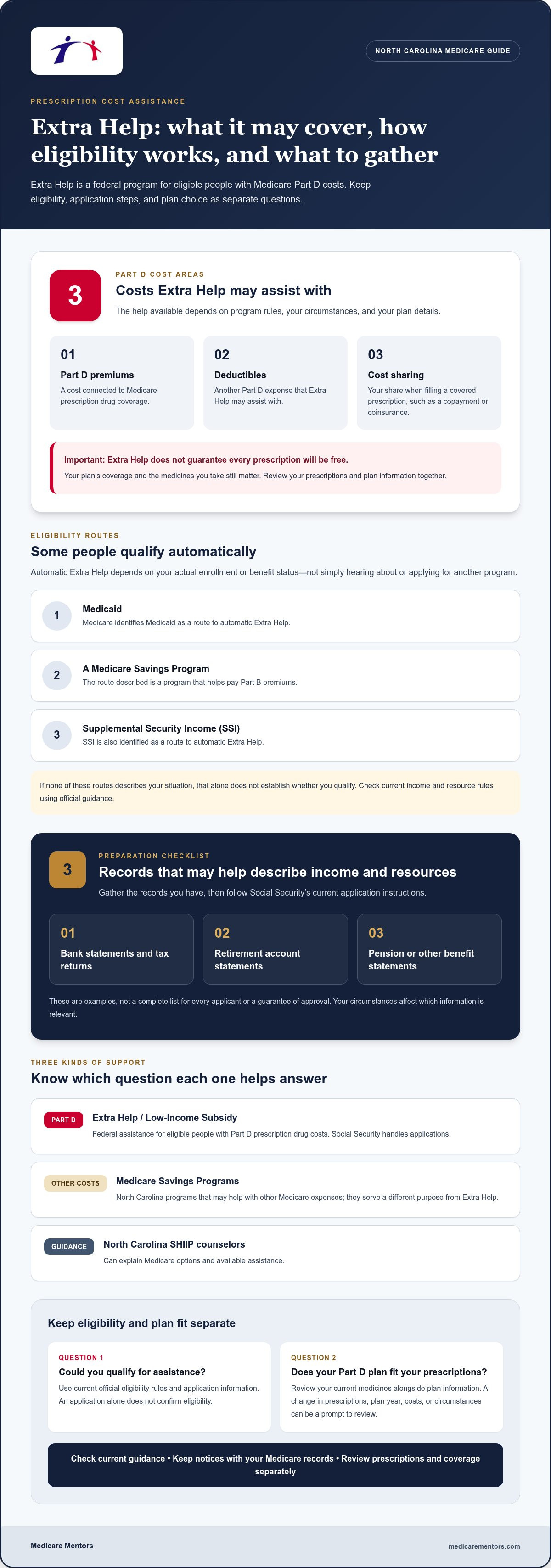
Official Medicare information describes Extra Help as assistance with Part D premiums, deductibles, and cost sharing. Cost sharing is the portion you pay when filling a covered prescription, such as a copayment or coinsurance. The help available and what you pay depend on program rules, your circumstances, and your plan details.
Extra Help can reduce certain Part D costs, but it doesn’t guarantee that every prescription will be free. Your plan’s coverage and the medicines you take still matter. If your costs have changed, review your current prescriptions and plan information together. Don’t assume the program will cover a particular medicine or eliminate all out-of-pocket expenses.
Who may want to look into Extra Help in North Carolina?
Consider checking the current rules if prescription costs are straining your budget, your medication needs have changed, or you’re reviewing coverage after a move or another life change. You don’t need to know whether you qualify before looking into the program. Reviewing the requirements can help you decide whether to apply or explore another kind of assistance.
Keep assistance eligibility separate from plan fit. Whether you qualify for Extra Help is one question; whether your Part D plan works for your prescriptions is another. Official program information explains current eligibility rules. Medicare Mentors offers personalized Medicare planning, including a review of prescriptions and plan options, without promising eligibility or a particular outcome.
How Extra Help Eligibility Works: Automatic Qualification and Applying
Extra Help eligibility depends on current income and resource rules. Because rules can change, an old figure or a neighbor’s experience may not tell you whether you qualify now. Use current official rules, not outdated limits, to decide whether to check your eligibility or apply. The Medicare’s Extra Help Program page explains eligibility routes and application information.
Some people qualify automatically through certain assistance programs. Others may need to apply to have their eligibility reviewed. Automatic qualification depends on your actual enrollment or benefit status. If you’re unsure which situation applies, review your current benefit information and official notices instead of making assumptions.
When might someone receive Extra Help automatically?
Medicare identifies Medicaid, a Medicare Savings Program that helps pay Part B premiums, and Supplemental Security Income (SSI) as routes to automatic Extra Help. The details matter: hearing about a program or applying for it isn’t necessarily the same as being enrolled or receiving qualifying assistance. Review your benefit information and official notices to understand your status.
If you don’t receive one of these qualifying forms of assistance, that alone doesn’t establish whether you’re eligible. You can still review current income and resource rules and consider applying for an eligibility review. This may be especially relevant if you’re getting extra help with prescription costs NC after a change in your financial or coverage situation.
What information may an applicant need to gather?
Before starting an application, gather the records you have. Social Security’s application guidance gives examples of documents that may help describe income and resources, including:
- Bank statements and tax returns
- Statements for retirement accounts
- Pension or other benefit statements
This is a preparation guide, not a guarantee of approval or a complete list for every applicant. Your circumstances may affect which information is relevant. Follow the official application instructions about what to provide and how to submit it.
If a notice says you qualify automatically, read it carefully and keep it with your Medicare records. If you apply, review the application and any follow-up notices to understand the decision and any next steps. Submitting an application alone doesn’t confirm eligibility.
Eligibility and plan choice are separate questions. If you’d like help understanding how your prescriptions fit with Part D plan options, Medicare Mentors provides education-first guidance through personalized Medicare planning. An advisor can review prescriptions and plan options, while official program channels determine Extra Help eligibility.
Extra Help, Medicare Savings Programs, and North Carolina Counseling Compared
Start by identifying the kind of help you need. Extra Help is tied to Medicare Part D prescription drug costs. Medicare Savings Programs address certain other Medicare expenses, while counseling services explain coverage options and resources. Each has a different purpose and eligibility rules, so don’t assume qualifying for one means you qualify for another.
| Resource | What it’s for | Who decides or provides it |
|---|---|---|
| Part D Extra Help | Assistance with costs related to Medicare prescription drug coverage. | Federal program; check current official eligibility guidance. |
| Medicare Savings Programs | State-administered assistance that may help with certain Medicare Part A or Part B costs. | Eligibility and applications follow North Carolina program rules. |
| North Carolina SHIIP | Medicare counseling and education to help you understand coverage and available assistance. | North Carolina’s Seniors’ Health Insurance Information Program provides counseling. |
How Extra Help differs from Medicare Savings Programs
These programs address different parts of your Medicare budget. Extra Help relates to Part D, the prescription drug benefit. Medicare Savings Programs can help with certain costs connected to Part A or Part B, such as premiums, and qualifying assistance may include other cost-sharing support under program rules. The programs aren’t interchangeable, and each has its own eligibility criteria and application process.
There can be a connection: Medicare guidance identifies certain qualifying Medicare Savings Program assistance as a route to receiving Extra Help automatically. That doesn’t mean every person who applies for or receives any state assistance automatically qualifies for both programs. Your actual enrollment and current rules matter. For getting extra help with prescription costs NC, review each program’s official guidance rather than treating one decision as a decision on the other.
Where North Carolina residents can find unbiased guidance
North Carolina SHIIP, the Seniors’ Health Insurance Information Program, is a state-based Medicare counseling resource. Its counselors can help you understand Medicare coverage, compare options, and learn about assistance programs. Counseling can explain where to look and what questions to ask, but it isn’t an eligibility decision. The relevant program makes that decision under its rules.
Medicare Mentors offers no-cost, no-obligation consultations. As an independent brokerage, its advisors can review your prescriptions and Part D plan options, with guidance tailored to your needs rather than tied to a single insurance carrier. SHIIP provides counseling, while program offices determine eligibility. If a medication change or rising drug expense has you reconsidering coverage, personalized Medicare planning can help you understand plan options alongside your prescriptions.
Apply for Extra Help in North Carolina: Next Steps
A little organization can make the application easier to manage. Set aside time, keep your records together, and work through the official instructions carefully. North Carolina residents, including those in Raleigh, Durham, Chapel Hill, Greensboro, Fayetteville, Wilmington, Charlotte, Winston-Salem, High Point, and Greenville, can also use SHIIP for Medicare counseling. Check official state information for its current services and contact details.
- Start with the official application page. Use Social Security’s Extra Help application page to begin. Read the instructions before entering information.
- Keep your materials together. A paper or digital folder can help you organize application notes and related correspondence.
- Answer each question carefully. Use your records to provide accurate information. If a question is unclear, consult Social Security’s official guidance instead of guessing.
- Save your records. Keep any confirmation or other records provided during the application process so you can refer to them if you need to follow up.
Prepare for an Extra Help application
Before you begin, make sure you can focus without rushing. Keep a way to note questions as they come up, and follow the current Social Security instructions about what to enter and submit. Use records you can verify instead of relying on memory. For questions about eligibility criteria, refer to Social Security or current official Medicare resources.
If you’re helping a family member, keep their information and application notes separate from your own. This can reduce mix-ups and make it easier to return to an unfinished task. Submit documents and personal details only through the official channels described in the application instructions.
After applying, review notices and prescription coverage
After submitting your information, watch for correspondence and keep it with your application records. If a notice includes instructions or requests information, note the action described and contact the agency named in the notice if you need clarification. Keeping the application, correspondence, and follow-up notes together can make later conversations more straightforward.
If your prescriptions or coverage needs have changed, update your medication list and write down the coverage questions you want answered. This gives you a useful starting point for a separate plan review, without confusing it with the application process.
For one-on-one help understanding Medicare plan options, Medicare Mentors’ personalized Medicare planning can help you organize coverage questions and discuss your prescriptions with an advisor.
Get Personal Medicare Prescription Guidance in North Carolina
Make a coverage question easier to address by turning it into a short list. If you’ve received a confusing bill, have a claim question, or noticed a change in your coverage, gather the related paperwork and write down what you want clarified. Include your plan name and the specific issue you’re trying to resolve.
When a one-on-one plan review may help
A review may be useful after a change in your health needs, a move, or a notice from your plan that leaves you unsure what to do next. Before your consultation, note what changed and what you want to understand. Specific questions can keep the discussion focused, whether you’re reviewing current coverage or considering your next steps.
How Medicare Mentors supports North Carolina clients
Medicare Mentors takes an education-first approach and provides ongoing support with coverage reviews, billing questions, and claims. Its independent advisors can review your prescriptions and plan options in a no-cost, no-obligation consultation. Medicare Mentors serves clients across North Carolina, including Raleigh, Durham, Chapel Hill, Greensboro, Fayetteville, Wilmington, Charlotte, Winston-Salem, High Point, and Greenville, as well as clients nationwide.
If a prescription or coverage change has raised questions, bring those concerns to a one-on-one consultation. Start with the issue that matters most, then review the options with an advisor.
Take the Next Step With Confidence
You don’t need to figure everything out today. Choose one useful next step, such as setting aside a recent notice or writing down the question you most want answered. If prescription costs are becoming harder to manage in North Carolina, clear information can help you decide what to do next.
Medicare decisions are personal, and it’s reasonable to take them at a pace that feels comfortable. Medicare Mentors is an independent brokerage serving North Carolina and clients nationwide. Its website reports a 5.0 average rating from 302 Google reviews.
When you’re ready, schedule a Medicare consultation to review your prescriptions and plan options with an advisor. Bring the question that’s on your mind and take the next step with more clarity.
Frequently Asked Questions
Can I apply for Extra Help if I already have a Medicare Part D plan?
Yes. You can apply for Extra Help while enrolled in Part D. Keep your plan name and current coverage information nearby as you complete the application through Social Security. Applying doesn’t confirm eligibility or determine what you’ll pay. After receiving a decision, compare it with your plan documents and follow any instructions in the notice. Don’t assume your current drug coverage changes just because you applied.
Do retirement accounts count when applying for Extra Help?
Social Security may ask for information about retirement accounts, including IRA or 401(k) balances. Gather the statements and other financial records requested in the current application instructions, then answer based on those records. The program’s current rules and your circumstances determine how the information is considered. If you’re unsure how to answer a specific question, consult Social Security’s application guidance.
Can I receive Extra Help and a Medicare Savings Program at the same time?
Yes, you can apply for both programs at the same time, but they have separate eligibility rules and address different Medicare expenses. Applying for one doesn’t guarantee approval for either program. If you’re getting extra help with prescription costs NC, keep the applications and related notices organized separately so you can track each decision. Follow the current instructions for each program and respond to the information requested.
What should I do if I receive an Extra Help notice I don’t understand?
Read the full notice, then identify which agency sent it, what decision it describes, and whether it asks you to take a next step. Contact the agency named in the notice with questions about its decision, and keep the notice handy during the conversation. If your question is how the notice relates to your drug coverage, a Medicare counselor or independent advisor can help you understand the plan questions separately.
Can my prescription plan change if I qualify for Extra Help automatically?
Possibly. Medicare.gov says some people who qualify automatically receive information about a Medicare drug plan and may choose a different plan. Don’t assume the notice means your current coverage has changed or that a particular plan fits your needs. Read the details, then compare available options with your medication list and preferred pharmacy. Verify current drug coverage and plan information before making a decision.
Where can North Carolina residents get help understanding Medicare drug coverage?
Use official Medicare and Social Security resources for current program rules and application decisions. North Carolina’s SHIIP offers Medicare counseling; check official state information for its current services and contact details. For a separate review of prescriptions and plan options, Medicare Mentors’ advisors provide one-on-one guidance. That discussion can help you frame coverage questions, while program eligibility decisions remain with the responsible agency.