
Blog
Life Insurance Options for Raleigh NC Residents
By Medicare Mentors ·
The policy that sounds most comprehensive may not be the one that best protects your family. The right Life Insurance depends on what you need it to do, whether that’s helping replace income, cover a mortgage, or provide money for final expenses.
It’s understandable if the choices feel confusing. Term, whole, and universal life work differently, and the best fit can change as your family, finances, or work situation changes. Retirement and Medicare eligibility can raise new questions, too. Medicare helps cover health care, but it doesn’t provide a death benefit for loved ones.
This guide explains how the main policy types differ and what to weigh at each life stage, so you can focus on your needs rather than a sales pitch. You’ll also learn how to think about coverage as one part of your broader financial picture and what details to bring up in a conversation. Medicare Mentors is an independent brokerage based in Raleigh, serving North Carolina residents and clients in many other states. Our education-first approach can help you compare options from multiple insurers in a free, no-obligation conversation.
Key Takeaways
- Start by listing who relies on your income and which financial responsibilities would remain if you died.
- Compare term, whole, and universal Life Insurance by intended duration, structure, and how each aligns with your needs.
- Review the policy’s specific terms, benefits, and costs rather than assuming every policy in a category works the same way.
- Revisit your coverage needs when family responsibilities, work, or retirement plans change.
- Use an informed conversation to clarify your priorities and compare options without feeling rushed to choose.
What Is Life Insurance and When Can It Help?
If the terms around Life Insurance feel unfamiliar, you’re not alone. The basic idea is straightforward: a policy may provide money to people you name if the person insured dies, subject to the policy’s terms. The useful question is what financial responsibility you’d want that money to help address, not whether everyone needs the same kind of protection.
That support may help loved ones manage everyday expenses, a remaining mortgage, or other obligations after a household loses income. It can also be part of planning around retirement or another major life change. A policy is one piece of a broader financial picture, and its role depends on who relies on you and what resources they could use. For individuals managing substantial wealth and complex estate structures, coordinating coverage through a virtual family office for high income earners can help ensure policies fit seamlessly alongside tax, legal, and investment priorities.
For a general overview of the concept and its common forms, see What is Life Insurance? You can also watch this introduction to the basics:
What does a life insurance policy do?
Four roles help make a policy easier to understand. The policyholder owns the policy and is generally responsible for its choices and payments. The insured person is whose life the coverage is based on. The insurer is the company that issues the policy. The beneficiary is the person or people named to receive the death benefit, which is the amount the policy may pay after the insured person dies.
The benefit isn’t an unconditional promise of payment. The policy’s terms, whether coverage is in force, and the circumstances of a claim all matter. Read the policy documents to understand how its provisions apply; details can differ between policies.
Who may want to consider life insurance?
Start with the people who count on your financial contribution. A parent may be thinking about support for children; a couple may want to consider how a surviving partner would manage shared expenses. Someone with a mortgage or other ongoing commitments may also want to assess how those obligations would affect loved ones.
There isn’t one right amount or policy type for everyone. Consider what income or support your household would lose, which responsibilities would remain, and what savings or other resources could help. Those answers can help clarify the purpose of coverage before you compare policies.
It’s also reasonable to review the question at retirement or another transition, such as leaving work or changing how your household earns income. Your dependents and financial commitments may have changed since you first considered coverage. Medicare and life insurance serve different purposes: Medicare helps cover health care, while life insurance may provide a benefit to named beneficiaries under policy terms. Medicare doesn’t replace that beneficiary-focused role.
Term, Whole, and Universal Life Insurance Compared
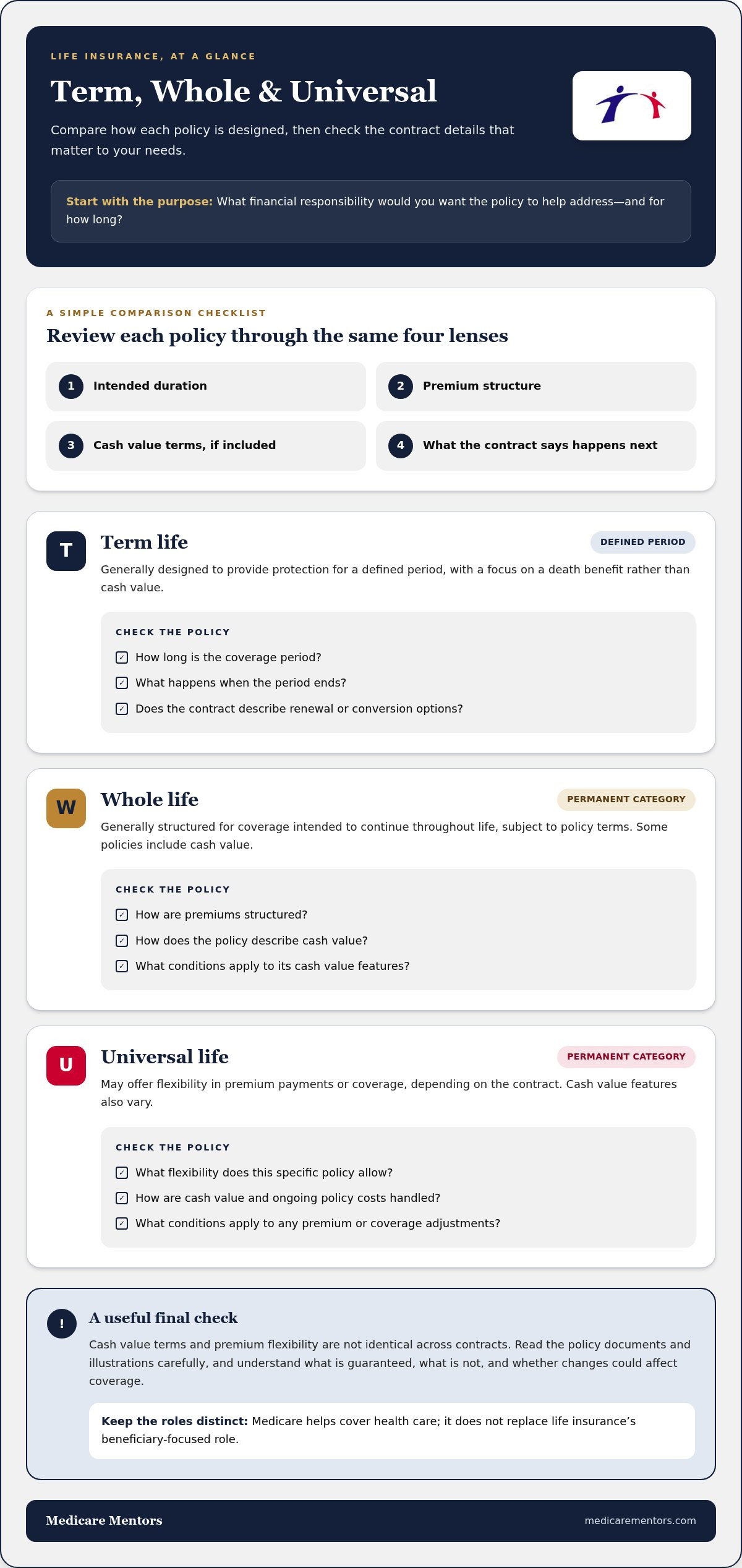
These policy categories differ mainly in how long coverage is designed to last and how premiums and any cash value are handled. The labels are a starting point, not a complete description of a specific contract. Compare the policy documents and connect the intended duration to the financial responsibility you want coverage to address.
| Policy type | Intended duration and broad structure | Questions to review |
|---|---|---|
| Term | Generally designed to provide protection for a defined period. It typically focuses on a death benefit rather than cash value. | How long is the coverage period? What happens when it ends? Are renewal or conversion options described in the contract? |
| Whole life | A permanent policy category, generally structured for coverage intended to continue throughout life, subject to policy terms. Some policies include cash value. | How are premiums structured? How does the policy describe cash value, and what conditions apply? |
| Universal life | A permanent policy category that may offer flexibility in premium payments or coverage, depending on the contract. Cash value features also vary. | What flexibility does this policy allow? How are cash value and ongoing policy costs handled? |
Cash value is an amount associated with some permanent policies, but its features and treatment aren’t identical across contracts. Don’t assume that a policy’s cash value will grow in a particular way or that you can use it without affecting coverage. The NAIC Consumer Guide to Life Insurance offers additional consumer-focused information to support your review.
How term life differs from permanent life insurance
Term coverage is designed around a stated period. That structure may suit a responsibility with a foreseeable endpoint, such as providing protection while a household depends on your income. Permanent categories are generally designed for longer-lasting coverage, but the contract’s provisions still matter. Match the duration to the purpose, then review what the policy says happens as the coverage period progresses or ends.
How whole life and universal life differ
Both are permanent policy categories, but their designs can differ. Whole life is commonly structured with a set premium pattern, while some universal policies allow adjustments under stated conditions. Any cash value terms, premium flexibility, and possible effects of changes depend on the individual contract. Read the policy illustrations and documents carefully, and make sure you understand what is guaranteed and what is not.
A useful comparison is to write down the protection purpose, intended duration, premium structure, and any cash value terms for each option. Medicare Mentors is an independent brokerage offering term, whole, and universal life insurance. If you’d like help understanding how these categories compare, you can explore life insurance guidance with Medicare Mentors.
Does Medicare Replace Life Insurance in Retirement?
No. As explained earlier, Medicare and life insurance have different roles. Reaching Medicare eligibility doesn’t by itself answer whether keeping a life policy makes sense. Retirement is a useful time to review how your household finances have changed and whether your existing coverage still fits.
What Medicare and life insurance are designed to address
Keep the distinction in mind as you make retirement decisions: Medicare relates to your health coverage, while life insurance is intended to support named beneficiaries under the policy’s terms. One doesn’t automatically take the place of the other. Treat them as separate parts of your planning, even if you’re reviewing both around the same time.
This can help prevent a common planning mix-up. A change in health coverage may affect your medical expenses, but it doesn’t settle what financial support you want to leave for someone else. Consider those questions separately, then look at how each decision fits your broader retirement budget.
How retirement can change the protection question
Retirement can change the way money flows through a household. A regular paycheck may stop, shared expenses may shift, or one partner may rely more heavily on the other’s retirement income. If you’re continuing to work past 65, leaving that job later may also affect coverage connected to employment. The details of your current policy can help clarify what choices you have during a transition.
As you review your situation, ask:
- Has the reason for your coverage changed? A policy bought during your working years may have been intended to address a need that has since changed.
- How would a change affect your household budget? Compare ongoing policy premiums with your current retirement income and other expenses.
- Is any coverage connected to your job? Read the plan materials before leaving work so you understand what happens to that coverage and when.
- Do the existing terms still fit? Review the policy’s duration, payment requirements, and provisions before deciding whether to keep or change it.
These questions don’t point every retiree toward the same choice. You may decide the original purpose still matters, or that your financial picture has changed enough to reassess it. If a policy is linked to employment, avoid assuming it will continue unchanged when you retire. Its documents explain the applicable terms and options.
Use retirement as a prompt to review, not as a reason to automatically buy, keep, or cancel coverage. A decision grounded in your current circumstances and the specific policy can help you move forward thoughtfully.
How to Decide What Life Insurance Fits Your Needs
A useful comparison starts with your circumstances, not a policy label or a coverage estimate pulled from a generic formula. Before looking at individual policies, work through these steps. They’ll help you define what protection should do and identify the details you need to compare.
- Identify who may rely on you. Think about a partner, children, or other loved ones who depend on your income or practical support. Consider whether that reliance is likely to change, such as when children become financially independent or you move into retirement.
- List the responsibilities you want to address. Note ongoing household expenses, debts, or other commitments that could affect the people you care about. The goal isn’t to assume every obligation needs insurance. It’s to decide which ones matter to your protection plan.
- Gather your existing coverage. Review personal policies alongside any coverage connected to your employer. Look at the amount, duration, premium structure, named beneficiaries, and other terms. This gives you a clearer picture of what’s already in place before you consider a change.
- Check what happens if circumstances change. If you leave a job, reduce your hours, or retire, don’t assume employer coverage will continue or can be transferred to an individual policy. The policy documents describe whether coverage can continue, what conditions apply, and what options are available. Read the actual terms rather than relying on the policy name or a general description.
- Compare policies against your purpose. For each option, write down what it’s designed to address, how long coverage is intended to last, how premiums are structured, and which conditions may affect the benefit. Compare like with like. A lower premium alone doesn’t tell you whether a policy fits the protection purpose you identified.
Review responsibilities and existing coverage
Keep a simple inventory: who you want to protect, which financial responsibilities you want to account for, and what coverage you already have. If you have both workplace and personal policies, review them together so you can see where their terms differ. Pay attention to provisions about continuation or portability, meaning whether coverage can follow you after leaving an employer. The contract, not an assumption, explains what applies.
Compare policy details before making a decision
Policy language can make two options that sound similar work differently. If a term is unclear, mark it and get an explanation before deciding. Ask how a change in premiums, coverage duration, or other contract conditions could affect your plan. Also distinguish between features the policy guarantees and those that depend on conditions or future performance.
A sound choice starts with your needs, then checks whether the policy terms match them. You don’t need to settle every question before comparing options. A written list of priorities and policy questions can make a conversation more focused. Medicare Mentors is an independent brokerage, and an education-first discussion can help you review options without centering the conversation on a single insurer. Talk through your life insurance needs with Medicare Mentors.
Explore Life Insurance Guidance with Medicare Mentors
Once you’ve identified who you want to protect and what responsibilities matter, the next step is understanding which policy options may fit those priorities. Medicare Mentors is an independent insurance brokerage based in Raleigh, North Carolina, offering term, whole, and universal life insurance. The guidance is education-first and personalized, so you can talk through your questions before deciding what, if anything, you want to pursue.
What independent guidance can add
Medicare Mentors isn’t tied to a single insurance carrier. That independent perspective can help you compare options from multiple companies and understand how policy designs differ, rather than focusing on one carrier’s products. It doesn’t mean every policy will be available or suitable for every person. Terms, eligibility, benefits, and costs depend on the specific policy and individual circumstances.
A useful conversation starts with your priorities. You might bring notes about existing coverage, who depends on you, and which financial responsibilities you want to account for. From there, questions can be organized around coverage purpose, intended duration, premium structure, and policy terms. If a phrase in a policy document is unclear, ask for a plain-language explanation before moving ahead. The aim is to help you understand the choices, not to promise a particular outcome.
That can be especially helpful during a transition, such as retirement or a change in work coverage, when older assumptions may no longer fit. You can focus the discussion on what has changed and what you still want to protect. A no-cost, no-obligation consultation gives you room to explore the available options without committing to a policy.
Choose a convenient way to start a conversation
You can connect by phone, video, or in person, whichever works best for you. Beforehand, it may help to gather your current policy documents and write down the questions you most want answered. You don’t need to know which policy type you want before starting. A few clear priorities are enough to begin an informed discussion.
Medicare Mentors serves people across North Carolina and in many other states, bringing Raleigh roots to conversations with clients in a wider area. If you’re ready to explore your options, start a free, no-obligation conversation at your own pace. The next step is simply learning how the choices relate to your needs, with no pressure to select a particular policy.
Take Your Next Step at Your Own Pace
Your needs may shift as work, family responsibilities, and retirement plans change. Before taking action, gather your current policy documents and jot down what you want your Life Insurance to do now. That gives you a practical starting point and helps keep the conversation focused on your priorities.
You don’t need to have every answer or choose a policy type before exploring your options. Start with the questions that matter most to you, and take time to understand the details before deciding what feels right.
Explore life insurance guidance with Medicare Mentors and take your next step at your own pace. A thoughtful review can help you move forward with greater confidence.
Frequently Asked Questions
Can I keep employer-provided life insurance after leaving a job?
Possibly, depending on your employer’s plan. Before your final day, request a written summary of any continuation or conversion options, the deadline to act, and how premiums would be billed. Ask whether a new application or health information is required. Keep the response with your benefits records, and avoid ending other coverage until you understand when any replacement policy would take effect.
Does having Medicare affect whether I can apply for life insurance?
Having Medicare doesn’t automatically determine whether an insurer will approve an application. The insurer considers the application under the requirements for the specific policy. If you apply, answer the questions accurately and have relevant health information ready if requested. Before accepting an offer, review its terms, costs, and effective date, and consider how they fit with any coverage you already have.
Can I change the beneficiary on a life insurance policy?
Often, the policy owner can request a beneficiary change, but the contract and designation determine the process. Some designations may include conditions that affect whether a change can be made without another person’s consent. Check the insurer’s instructions for the required form, complete each requested detail, and keep a copy. Follow up to verify the insurer has recorded the change as intended.
What happens if I miss a life insurance premium payment?
A missed payment may not end coverage immediately, so check the policy and any notice from the insurer promptly. North Carolina life insurance policies must provide at least a 30-day grace period for late premium payments. Use the insurer’s stated payment instructions and confirm that the payment has been received. If coverage has lapsed, ask the insurer what options the contract allows.
Can someone have more than one life insurance policy?
Yes. You might have a personal policy alongside coverage through work, for example. Keep a list of each policy, its owner, beneficiaries, premium due dates, and insurer contact details. This makes it easier for you or a trusted family member to locate the records and understand what coverage is in force. Each policy has its own terms, so review them individually.
Does life insurance cover long-term care expenses?
Not automatically. Some policies may offer an optional feature or design that can provide access to benefits for care while the insured person is living, but availability and conditions depend on the contract. Check whether the policy addresses long-term care, what triggers a benefit, and how using it could affect the amount payable to beneficiaries. Don’t assume a standard death benefit pays for care expenses.