
Blog
Medicare Advantage vs. Medigap in 2026: Which Path Is Right for You?
By Medicare Mentors ·

That "zero-premium" Medicare plan you see on television might actually become your most expensive health decision if you face a sudden illness. When weighing medicare advantage vs medigap for 2026, the right choice isn't just about finding the lowest monthly bill. It's about matching your coverage to your actual lifestyle and health needs. We know it's confusing to hear about "free" plans while your neighbor pays a monthly premium for a supplement, and the fear of losing access to your trusted specialists at Duke or UNC is a heavy burden to carry.
We're here to help you clear the fog and act as your advocate in this process. You deserve a plan that works whether you're at home in North Carolina or traveling out of state to visit family. In this article, we'll help you discover the critical differences between these two paths so you can choose the most cost-effective and reliable coverage for your future. We'll preview the "pay-as-you-go" versus "budget-in-advance" models, explain the new $2,000 out-of-pocket prescription drug cap, and show you how to ensure your favorite doctors remain in your circle of care.
Key Takeaways
- Learn why you must choose between a private replacement plan or a supplemental policy, as federal law prevents you from carrying both at once.
- Understand the financial trade-offs of medicare advantage vs medigap, comparing low monthly premiums with potential out-of-pocket costs during a health crisis.
- Discover how to verify if your preferred specialists at major North Carolina health systems are covered before you commit to a specific network.
- Identify which path offers nationwide freedom to see any doctor who accepts Medicare, providing peace of mind for those who travel or move.
- Get a step-by-step framework for analyzing your current medications and budget to ensure your 2026 coverage remains cost-effective all year long.
Medicare Advantage vs. Medigap: Understanding the Two Paths
Original Medicare (Parts A and B) serves as the foundation for your health coverage. It provides your hospital and medical insurance, but it was never designed to cover everything. For most services, you're responsible for a 20% coinsurance that has no annual limit. This financial exposure is why most people choose a secondary plan. When you look at medicare advantage vs medigap for 2026, you're essentially choosing between two different ways to manage that 20% gap. It's important to understand that you cannot legally have both plans at the same time; you must pick the path that best fits your budget and health needs.
We often describe this choice using a simple financial metaphor. Medicare Advantage is a "Pay-as-You-Go" model. You pay very little each month, but you pay a small amount every time you visit a doctor or specialist. Medigap is a "Pre-Paid" model. You pay a higher premium every month, but your medical bills are largely covered before you ever walk into the clinic. One plan prioritizes monthly cash flow, while the other prioritizes total financial predictability during a health crisis.
To better understand this concept, watch this helpful video:
The Medicare Advantage Path (Part C)
Medicare Advantage plans are offered by private insurance companies that take over the role of Medicare. When you join one of these plans, the private insurer manages your care and pays your claims. Most of these plans include Part D prescription drug coverage right in the bundle. Because the federal government pays these companies a set fee to manage your health, they can often offer plans with $0 or very low monthly premiums. It's a convenient, all-in-one option, but it requires you to stay within a specific network of doctors and hospitals to keep your costs low.
The Medicare Supplement Path (Medigap)
A Medigap (Medicare Supplement) policy works alongside Original Medicare rather than replacing it. You keep your red, white, and blue Medicare card, and Medicare remains your primary payer. The Medigap plan sits "on top" of Medicare to pay the deductibles and the 20% coinsurance that you would otherwise owe. This path is ideal if you value freedom of choice, as you can see any provider in the nation who accepts Medicare. Since these plans don't include prescriptions, you'll pair this policy with a separate Part D plan as part of your medicare planning to ensure full coverage.
Medicare Advantage (Part C): Benefits, Networks, and Costs
Medicare Advantage plans are popular because they bundle several services into a single package. For many, the appeal of a $0 or low monthly premium is hard to ignore. The average premium for these plans is projected to be $14.00 in 2026. This makes them a strong choice for healthy retirees who want to keep their monthly overhead low. However, when comparing medicare advantage vs medigap, it's vital to look past the monthly bill. You're trading that low premium for co-pays that apply every time you see a specialist or undergo a procedure.
To protect you from unlimited costs, these plans include a mandatory out-of-pocket maximum. In 2026, this limit can be as high as $9,250 for in-network services. Once you hit this number, the plan pays 100% of your covered medical expenses for the rest of the year. This is your financial safety net. Many plans also include "extra" benefits that Original Medicare doesn't cover. These often include dental, vision, and hearing coverage; fitness memberships or Silver Sneakers programs; and even over-the-counter pharmacy allowances.
HMO vs. PPO: Managing Your Doctor Choice
The network you choose dictates how you access care. Health Maintenance Organizations (HMOs) usually require you to choose a primary care doctor who acts as a "gatekeeper" for referrals. Preferred Provider Organizations (PPOs) offer more flexibility. You can see specialists without a referral and even go out-of-network, though you'll pay more for doing so. In North Carolina, network availability varies significantly. A plan that includes WakeMed in Raleigh might not provide the same access to Charlotte-area systems. We can help you verify your specific doctor networks to avoid surprises during a health crisis.
The Role of Part D in Medicare Advantage
Most Advantage plans include prescription drug coverage. This convenience means you only carry one insurance card. A major change for 2026 is the new $2,000 out-of-pocket cap on prescription drugs. This federal regulation ensures that even if you take expensive medications, your pharmacy costs won't spiral out of control. If a plan's drug list, or "formulary," doesn't include your specific prescriptions, you might face higher costs. You can find more details about how these rules vary on the official Medicare website.
If you're feeling overwhelmed by these network choices, our team at Medicare Mentors can look up your specific providers to see which plans they accept.
Medicare Supplement (Medigap): Predictability and Freedom
If you value the ability to see any specialist in the country without asking for permission, Medigap is likely your best fit. Unlike the network-restricted models we discussed earlier, a Medicare Supplement plan offers the "Any Doctor" advantage. If a provider accepts Medicare, they accept your Medigap policy. This nationwide freedom is a major relief for retirees who spend their winters in warmer climates or those who want access to the best specialists at clinics like the Mayo Clinic or Johns Hopkins. You'll never need a referral to see a cardiologist or a physical therapist, which removes a significant layer of stress from your healthcare experience.
Financial predictability is the other pillar of this choice. When comparing medicare advantage vs medigap, the supplement path is often the preferred choice for those managing chronic health conditions. While your monthly premium is higher than an Advantage plan, your out-of-pocket medical costs are almost entirely eliminated. You won't have to worry about a surprise $300 co-pay for an MRI or a daily charge for a hospital stay. For many of our clients, knowing exactly what their medical budget is each month provides a sense of security that is worth the higher premium.
Standardized Plans: Comparing Plan G and Plan N
Medigap plans are standardized by the federal government, which means the basic benefits for a specific plan letter are identical regardless of which insurance company you choose. Plan G has become the "Gold Standard" for new enrollees in 2026. Once you pay your annual Part B deductible, which is $283 this year, Plan G covers 100% of your remaining Medicare-approved medical bills. Plan N is a popular alternative that offers lower monthly premiums. In exchange for those savings, you'll pay small co-pays of up to $20 for some doctor visits and up to $50 for emergency room visits.
Building a Complete Package with Medigap
One common misconception is that Medigap plans include the same "extra" perks found in Advantage plans. They don't. Because Medigap is designed to stay strictly within the lines of Original Medicare, you must build your own comprehensive package. This means you'll need to select a separate Medicare Part D plan to cover your prescriptions. To ensure your teeth, eyes, and ears are protected, we also recommend adding standalone dental, vision, and hearing insurance.
The timing of your application is also critical. Your Medigap Open Enrollment Period is a one-time, six-month window that starts when you're 65 and enrolled in Part B. During this time, insurance companies can't use medical underwriting to deny you coverage or charge you more for pre-existing conditions. We can help you compare the rates of different carriers to ensure you're getting the best value for these standardized benefits.
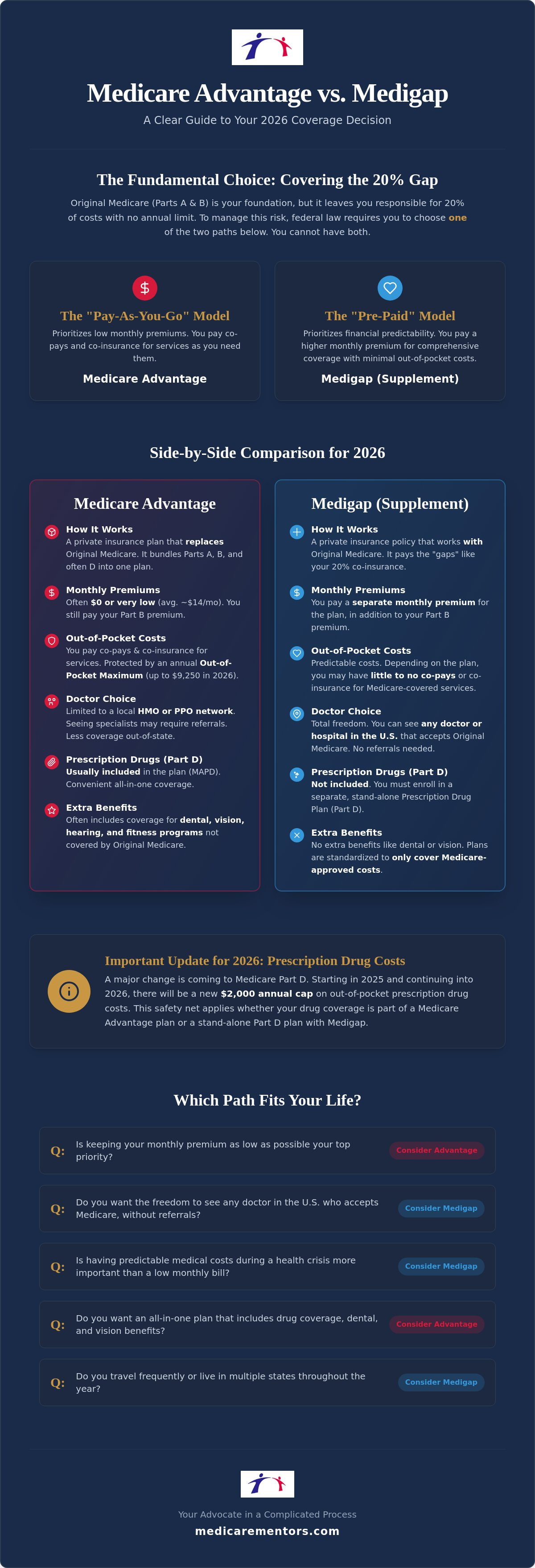
Key Differences: A Side-by-Side Comparison for 2026
Choosing between medicare advantage vs medigap is often a decision between lower monthly costs and broader access to care. To help you visualize these paths, we've broken down the most significant differences you'll encounter in 2026. Understanding these variations helps you avoid the "zero-premium" trap that can lead to high costs later.
- Monthly Premiums: Advantage plans average around $14.00 per month, while Medigap plans typically range from $100 to over $300 depending on your age and location.
- Provider Choice: Advantage plans use local networks, while Medigap allows you to see any doctor in the country who accepts Medicare.
- Out-of-Pocket Costs: You'll pay co-pays for most services on an Advantage plan. With a Plan G Medigap policy, your medical bills are largely covered after a small annual deductible.
- Referrals: Many Advantage plans require a primary doctor's permission to see a specialist. Medigap never requires referrals.
- Extra Benefits: Advantage plans bundle dental and vision, whereas Medigap users typically purchase separate policies for these needs.
Travel and Geographic Flexibility
Your lifestyle plays a huge role in which plan feels right. Medigap is the clear winner for "snowbirds" or those who travel frequently across the United States. Because it isn't tied to a local network, your coverage travels with you from the mountains of North Carolina to the coast of Florida. In contrast, most Advantage plans only cover emergencies once you leave their service area. If you move to a different county within North Carolina, you may even be required to switch plans because your network of doctors might change entirely. In our state, this choice is particularly important because hospital systems like Duke and UNC often have different contract agreements with private Advantage plans. If you're planning a move soon, let us help you check the networks in your new zip code.
Financial Risk Assessment
We always encourage our clients to consider a "bad health year" scenario. On an Advantage plan, a major surgery or a series of specialist visits could lead you toward the Maximum Out-of-Pocket limit, which can be as high as $9,250 in 2026. This limit acts as your ultimate safety net, but it's a significant amount to pay in a single year. For Plan G users in 2026, the annual Part B deductible of $283 is the only major out-of-pocket cost you'll face for Medicare-approved medical services. This contrast makes Medigap a favorite for those who want to eliminate the anxiety of unexpected medical bills during a health crisis.
If you want a personalized cost comparison based on your specific health history, you can contact our team at Medicare Mentors for a no-pressure consultation.
How to Decide: Choosing Your Path with Medicare Mentors
The choice between medicare advantage vs medigap isn't just a financial calculation. It's a deeply personal decision that affects your daily life and your long-term security. We believe that the best way to choose is to look at your unique health puzzle. This starts by analyzing your current health status and making a detailed list of your medications. We want to ensure that the plan you choose actually covers the things you need most, from your specific prescriptions to the specialists you trust in Raleigh or Durham.
Online calculators often miss the nuances of local network shifts, especially with hospital systems in North Carolina. An independent Medicare broker provides the human element, verifying if your specific specialists at Duke or UNC are truly covered for the coming year. We are here to teach you the differences so you can make an informed choice.
Trigger Events: When to Re-Evaluate Your Choice
Significant life transitions often serve as the catalyst for these decisions. If you're turning 65, you're entering your Initial Enrollment Period, which is your best window to secure coverage without health questions. Many of our clients are also retiring past 65 and losing employer-provided coverage, which triggers a Special Enrollment Period. We also specialize in helping those relocating to North Carolina from another state. Since Medicare Advantage networks are tied to specific counties, moving to our area usually requires a fresh look at your options to ensure you don't lose access to care.
Next Steps for a Stress-Free Enrollment
You can move forward with confidence by following a methodical, patient process. We recommend starting with a personalized Medicare planning session to map out your specific needs. Our team compares every carrier in North Carolina to find the one that fits your budget and covers your doctors. Our promise is to provide the education first and the enrollment second. We look forward to helping you build a plan that provides both medical security and peace of mind.
Secure Your Health and Peace of Mind for 2026
Choosing your path doesn't have to be a source of anxiety. You now understand that Medicare Advantage offers an all-in-one approach with low monthly costs, while Medigap provides the freedom to see any doctor and the comfort of predictable bills. We believe the right plan is the one that lets you sleep soundly, knowing your specialists at Duke or UNC are within reach and your budget is protected. Deciding between medicare advantage vs medigap is a significant milestone, but you don't have to navigate it alone.
Since 2011, Dave and Michele Johnson have acted as protective allies for North Carolina residents. We use a teacher-student approach to ensure you're never pressured, only educated. As an independent brokerage, we don't work for the insurance companies; we work for you. We'll help you verify your networks and compare every 2026 option available in our state so your coverage remains reliable as you age.
Schedule your no-cost Medicare planning session with Dave and Michele today. We look forward to helping you move into this next chapter with total confidence and clarity.
Frequently Asked Questions
Is Medigap better than Medicare Advantage?
Neither path is objectively better; the right choice depends entirely on your personal health needs and financial goals. Medigap is often superior for those who want nationwide doctor choice and predictable monthly costs without the worry of co-pays. Medicare Advantage is frequently the preferred choice for healthy individuals who prioritize low monthly premiums and enjoy bundled extras like fitness memberships and dental allowances.
Can I switch from Medicare Advantage back to Medigap later?
You can switch, but you will likely need to answer health questions through a process called medical underwriting. Outside of your initial enrollment window or specific "trial right" periods, insurance companies can deny you a Medigap policy based on your health history. This is a critical risk to consider when choosing medicare advantage vs medigap because you might not be able to return to a supplement plan if your health declines later.
Do I still pay my Medicare Part B premium if I have an Advantage plan?
Yes, you must continue paying your monthly Part B premium to the federal government even if you join a Medicare Advantage plan. The standard Part B premium for 2026 is $202.90 per month. Some Advantage plans offer a "Part B buy-back" or "reduction" benefit where they pay a portion of this cost for you; however, for most people, this remains a standard monthly expense regardless of their plan choice.
Does Medicare Advantage cover dental and vision?
Most Medicare Advantage plans include basic coverage for dental, vision, and hearing services as part of their bundled benefits. These often cover routine cleanings, eye exams, and a set allowance for glasses or hearing aids. However, the depth of this coverage varies significantly between carriers. If you need extensive dental work like crowns or implants, we often suggest looking into a standalone dental policy to ensure your needs are fully met.
Which plan is better if I have a lot of prescriptions?
Both paths now offer significant protection thanks to the new $2,000 out-of-pocket cap on prescription drugs for 2026. Medicare Advantage plans bundle this coverage into one card, while Medigap requires a separate Part D plan. The better plan is the one that includes your specific medications on its list of covered drugs at the lowest cost. We can run a customized report to see which option keeps your pharmacy costs lowest.
What happens to my coverage if I move to another part of North Carolina?
Your Medigap policy will move with you anywhere in the state or country without any changes to your benefits. However, Medicare Advantage plans are tied to specific service areas, usually defined by your county. If you move from Raleigh to a different part of North Carolina, your current Advantage network may no longer be available. This move would trigger a Special Enrollment Period, allowing you to choose a new plan for your new home.
Is Plan G the same as Medicare Advantage?
Plan G is a standardized Medigap policy and is not the same as a Medicare Advantage plan. While an Advantage plan replaces your Original Medicare and uses a private network, Plan G works alongside your red, white, and blue Medicare card. It covers nearly all of your out-of-pocket medical costs after you meet the annual Part B deductible. It's the most popular choice for those who want freedom from network restrictions.
How much does a Medicare broker charge for helping me choose?
You do not pay a fee for our services at Medicare Mentors. Independent brokers are compensated by the insurance companies when they help you enroll in a plan. This means you receive personalized education, network checks for doctors at Duke or UNC, and ongoing support at no cost to you. Because we are independent and represent many different carriers, our loyalty remains with you rather than a specific insurance company.