
The Medicare plan with the lowest monthly premium may not be the best fit for your doctors, prescriptions, or budget. Start by understanding your coverage options, then compare how each one fits your needs.
If terms like Original Medicare, Medicare Advantage, Medigap, and Part D feel like a jumble, you’re not alone. Retirement, a move to North Carolina, a change in doctors, or higher prescription costs can all prompt a closer look at your coverage.
This guide explains the main parts of Medicare and how common coverage paths fit together. You’ll learn what to compare, including provider networks, prescription coverage, and costs, and what information to gather before reviewing plans. Whether you live in Raleigh, Durham, Chapel Hill, Greensboro, Fayetteville, Wilmington, Charlotte, Winston-Salem, High Point, or Greenville, check plan availability and provider participation for your county. Options can vary from one county to another.
Medicare Mentors offers independent, education-first guidance if you have questions along the way. The aim is to make Medicare easier to understand, so you can review your options without pressure and move forward with more confidence.
Key Takeaways
- Learn how Medicare Parts A and B form Original Medicare, and how other coverage choices may fit alongside it or provide another way to receive coverage.
- Compare plan options against the doctors, hospitals, prescriptions, travel, and care arrangements that matter to you.
- If you’re turning 65, retiring, moving, or changing doctors, gather your coverage details and check your next steps before making a change.
- Confirm provider participation and plan availability for your county, since options can differ around Raleigh and Durham.
- A one-on-one conversation with an independent guide can help you organize your questions and understand available choices without pressure.
What Is Medicare? Understand the Four Parts Before Choosing Coverage
Medicare is federal health insurance mainly for people age 65 and older, along with some people who qualify earlier. Its four parts describe different kinds of coverage, and they don’t all work the same way. Understanding each part can help you see which options belong together and what to check next.
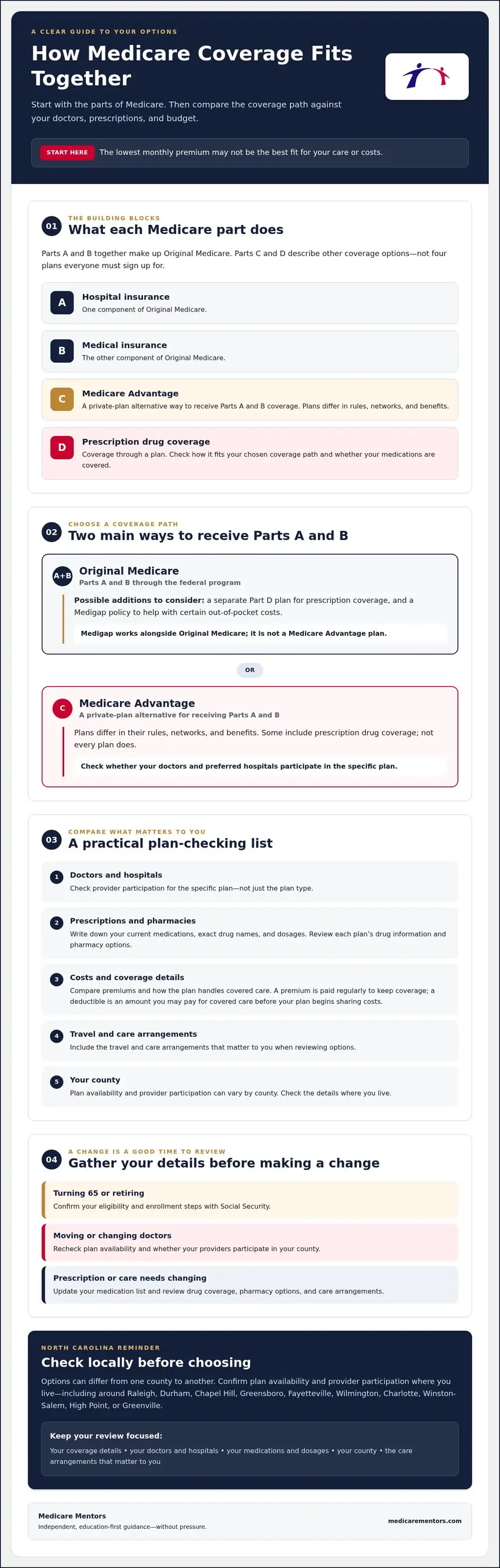
Think of the parts as building blocks, not four plans you must sign up for. Parts A and B make up Original Medicare. Part C, called Medicare Advantage, is another way to receive Medicare coverage through a private plan. Part D helps cover prescription drugs. A comprehensive overview of Medicare offers more background on the program’s history and structure.
What do Medicare Parts A, B, C, and D cover?
Here’s the short version. A “premium” is an amount paid regularly to keep coverage. A “deductible” is an amount you may need to pay for covered care before your plan begins sharing costs. The details depend on the coverage you choose, so use this table as a starting point, not a complete list of benefits.
| Part | Broad role | Where to learn more |
|---|---|---|
| A | Hospital insurance; one component of Original Medicare. | Review Original Medicare coverage. |
| B | Medical insurance; the other component of Original Medicare. | Review Original Medicare coverage. |
| C | Medicare Advantage, an alternative way to receive Parts A and B coverage through a private plan. | Compare Medicare coverage paths. |
| D | Prescription drug coverage through a plan. | Check how drug coverage fits your path. |
How Part D fits depends on the coverage path and plan you select. Some Medicare Advantage plans include drug coverage. With Original Medicare, you may add prescription coverage through a separate Part D plan. Check the details of the specific plan instead of assuming your prescriptions are covered.
Who may qualify for Medicare?
Eligibility commonly begins around age 65, but some people qualify earlier. Your work history, circumstances, and enrollment situation can affect what applies to you. If you’re approaching 65, still working, or planning to retire, confirm your eligibility and enrollment steps with Social Security. For help understanding how coverage options fit together, explore Medicare planning guidance.
How Medicare Coverage Paths Fit Together
Once you understand the four parts, consider how they fit into a coverage path. The main choice is whether to receive Parts A and B through Original Medicare or through a Medicare Advantage plan. If you choose Original Medicare, you may also consider a Medigap policy and prescription drug coverage. These are separate pieces, each with plan details to review.
Original Medicare, Medicare Advantage, and Medigap: how the pieces differ
Original Medicare means Parts A and B, provided through the federal program. You can consider a separate Medigap policy to help with certain out-of-pocket costs. Medigap works alongside Original Medicare, not as a Medicare Advantage plan.
Medicare Advantage, also called Part C, is offered by private insurers as another way to receive Part A and Part B coverage. Plans differ in their rules, networks, and benefits, and some include prescription drug coverage. Check whether your doctors and preferred hospitals participate in the specific plan you’re considering. For a closer look at how this path works, read our Medicare Advantage guide. If you’re considering Medigap, our Medicare Supplement Insurance guide explains how it fits with Original Medicare.
Where does prescription drug coverage fit?
Prescription coverage needs its own review, whichever path you’re considering. With Original Medicare, you can look at a separate Part D plan. A Medicare Advantage plan may include drug coverage, but not every plan does. Check the plan rather than assuming your medications are covered because it offers prescription benefits.
Before comparing plans, make a current list of your prescriptions, including exact drug names and dosages. Review each plan’s drug information and pharmacy options, since coverage can vary. The Medicare Part D guide can help you understand what to review.
For official information about getting started and enrollment steps, visit Medicare.gov’s guide to getting started. If you’d like help organizing questions about your doctors, prescriptions, and coverage path, Medicare Mentors offers Medicare planning guidance at no cost to the client.
How to Compare Medicare Choices Around Your Care Needs
A useful comparison starts with your everyday care, not a plan’s headline benefits. List the doctors you want to keep, the prescriptions you take, and how you prefer to get care. Many families also evaluate daily living assistance and memory support alongside medical insurance; to see how dedicated senior care services operate, learn more about Earth Angels Home Care. Then compare each option against those priorities. Plan rules, provider participation, and availability can change, so confirm details for the specific plan and county you’re considering in North Carolina.
Which doctors, hospitals, and pharmacies matter to you?
Write down your primary care provider, specialists, preferred hospitals, and pharmacies before comparing plans. For each plan, verify participation with both the provider and the plan. Ask about the specific location you use, since participation can depend on the plan and location. Don’t assume a plan available in one North Carolina county is also available in another.
| What matters to you | What to check |
|---|---|
| Doctors and specialists | Are your current providers included in the plan, and at the locations you visit? |
| Hospitals | Can you use your preferred hospital under the plan’s rules? |
| Prescriptions and pharmacies | Are your medications covered, and are your preferred pharmacies included? |
| Travel | How does the plan handle care when you’re away from home? |
| Care arrangements | Do the plan’s rules fit how you prefer to access care and see specialists? |
Check both the plan’s provider directory and the provider’s office. Directories can change, so ask whether the provider currently accepts the exact plan you’re reviewing. For local, independent counseling, the North Carolina Department of Insurance offers North Carolina Medicare guidance through SHIIP.
How should prescriptions and future needs affect your choice?
Gather your medication names, dosages, and preferred pharmacies. Review each plan’s drug information, including whether your prescriptions are covered and what rules may apply. Check the plan’s current information for your specific medications rather than guessing at your personal drug costs. A change in prescriptions, doctors, or care preferences is a good reason to revisit the details.
Read the plan documents for coverage rules and your share of costs, such as copayments or deductibles. Consider your expected needs and preferred access to care without trying to predict future health. If you’d like help organizing your questions, Medicare Mentors offers one-on-one plan guidance at no cost to the client. Learn more through Medicare plan guidance.
When to Review Medicare: Turning 65, Retiring, Moving, or Changing Needs
A change in work, address, doctors, or prescriptions is a good reason to check whether your current coverage still fits. It doesn’t automatically mean you need to switch plans. First identify what changed, find out which choices apply to you, and check whether an enrollment period affects your next step.
What should you do when work or location changes?
If you’re approaching 65, retiring soon, or continuing to work past 65, review how your workplace coverage fits with your Medicare decisions. Losing employer coverage calls for a timely, personal review. Timing and options can differ, so confirm your circumstances with Social Security or Medicare before making a change.
Moving to North Carolina is another reason to check your coverage. Plan availability and provider participation can vary by county, so confirm whether your plan and doctors are available where you’ll live. A doctor or hospital leaving a plan’s network, or a rise in prescription costs, can also prompt a fresh review.
What belongs on a coverage review checklist?
Use this five-step checklist to keep the process manageable:
- Identify the change. Note whether you’re turning 65, retiring, losing work coverage, moving, or responding to changes in doctors, networks, or prescriptions.
- Gather your records. Collect current plan information, provider names, prescription names and dosages, preferred pharmacies, and questions about upcoming care.
- Check timing. Annual Enrollment runs from October 15 through December 7 each year. It’s a yearly opportunity for people with Medicare to review coverage and make certain plan changes, which generally take effect January 1 of the following year. Check official Medicare or Social Security information to confirm current dates and which enrollment rules apply to you.
- Compare choices. Review plan rules, provider participation, prescription coverage, and your share of costs against your needs.
- Confirm before acting. Check important details with the plan and your providers, then make sure you understand what will change and when.
For more detail, read the 2026 Medicare enrollment guide. If you’d like help sorting through a work or coverage change, talk with Medicare Mentors about your options.
Get Medicare Guidance That Helps You Choose With Confidence
You don’t have to sort through every plan detail alone. A one-on-one conversation can help you organize what matters, understand unfamiliar terms, and identify questions to resolve before choosing coverage. Bring your goals, doctor and hospital names, prescription list, preferred pharmacies, and concerns about upcoming care.
What can an independent broker help you understand?
Medicare Mentors is an independent brokerage, not tied to a single insurance carrier. An independent broker can explain relevant choices and compare plan information based on your needs, while confirming which options are available in your area. Independence doesn’t mean every plan is represented, so ask which carriers and plans can be reviewed and how the broker is compensated.
The conversation should help you understand trade-offs, not rush you toward a decision. Ask how a plan handles your providers and prescriptions, which rules to review, and what costs may be your responsibility. Medicare Mentors provides Medicare education, consultations, and plan guidance at no cost to the client. That doesn’t guarantee a particular plan, savings, or outcome.
What happens after you choose coverage?
Your needs and plan details can change. An annual coverage review gives you a chance to revisit your doctors, prescriptions, and plan information and consider whether your current coverage still fits. If you have billing or claims questions, ongoing support can help you understand what to check or whom to contact. It doesn’t guarantee that a question or claim will be resolved in a particular way.
Medicare Mentors highlights almost 300 Five-Star Reviews. Reviews can offer perspective on other people’s experiences, but your own needs and plan details should guide your decision.
If you’re turning 65, retiring, moving, or simply want a clearer picture of your options, take the next step at your own pace. Explore Medicare planning support to learn about one-on-one guidance and prepare questions for a conversation.
Choose Your Next Step With Confidence
The right coverage path depends on the details of your life: the doctors you want to keep, the prescriptions you take, and how you prefer to access care. Start by understanding how the coverage options fit together, then check plan information for your county and confirm provider participation directly. If you’re turning 65, retiring, moving, or facing a change in doctors or prescriptions, use that change as a prompt to review your options.
You don’t have to work through every question on your own. Medicare Mentors is a family-run independent brokerage founded by Dave and Michele Johnson. Its education, consultations, and plan guidance are provided at no cost to the client. Medicare Mentors also highlights almost 300 Five-Star Reviews. These details can help you learn more about the brokerage, while your needs and the plan information guide your choice.
There’s no need to have every answer before starting a conversation. Explore Medicare planning with a helpful, no-pressure conversation and bring the questions that matter most to you. A clearer next step is a good place to begin.
Frequently Asked Questions
What are the four parts of Medicare?
Medicare has four parts: Part A helps cover inpatient hospital care; Part B covers medical services such as doctor visits; Part C, called Medicare Advantage, offers another way to receive Part A and Part B coverage through a private plan; and Part D provides prescription drug coverage. Parts A and B together are Original Medicare. What each plan covers and what you pay can vary, so check the plan details.
Is Medicare the same as Medicare Advantage?
No. Medicare is the federal health insurance program, while Medicare Advantage is a private-plan option for receiving Part A and Part B coverage. These terms aren’t interchangeable. Medicare Advantage plans may have different provider networks, coverage rules, and extra benefits, depending on the plan. Before choosing one, check its current details, including whether your doctors and preferred hospitals participate in the plan available in your county.
Can I have Medicare Advantage and Medigap at the same time?
Medigap is designed to work with Original Medicare, not Medicare Advantage. Medicare Advantage is an alternative way to receive Part A and Part B coverage, while Medigap helps with certain costs under Original Medicare. The two aren’t meant to be paired, and Medigap generally won’t pay Medicare Advantage cost-sharing. If you’re considering a switch, ask Medicare or a knowledgeable counselor how the choice applies to your situation.
How do I know whether Original Medicare or Medicare Advantage fits my needs?
Compare the options against your doctors, hospitals, prescriptions, travel habits, and preferred way to access care. Original Medicare generally lets you see providers nationwide who accept Medicare. Medicare Advantage plans may use provider networks and have plan-specific rules. Review the current plan documents, check provider participation directly, and compare your potential costs and coverage. Availability and details can vary by county, including around Raleigh and Durham.
When should I start looking at Medicare if I am turning 65?
Start reviewing your choices before your 65th birthday so you have time to understand your options and confirm your next steps. The Initial Enrollment Period generally spans seven months: the three months before the month you turn 65, your birthday month, and the three months after. If you’ll keep working or have employer coverage, check your circumstances with Social Security before assuming which enrollment timing applies.
What happens to my Medicare choices if I move to North Carolina?
Your options may need a fresh review because plan availability and provider networks can vary by county. If you move to the Raleigh or Durham area, check whether your current plan is available where you’ll live and whether your doctors, hospitals, and pharmacies participate. Contact your plan and verify your choices through official Medicare resources. Don’t assume a move automatically gives you a particular enrollment option or deadline.
Can someone help me compare Medicare plans at no cost?
Yes. Medicare Mentors offers one-on-one consultations, plan guidance, and education at no cost to the client. The independent brokerage, founded by Dave and Michele Johnson, isn’t tied to a single insurance carrier, but it may not represent every available plan. Ask which options can be reviewed and how the broker is compensated. Medicare Mentors highlights almost 300 Five-Star Reviews, though individual experiences and plan needs differ.