Blog
Medicare Part D Costs in 2026: Your Guide to the New $2,100 Out-of-Pocket Cap
By Medicare Mentors ·

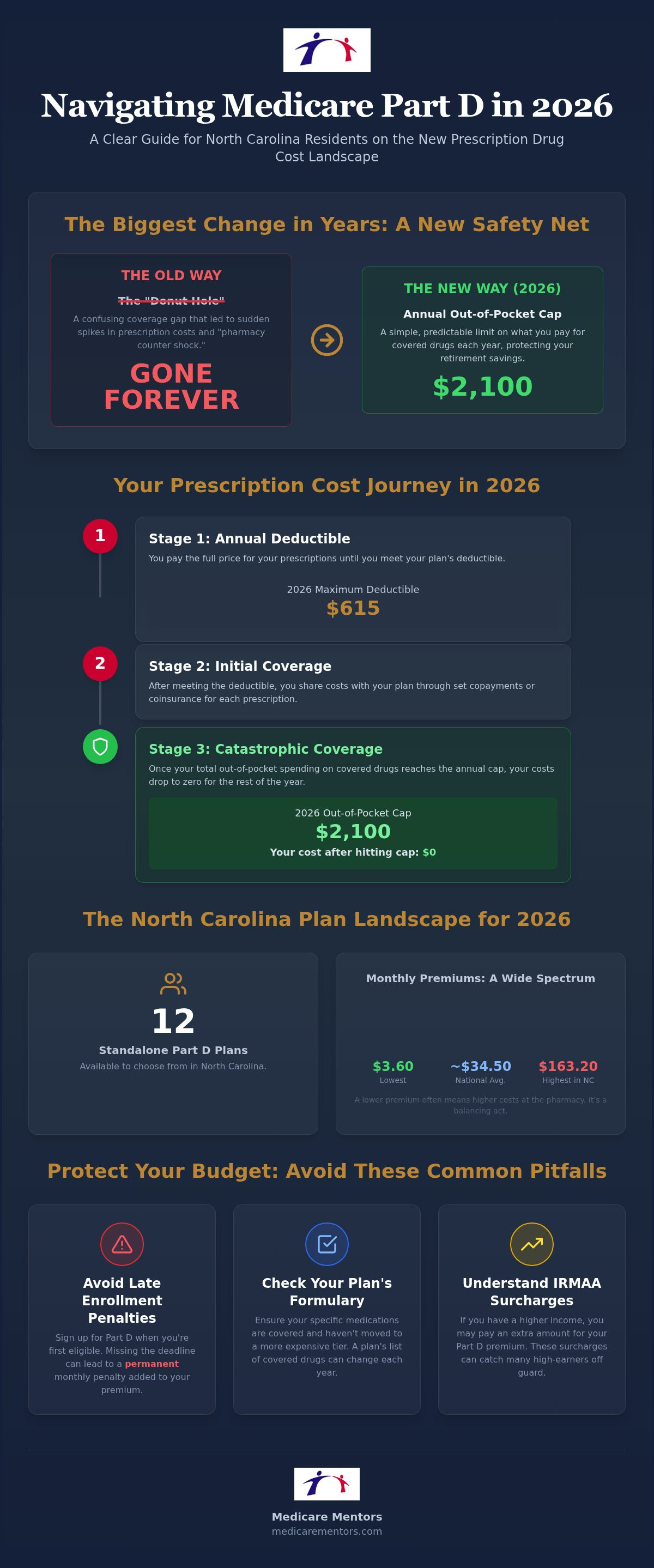
Imagine reaching a point in the year where your pharmacy bill suddenly drops to zero dollars for every covered prescription you need. In 2026, that is exactly what happens once you hit the new $2,100 out-of-pocket spending limit. It is a major shift from the old days of the "donut hole," yet many North Carolina seniors still feel a sense of dread when they think about their medicare part d costs. We understand that feeling of uncertainty. It is hard to feel confident about your retirement when specialty drug prices keep climbing and the number of plan options in our state has dropped to just 12 standalone choices.
We are here to help you turn that confusion into a clear, actionable plan. In this guide, we will show you how to navigate these new rules so you can keep more of your hard-earned money in your pocket. You will learn how to identify which of the 2026 plans covers your specific medications and how to avoid the IRMAA surcharges that catch many high-earners off guard. We will also walk through the steps to avoid permanent late enrollment penalties, ensuring your transition into this new era of Medicare is smooth, predictable, and stress-free.
Key Takeaways
- Learn how the new $2,100 out-of-pocket cap protects you from high prescription costs by eliminating the "donut hole" coverage gap forever.
- Compare the 12 standalone plans available in North Carolina to find the right balance for your medicare part d costs, whether you live in Raleigh, Charlotte, or Wilmington.
- Discover how to check your plan's formulary to ensure your specific medications haven't shifted to a more expensive tier for the 2026 plan year.
- Protect your retirement budget by avoiding permanent late enrollment penalties through timely sign-ups and verifying your creditable coverage.
- Identify local resources and assistance programs that can help you lower your prescription expenses even further if you meet certain income requirements.
Understanding Medicare Part D Costs in 2026: The New Landscape
For years, seniors have had to navigate a complex maze to estimate their medicare part d costs. 2026 represents a major turning point as the Inflation Reduction Act of 2022 reaches its full potential. We've seen many clients struggle with the "donut hole" in the past, but those days are finally ending. This year, the system moves to a much simpler model that centers around a $2,100 out-of-pocket cap. To protect your retirement savings, this cap provides a clear boundary for your spending, ensuring that a single expensive prescription won't derail your entire financial plan.
Since the creation of the Medicare Part D program, the rules have often felt like they were written in another language. Our goal is to act as your translator and advocate. This new landscape is designed to benefit those who rely on high-cost specialty drugs the most. By capping the amount you pay, the government is shifting the financial burden away from you and onto the insurance companies and drug manufacturers.
To better understand how this new structure protects your wallet, watch this helpful video:
The Three Stages of Coverage in 2026
The 2026 journey for your prescriptions now follows three distinct phases. First, you'll likely encounter the annual deductible. For 2026, the maximum deductible is $615. While some plans may offer a lower deductible, you'll generally pay the full price of your meds until this amount is met. Next is the Initial Coverage stage, where you share the cost with your plan through copays or coinsurance. Finally, you reach the Catastrophic Coverage stage. Once your out-of-pocket spending hits the $2,100 mark, your costs for covered drugs drop to zero for the rest of the year. This $2,100 cap is the absolute limit for covered drug spending in 2026.
Why the 'Donut Hole' is History
The elimination of the coverage gap is a massive win for North Carolina seniors. In the old four-stage system, you might have experienced a sudden, sharp increase in costs mid-year, often referred to as "pharmacy counter shock." By removing this stage, the new three-stage system offers a predictable path. You no longer have to worry about your costs spiking just because you've reached a certain spending level. This simplification helps you maintain a steady budget throughout the year. If you're retiring soon or moving to North Carolina, our medicare planning services can help you see exactly how these stages will apply to your current medications.
Monthly Premiums and Annual Deductibles: What to Expect in North Carolina
Living in North Carolina gives you access to a unique and competitive market, but it also means your monthly bill can vary wildly based on your zip code. While the national average premium sits around $34.50, North Carolina residents will see a much wider spectrum of choices. For 2026, the lowest monthly premium for a standalone plan in our state is just $3.60, while the highest reaches $163.20. It's a balancing act. Choosing a plan with a rock-bottom premium might feel like a win for your monthly budget, but it often leads to higher medicare part d costs when you actually visit the pharmacy counter.
According to the official 2026 Medicare costs, the maximum annual deductible is set at $615. Many people find themselves drawn to $0 deductible plans because they provide immediate coverage for every prescription. However, these plans are rare in NC this year, with only two options available. Often, the higher monthly premiums on these "no-deductible" plans end up costing you more over twelve months than if you had simply paid the deductible upfront. For a deeper look at these trade-offs, check out our guide to Medicare Part D plans in 2026.
NC Plan Availability and Pharmacy Networks
In 2026, the number of standalone Part D plans in North Carolina has decreased to 12. This consolidation means your current plan might have changed its pharmacy network. Whether you're in Raleigh, Charlotte, or Wilmington, using a "preferred" pharmacy versus a "standard" one can change your copay by $20 or more per refill. We've seen major carriers adjust their networks for 2026, so it's vital to check if your local neighborhood pharmacy in Durham or Asheville is still on the preferred list. If you're feeling overwhelmed by these changes, our team can help with personalized medicare planning to find your best local fit.
Budgeting for Your 2026 Deductible
If you choose a plan with the standard $615 deductible, you should prepare for higher costs in January and February. Once you meet that amount, your plan starts sharing the bill. Some plans offer a "tier-specific" deductible, which means you might get $0 copays on Tier 1 generics immediately, even before the main deductible is met. We strongly advise North Carolina residents to compare at least three local plans before enrolling to ensure they aren't overpaying for coverage they don't need. This simple step can save you hundreds of dollars over the course of the year.
Beyond the Basics: Copays, Tiers, and IRMAA Surcharges
While the $2,100 cap sets the finish line for your spending, the specific path you take to get there depends on drug tiers and formularies. Every insurance carrier uses a "formulary," which is essentially a list of the medications they agree to cover. These lists aren't permanent. We often see medications shift between tiers from one year to the next, which can drastically change your medicare part d costs without warning. Most plans use a 5-tier system. Tier 1 is for preferred generics with the lowest cost, while Tier 5 is reserved for high-cost specialty drugs. Understanding where your specific medications sit is the first step in avoiding surprises at the pharmacy counter.
How Drug Tiers Impact Your Journey to the $2,100 Cap
If you take a Tier 5 specialty medication, you might hit that $2,100 out-of-pocket limit in just one or two months. For others taking only Tier 1 generics, you might never reach the cap at all. It's all about the "True Out-of-Pocket" (TrOOP) calculation. This includes your deductible and your copays, but it doesn't include your monthly premiums or the cost of drugs not on your plan's formulary. If you realize you've missed a sign-up window, you may also face a Part D late enrollment penalty, which adds a permanent cost to your monthly bill. We've seen many folks in North Carolina get caught off guard by this, so checking your enrollment status early is vital.
The IRMAA Trap for Retirees
Your income can also play a major role in what you pay each month. The Income-Related Monthly Adjustment Amount, or IRMAA, is a surcharge for higher earners. For 2026, Social Security looks back at your 2024 tax return to decide if you owe an extra fee. If you're an individual earning more than $109,000 or a married couple earning over $218,000, you'll see an additional charge ranging from $14.50 up to $91.00 per month. This often feels like a heavy burden for new retirees whose income was high in 2024 but has dropped since they stopped working. You can file a "Life-Changing Event" appeal to lower these costs if you've recently retired or lost income. Using personalized Medicare planning can help you navigate these appeals and ensure your surcharges reflect your current financial reality rather than your past salary.
Avoiding Costly Mistakes: Late Enrollment Penalties and Enrollment Timing
Missing your enrollment window isn't just a paperwork headache; it's a financial decision that sticks with you forever. The late enrollment penalty is a lifetime addition to your monthly premium. We want to help you avoid this permanent hike so you can keep your retirement budget intact. If you go 63 days or more without "creditable" drug coverage after your initial window closes, you'll owe an extra 1% of the national base beneficiary premium for every month you were eligible but didn't sign up. For 2026, that base premium is $38.99. This small percentage might seem minor at first, but it compounds over years, steadily increasing your medicare part d costs for as long as you have coverage.
To help you stay on top of these critical deadlines, we've designed The Complete 2026 Medicare Enrollment Guide to walk you through the process with confidence. Most North Carolina seniors will need to make their decisions during the Annual Enrollment Period (AEP), which runs from October 15 to December 7. This is your primary chance to adjust your coverage for the upcoming year.
What Counts as Creditable Coverage?
Not all health plans are created equal in the eyes of Medicare. While coverage from a current employer or VA benefits usually counts as "creditable," COBRA often does not. We've spoken with many North Carolinians who were shocked to find they owed penalties because they thought COBRA protected them. If you're moving to North Carolina from another state mid-year, you typically have a two-month Special Enrollment Period (SEP) to pick a new local plan without penalty. Even if you don't take many medications now, keeping a low-cost "placeholder" Part D plan is a smart way to lock in your rights and protect yourself from future surcharges.
The Hidden Cost of Choosing the Wrong Plan
"Plan Inertia" is perhaps the most expensive mistake you can make in 2026. Because North Carolina has seen a consolidation down to only 12 standalone plans, the plan you liked last year might look completely different now. Staying on the same plan just because it's familiar could cost you thousands if your medications moved to a higher tier or your pharmacy left the network. We recommend using the Medicare Plan Finder tool with your specific NC zip code to see the most accurate results. If you want a second set of eyes on your options, you can schedule a no-cost consultation with our mentors to ensure your 2026 choice aligns with your health needs and your budget.
How to Lower Your Out-of-Pocket Prescription Costs
Even though the new $2,100 cap provides a vital safety net, we know that many families still find monthly medicare part d costs to be a significant part of their budget. You don't have to face these expenses alone. There are several programs and habits that can lower your bills well before you ever reach that out-of-pocket limit. From government subsidies to simple pharmacy switches, taking a proactive approach can save you hundreds of dollars each year. We want to ensure you have every tool available to keep your healthcare affordable.
One of the most effective ways to find these hidden savings is by working with an independent Medicare broker. Because we aren't tied to a single insurance company, we can objectively compare all 12 standalone plans available in North Carolina. This allows us to find the specific plan that treats your unique list of medications most favorably. We often find that a simple switch during the enrollment period can result in immediate monthly savings.
Qualifying for Extra Help in NC
The "Extra Help" program, also known as the Low Income Subsidy (LIS), is a federal program specifically designed to help pay for your Part D premiums and deductibles. In 2026, if your income and assets fall below certain limits, you could pay $0 for your monthly premium and have very low copays for every drug. You can apply for this assistance through the Social Security Administration or your local North Carolina Medicaid office. It's a vital resource that many people qualify for without even realizing it. If you're unsure if you meet the criteria, we can help you understand the application process during a consultation.
Practical Tips for Immediate Savings
Beyond government programs, your daily habits make a big difference at the pharmacy counter. We suggest asking your doctor about "therapeutic alternatives." These are different drugs that treat the same condition but might be in a much lower, more affordable tier on your plan's formulary. You should also compare prices between "big box" retailers and independent pharmacies in Raleigh or your local town. Sometimes, a 90-day mail-order supply is the cheapest route. In other cases, using a discount card like GoodRx might actually beat your insurance price for specific generics. We always suggest checking these options before you pay the full copay at the window. These small steps are essential for managing your medicare part d costs effectively throughout the year.
Secure Your Prescription Savings for 2026
The shift to a $2,100 spending limit represents one of the most significant improvements to the Medicare program in decades. It offers you a predictable ceiling for your expenses, ensuring that high-cost specialty drugs won't drain your retirement savings. However, with the number of standalone plans in North Carolina dropping to just 12, the specific way you manage your medicare part d costs will depend entirely on how your medications fit into these new, consolidated formularies. Staying on the same plan without a review could mean missing out on significant savings or losing access to your preferred pharmacy.
You don't have to navigate these technical changes alone. Since 2011, we've provided independent, unbiased guidance to seniors across our state, focusing on education rather than sales. We invite you to Get a Free 2026 Part D Cost Review with a Medicare Mentor to see exactly how these rules apply to your health needs. Our no-cost consultations are designed to lower your anxiety and give you total confidence in your coverage. You've worked hard for your retirement; let's make sure your healthcare plan works just as hard for you.
Frequently Asked Questions
How much is the Medicare Part D deductible for 2026?
The maximum annual deductible for any Part D plan in 2026 is set at $615. While some plans might offer a lower or even a $0 deductible for specific tiers, this is the legal limit insurers can charge. You'll typically pay the full negotiated price for your medications until you meet this limit, after which your insurance begins to share the bill with you.
Is the $2,100 out-of-pocket cap the same for every Part D plan?
Yes, the $2,100 out-of-pocket cap is a mandatory federal limit that applies to every single Medicare Part D plan. Whether you choose a standalone plan or a Medicare Advantage plan that includes drug coverage, your spending is protected by this cap. Once your deductible and copays reach $2,100, your insurance provider pays 100% of the cost for your covered drugs for the rest of the year.
Can I change my Medicare Part D plan if my drug costs go up mid-year?
Generally, you can't change your plan mid-year just because your costs increase. You're typically locked into your choice until the next Annual Enrollment Period. However, you might qualify for a Special Enrollment Period if you experience a major life change. This includes things like moving to a new home in North Carolina or losing your current employer-provided coverage after retiring.
What happens if I don't sign up for Part D when I turn 65?
If you don't sign up when you're first eligible, you'll likely face a permanent late enrollment penalty. This penalty is added to your monthly premium for as long as you have drug coverage. It's calculated as 1% of the national base premium, which is $38.99 in 2026, for every full month you went without creditable coverage after your initial window closed.
Does the $2,100 cap apply to drugs I buy outside of my insurance plan?
The $2,100 cap only applies to medications that are on your specific plan's formulary. If you buy a drug that isn't covered or use a discount card instead of your insurance, those costs won't count toward your out-of-pocket limit. It's vital to ensure your specific medications are included in your plan's list to truly benefit from the protection of the cap.
How do I know if my employer's drug coverage is 'creditable'?
You can verify this by checking the "Notice of Creditable Coverage" that your employer or union must send you each year. This notice confirms if your current plan meets Medicare's minimum standards. If you haven't received one, we suggest contacting your benefits administrator to request a copy. Keeping this document is essential for avoiding future enrollment penalties when you eventually transition to Medicare.
Will my Part D premium increase because of the new $2,100 cap?
Some plans may increase premiums to help cover the costs of the new $2,100 cap. Because insurers are now responsible for more of your drug costs, they may adjust their monthly fees to balance the risk. It's more important than ever to review your medicare part d costs during the enrollment period to find a plan that balances a fair premium with the cap's protection.
What is the average cost of Medicare Part D in North Carolina for 2026?
For 2026, the average monthly premium for a standalone Part D plan in North Carolina is $71.70. While this is the average, you'll find options ranging from as low as $3.60 to as high as $163.20. We can help you compare these 12 available plans to find the most affordable way to manage your medicare part d costs while keeping your favorite pharmacy and doctors.