Blog
Medicare Part D Formulary Explained: A Simple Guide to Your Prescription Costs in 2026
By Medicare Mentors ·

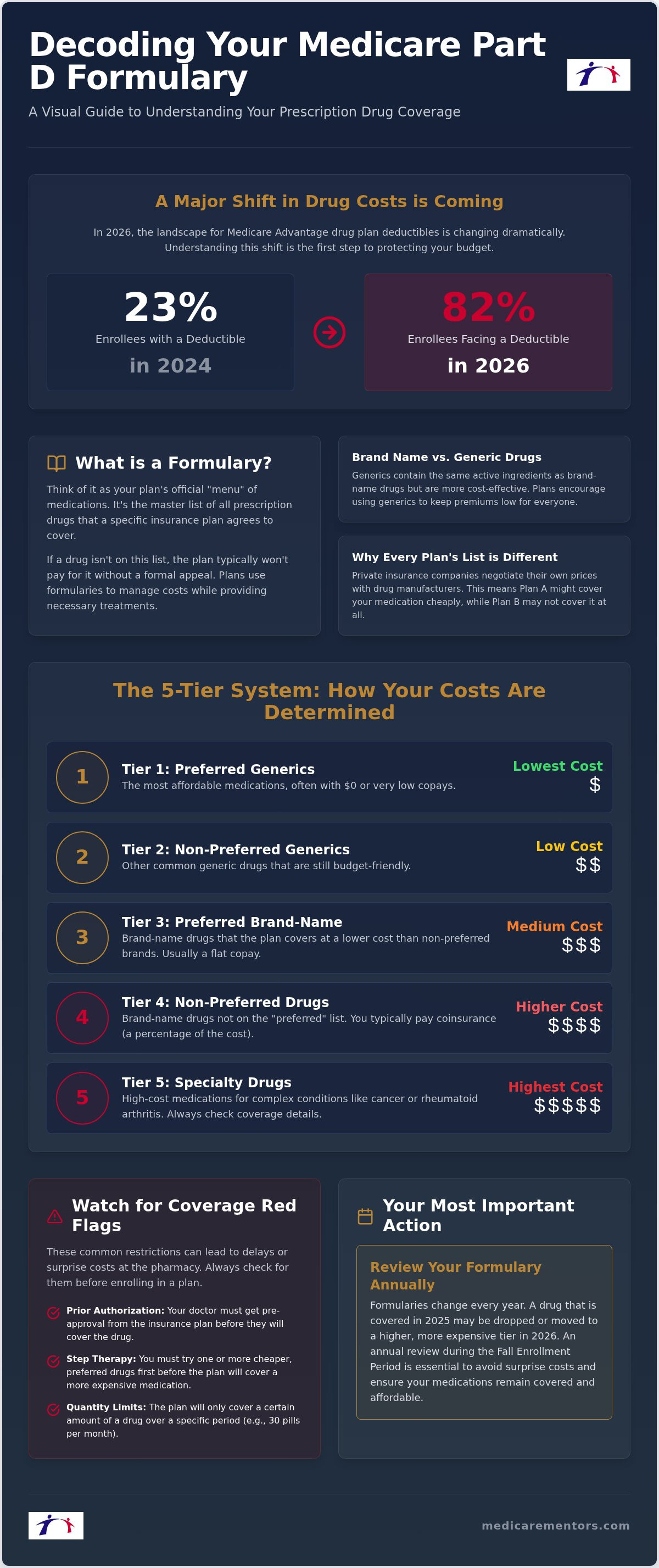
Did you know that in 2026, 82% of Medicare Advantage drug plan enrollees will face a deductible, a massive jump from just 23% in 2024? It's completely normal to feel a bit of anxiety when you see those numbers, especially if you rely on specific medications to stay healthy. We understand how stressful it is to worry about surprise costs at the pharmacy or the fear that a vital drug might be dropped from coverage. Having a medicare part d formulary explained in simple terms is the first step toward finding peace of mind and protecting your wallet.
In this guide, we promise to help you decode these complex drug lists so you can choose your 2026 plan with total confidence. You'll learn how to navigate the tier system, take advantage of the new $2,100 out-of-pocket spending cap, and ensure your current medications are fully covered. We'll walk through the specific changes coming this year and show you how to read your plan documents like a pro, making sure you never pay more than you should for your prescriptions.
Key Takeaways
- Discover how a formulary acts as a master list for your medications and learn the strategic way to use it to lower your pharmacy bills.
- Master the 5-tier system to identify which medications are "preferred" and how choosing lower tiers can significantly reduce your monthly out-of-pocket spending.
- Spot common coverage "red flags" like prior authorization and step therapy before they cause a headache or surprise costs at the pharmacy counter.
- Understand why we recommend an annual review, as your medicare part d formulary explained in 2025 will likely look different for the 2026 plan year.
- Learn how partnering with an independent broker provides a clear, unbiased look at all your options in North Carolina rather than just one carrier's list.
What is a Medicare Part D Formulary? (The Basics Without the Jargon)
Imagine walking into a restaurant and asking for a specific dish, only to be told it's not on the menu. That's exactly how a formulary works. It's the master list of prescription drugs that a specific insurance plan agrees to cover. We like to think of it as your plan's "menu" of available medications. Since the Medicare Part D program began, these lists have been the primary way plans manage costs while ensuring you get the treatments you need. Having a medicare part d formulary explained simply means understanding that if a drug isn't on this list, the plan won't pay for it unless you win a formal appeal. Plans use these lists to balance the need for effective medicine with the reality of rising costs.
You can usually find this list in two places. Most people look at the online portal for their specific plan, which is updated frequently throughout the year. You can also find it in your "Evidence of Coverage" document, which is the thick booklet your insurance company sends every autumn. If you're feeling overwhelmed by the fine print, don't worry. We're here to help you sift through the pages to make sure your specific prescriptions are included before you sign up.
Brand Name vs. Generic Drugs in a Formulary
Insurance companies focus on generics because they help keep your monthly premiums lower for everyone. Therapeutic equivalence means the generic drug has the same active ingredients and works in the body the same way as the brand-name version. Most plans will strongly encourage you to use these generics first. If your doctor insists on a brand-name medication that isn't on the "preferred" part of the list, they'll often need to provide medical records to justify why the generic version won't work for your specific health needs. This extra step helps the plan ensure they're being cost-effective without sacrificing your health.
Why Every Plan's List is Different
It might seem strange that two different plans can have completely different lists. This happens because private insurance companies, including those serving our neighbors in Raleigh and Charlotte, negotiate their own prices directly with drug manufacturers. These companies also partner with specific pharmacy networks to get better rates. Because of these private deals, Plan A might cover your blood pressure medication for a small copay, while Plan B might not cover it at all. When you have a medicare part d formulary explained in the context of these negotiations, it becomes clear why shopping around is so vital. Your choice of pharmacy can also change what you pay, as some plans offer "preferred" pricing at certain locations. This is why we always tell our clients that choosing a plan based on a friend's recommendation usually isn't the best path; your specific list of meds is what matters most.
Understanding the Tier System: How Your Costs are Determined
Think of the tier system as a cost-sharing ladder. The lower the tier, the less you pay out of your own pocket. This structure is a fundamental part of having a medicare part d formulary explained because it determines whether you'll pay a small, flat fee or a large percentage of the drug's total price. Most plans use a five-level system to organize medications based on their cost and how often they're prescribed. These tiers aren't chosen at random; they follow strict CMS regulations on drug pricing to ensure plans remain fair while managing the rising expense of modern medicine.
Breaking Down Tiers 1 through 5
To keep your pharmacy trips affordable, Tier 1 and Tier 2 usually consist of generic drugs. Tier 1 drugs are "preferred" generics, which often have a $0 or very low copay. Tier 2 contains other generics that might cost slightly more but are still budget-friendly. As you move into Tier 3, you'll find preferred brand-name drugs. These usually require a flat copay, which is a fixed dollar amount you pay every time you fill the script. Tiers 4 and 5 are where costs can become more unpredictable. These levels include non-preferred drugs and specialty medications, where you'll often pay coinsurance. Unlike a flat copay, coinsurance is a percentage of the drug's full cost, which can lead to higher bills if the medication is expensive.
How to Spot a 'Specialty' Drug
Managing costs for complex conditions often involves Tier 5 specialty drugs. These are high-cost medications used to treat serious illnesses like cancer or multiple sclerosis. For 2026, a drug is typically placed in the specialty tier if it costs more than a specific monthly threshold set by Medicare. The good news for 2026 is the new $2,100 annual out-of-pocket spending cap. Once you spend $2,100 on covered drugs, your plan pays 100% of your covered medication costs for the rest of the year. This provides a massive safety net for anyone relying on Tier 5 medications.
It's also common for drugs to move between tiers from one year to the next. A medication that was a Tier 2 generic in 2025 might be reclassified as Tier 3 in 2026 if the plan's contract with the manufacturer changes. To ensure your current medications still fit your budget, we recommend a yearly review of your medicare planning strategy. If you're worried about a specific medication jumping to a higher cost, you can always schedule a quick consultation with us to double-check your 2026 coverage levels.
Formulary Restrictions: Prior Authorization, Step Therapy, and Quantity Limits
Have you ever stood at the pharmacy counter, ready to pick up your prescription, only to be told the insurance "blocked" it? It's a frustrating experience that often happens because of formulary restrictions. These rules act as safety valves for insurance companies to manage costs and ensure patient safety. When you have a medicare part d formulary explained by an expert, you'll see these hurdles listed as codes like "PA," "ST," or "QL" next to your medications. Our goal is to help you identify these "red flags" before you enroll so you aren't caught off guard when you're simply trying to stay healthy.
Prior Authorization: Getting the 'Green Light' First
Prior authorization is essentially getting a "green light" from the insurance company before they agree to pay for a specific drug. The plan wants to confirm that the medication is medically necessary for your specific diagnosis. Your prescribing physician plays the lead role in this process. They must submit medical records or a formal statement to the insurance carrier explaining why this drug is required. While this sounds like a lot of red tape, typical timelines for approval range from 24 to 72 hours for urgent requests, though standard reviews might take a few days. If you want to see how these rules impact your total coverage, take a look at our detailed guide on Medicare Part D Plans in 2026.
Step Therapy: The 'Try This First' Rule
Step therapy requires you to try a lower-cost, proven medication before the plan will cover a more expensive alternative. It's often referred to as the "try this first" rule. This process protects both the plan's financial stability and the patient's health by starting with drugs that have a long, documented history of success. If you've already tried the cheaper version and it failed to treat your condition, your doctor can file a "Step Therapy Exception." This allows you to skip the lower steps and get the specific brand or specialty drug you need. Having a medicare part d formulary explained in this way helps you prepare for these conversations with your doctor ahead of time.
Quantity Limits for Safety and Cost
Quantity limits restrict the amount of medication you can receive within a specific timeframe, such as a 30-day or 90-day supply. Plans use these limits to prevent waste and ensure safety, particularly with medications like migraine treatments or controlled substances. For example, a plan might only allow nine tablets of a specific migraine drug per month. If your medical condition requires a higher dosage, your doctor can request a "formulary exception" to bypass these limits. We believe that understanding these small details is what makes for a smooth, stress-free Medicare experience.
The Annual Shuffle: Why You Must Review Your Formulary Every Year
Even if your health stays exactly the same, your plan probably won't. Every January 1st, insurance companies reset their drug lists, which can lead to higher costs if you don't stay alert. This is why we emphasize having a medicare part d formulary explained in the context of these yearly updates. If you allow your plan to auto-renew without checking the new list, you might find your favorite pharmacy is no longer "preferred" or your primary medication has jumped to a much higher tier. We've seen many neighbors in North Carolina face unexpected bills simply because they didn't realize their coverage had shifted under their feet.
Life transitions often make these reviews even more critical. If you're retiring soon, moving to Raleigh or Charlotte, or losing coverage from an employer, your current drug list might not be available in your new area or plan type. Taking a proactive approach to Medicare Planning ensures that your transition is smooth and your medications remain affordable. We treat every review as a fresh start, looking at every available option to find the best fit for your specific needs.
The Annual Notice of Change (ANOC)
Keep a close eye on your mailbox every September. That's when your insurance company sends the Annual Notice of Change, or ANOC. This is the most important document you'll receive all year because it acts as a "report card" for your upcoming coverage. To save time, skip straight to the section titled "Changes to our Drug List." This part will tell you if any of your current medications are being dropped or moved to a higher tier. If you see a drug you rely on listed there, it's a clear signal that you should compare other plans before the enrollment deadline in December.
Navigating the 'Donut Hole' in 2026
The coverage gap, traditionally called the "donut hole," is changing significantly in 2026. Because of new federal rules, there's now a $2,100 annual out-of-pocket spending cap that provides a massive safety net for everyone. You can learn more about how this works in our guide to The Medicare Donut Hole Explained. Your plan's formulary plays a huge role in how fast you reach this cap. By working with your doctor to choose Tier 1 or Tier 2 generics when possible, you can keep your monthly costs low and potentially stay well under that $2,100 limit for the entire year.
Understanding these changes doesn't have to be a solo task. We're here to help you navigate the fine print so you can focus on enjoying your retirement rather than worrying about pharmacy costs. If you're ready to see how your current medications will be covered next year, you can schedule a no-cost plan review with our team today.
How to Review Your Plan with a Medicare Mentor (The Easy Path)
We believe you shouldn't have to be an insurance expert just to get your prescriptions filled at a fair price. Having a medicare part d formulary explained by a professional educator ensures you don't miss the small details that often lead to big costs. Our "Education-First" approach is designed to lower your anxiety by walking you through the fine print at your own pace. We don't just hand you a brochure; we sit down with you to look at your specific medications and show you exactly how each plan will treat them in 2026.
As independent brokers, we aren't tied to any single insurance company. This independence is our most powerful tool because it allows us to act as your protective ally. We compare dozens of plans side-by-side to find the one that actually covers your medicine cabinet. Our no-cost guarantee means you get our full expertise without ever receiving a bill from us. We're paid by the insurance carriers to help you enroll, which keeps our guidance accessible to every senior in our community. This transition from confusion to clarity is the hallmark of a personal consultation with our team.
Local Expertise for North Carolina Residents
Serving families in Durham, Greensboro, Wilmington, and throughout the state is what we do best. Because we're a family-run business with nearly 300 five-star reviews, we understand the local pharmacy networks and NC-specific plan availability better than a generic national call center. We know which local pharmacies are considered "preferred" by certain plans, which can save you hundreds of dollars over the course of a year. When you work with us, you're working with neighbors who are deeply invested in your personal success and long-term well-being. To make things as convenient as possible, we're happy to meet with you in person, over the phone, or via a secure video call.
Beyond Part D: A Holistic Health Review
Choosing the right drug plan is only one piece of the puzzle. Your medication costs often play a major role in the Medicare Advantage vs. Supplement debate. We also help you look at the big picture by ensuring your Dental, Vision, and Hearing needs are met. Beyond these basics, we can discuss protective policies for cancer, heart attack, and stroke, as well as final expense coverage to ensure your family's financial security. This holistic approach helps you visualize how all your different services work together to protect your health and your savings.
The final step to peace of mind is simply reaching out. We invite you to start your journey with a low-friction conversation where we can get your medicare part d formulary explained in a way that makes sense for your life. If you're ready to take the guesswork out of your 2026 coverage, you can use our Medicare Planning tools or schedule your free review today. We're here to make sure you choose your next plan with total confidence.
Take Control of Your 2026 Pharmacy Costs
You now have the tools to look at your medication list with a new perspective. By understanding how tiers and restrictions work, you can avoid the frustration of surprise costs at the pharmacy counter. Your plan isn't a static document; it changes every year. This means your coverage for 2026 deserves a fresh look to ensure it still fits your health needs and your budget.
Having a medicare part d formulary explained in plain English is a great start, but seeing how those rules apply to your specific prescriptions is where you find true peace of mind. As a family-owned business since 2011, we provide independent guidance at no cost to you. We've earned nearly 300 five-star reviews by acting as a protective ally for North Carolina seniors. We're here to help you piece together your healthcare puzzle without any high-pressure tactics.
Ready to secure your savings for the coming year? Schedule Your Free 2026 Part D Review with a Medicare Mentor today. We look forward to helping you move forward with total confidence.
Frequently Asked Questions
What happens if my medication is removed from the formulary mid-year?
Plans generally cannot remove a drug mid-year unless a generic version becomes available or the FDA pulls the drug for safety reasons. If your plan does make a change, they must notify you in writing at least 30 days before the change takes effect. They might also provide a 60-day refill of the medication to give you time to work with your doctor on an alternative.
Can I ask my doctor to request a formulary exception for a non-covered drug?
Yes, your doctor can submit a formal request for a formulary exception if a drug you need isn't on the covered list. Your physician will need to provide a statement explaining that the non-covered drug is medically necessary for your condition. They must also show that the alternatives already on the list would be less effective or cause an adverse reaction for you.
Is a Medicare Part D formulary the same for every insurance company?
No, every insurance company negotiates its own private deals with drug manufacturers, which results in completely different lists. While Medicare requires plans to cover at least two drugs in most categories, the specific brands and costs vary between carriers. This is why having a medicare part d formulary explained in the context of your specific prescriptions is vital to avoiding high costs.
How do I know which tier my specific prescriptions fall into?
You can find your drug's tier by using your plan's online search tool or checking the printed "Drug List" in your Evidence of Coverage. Each medication will have a tier number next to it, typically ranging from 1 to 5. If you find the online portals confusing, we can help you run a personalized report that shows the tiers for all your medications across every available plan.
What is the difference between a preferred and non-preferred pharmacy?
A preferred pharmacy has a special contract with your plan to offer the lowest possible copays for your medications. Non-preferred pharmacies are still in the plan's network, but you'll almost always pay a higher price for the exact same drug there. We always suggest checking your plan's pharmacy directory to ensure you're using a preferred location to keep your out-of-pocket costs as low as possible.
Can my plan change my drug's tier during the middle of the year?
Plans can move a drug to a higher tier mid-year, but they must follow strict rules and notify you in writing. Most tier changes happen on January 1st when the new plan year begins. If a mid-year change occurs, you'll receive a notice in the mail. We recommend reviewing these notices immediately so you can discuss cheaper alternatives with your doctor before your costs go up.
How much does it cost to have a Medicare Mentor review my formulary?
There is no cost to you for a plan review or any of our educational services. We're an independent, family-run business, and we receive compensation directly from the insurance carriers when we help you enroll in a plan. This allows us to offer you professional, unbiased guidance and a medicare part d formulary explained in simple terms without ever sending you a bill for our time.
What should I do if I move from Raleigh to another state regarding my Part D plan?
You'll need to select a new plan because Part D coverage is tied to your specific zip code. Moving out of your current plan's service area qualifies you for a Special Enrollment Period. This window allows you to join a new plan that is available in your new state. We can help you compare the options in your new location to ensure your medications remain covered and affordable.