
Blog
Medicare Special Enrollment Period Qualifying Events: Your 2026 Guide
By Medicare Mentors ·

Imagine you have just finished packing the last box for your move to Raleigh, only to discover that your current Medicare plan doesn't include the local doctors you were hoping to see. It's a common worry, and you might feel a bit of pressure wondering if you're stuck or if you'll face a permanent penalty because you missed a deadline. Understanding medicare special enrollment period qualifying events is the first step to realizing that your move, retirement, or loss of employer coverage actually gives you a fresh start to find the right care.
We believe that your health insurance should work for you, not against you. We're here to help you navigate these rules so you can make a smooth transition without the fear of losing your "creditable coverage" status or paying extra fees. Whether you're retiring after age 65 or moving across North Carolina, you have options that protect both your health and your wallet. Our goal is to serve as your partner, making sure you feel confident in every decision you make.
In this 2026 guide, we'll break down the specific timelines for switching plans and explain how to verify that your new choice covers the specialists you trust. You'll learn how to navigate the 63-day rule and find a plan that fits your new life in the Tar Heel State perfectly.
Key Takeaways
- Identify the specific medicare special enrollment period qualifying events that give you a fresh start to update your coverage without facing lifelong late enrollment penalties.
- Navigate the critical 8-month timeline for enrolling in Part B after you stop working to ensure your transition into retirement is seamless and penalty-free.
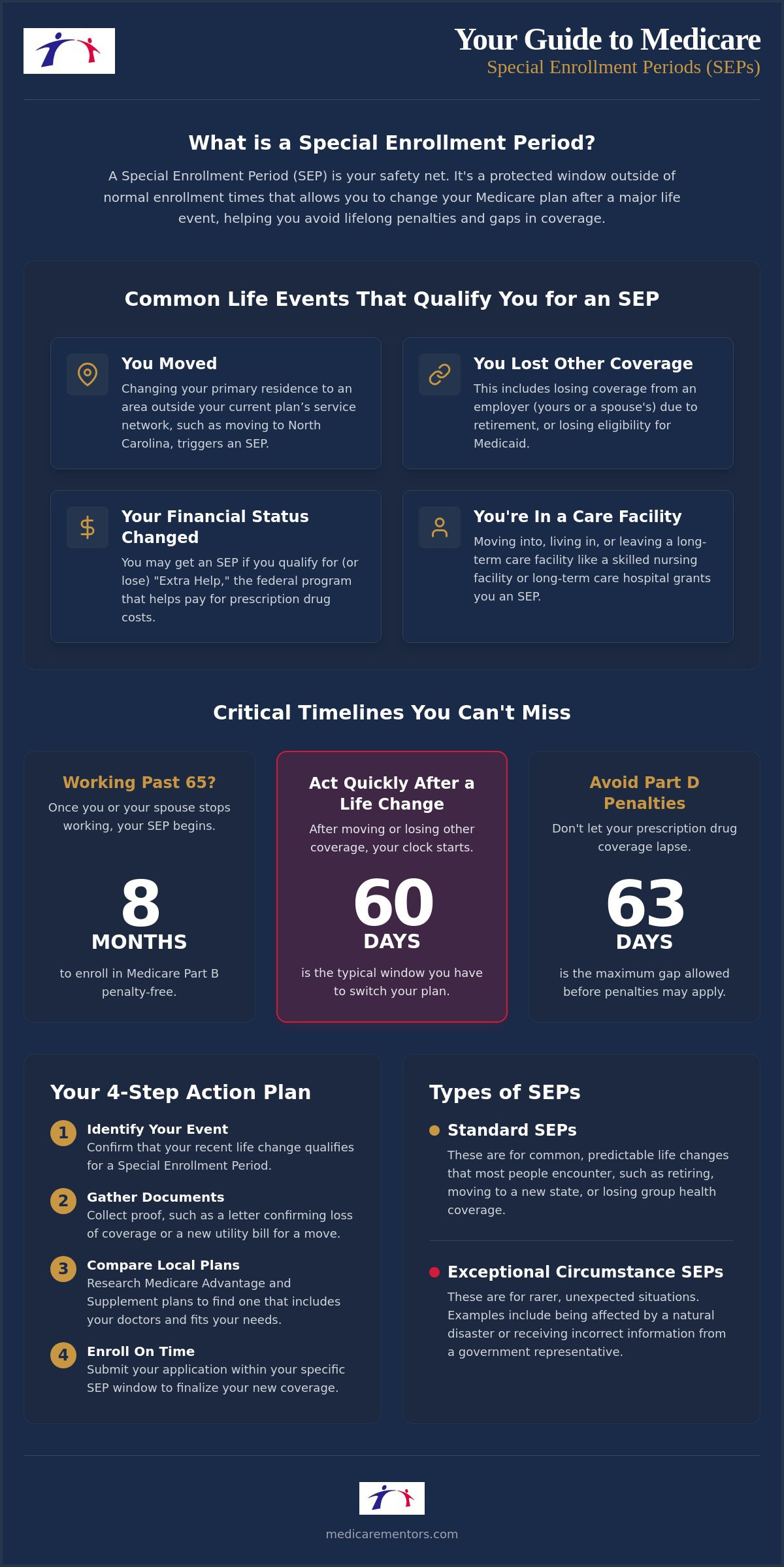
- Learn which documents you need to gather to prove a qualifying life change, such as a move or loss of employer coverage, to secure your 60-day switching window.
- Compare Medicare Advantage and Supplement plans to find a local North Carolina network that keeps your trusted Raleigh or Charlotte doctors within reach.
What is a Medicare Special Enrollment Period (SEP)?
Most people think they can only change health plans once a year during the busy autumn season. While the Annual Enrollment Period is the most famous window, life doesn't always follow a calendar. A Special Enrollment Period (SEP) is a specific window of time that opens outside the standard enrollment dates, allowing you to join, switch, or drop Medicare plans. It's helpful to view an SEP as a protected time for beneficiaries to maintain continuous health coverage regardless of when life's major shifts occur.
These periods are triggered by specific medicare special enrollment period qualifying events that disrupt your current coverage. Whether you are moving to a new home in Charlotte or finally hanging up your hat at work, these events grant you the legal right to adjust your coverage. By using these windows correctly, you avoid the lifelong late enrollment penalties for Part B or Part D that often catch people off guard. For a broader look at how these rules fit into the system, you can check this Medicare program overview to see the foundational structure of your benefits.
To better understand this concept, watch this helpful video:
Why SEPs Are Your Safety Net in 2026
Understanding the specific medicare special enrollment period qualifying events is essential for protecting your future finances. Retiring or moving shouldn't leave you feeling vulnerable or uninsured. In 2026, the market is shifting with fewer plans available in some counties, making your ability to switch even more vital. Depending on the specific event, an SEP provides a window lasting anywhere from two to eight months. The primary goal is to ensure your "creditable coverage" never has a gap longer than 63 days. If you exceed that 63-day gap, you might face higher monthly premiums for as long as you have Medicare. We help you stay ahead of those deadlines so your transition is seamless.
Standard vs. Exceptional Circumstances SEPs
Most people we help fall into the "Standard" category. These are the life changes we expect, such as moving to a new service area or losing employer-sponsored insurance. However, Medicare also recognizes "Exceptional Circumstances." These might include living in an area affected by a natural disaster or receiving incorrect information from a government representative. Since 2023, these rules have expanded to protect you from mistakes that aren't your fault. We act as your mentors during medicare planning to identify which category your situation fits into, ensuring you don't miss out on a valid opportunity to save on costs or improve your doctor network.
Common Qualifying Events for Switching Medicare Plans
While there are dozens of technical reasons Medicare might grant you a switch, most people encounter just a handful of common medicare special enrollment period qualifying events. These events act as a reset button for your coverage. They ensure that when your life circumstances change, your healthcare can change with you. Each of these medicare special enrollment period qualifying events comes with its own set of rules and required paperwork, but they all share one goal: keeping you covered.
Common triggers that open these windows include:
- Moving: Changing your primary residence to an area outside your plan's service network.
- Losing Coverage: Leaving an employer-sponsored plan, losing Medicaid, or seeing a plan terminate its contract.
- Financial Changes: Qualifying for "Extra Help" to pay for prescription medications.
- Institutional Stays: Moving into or out of a skilled nursing facility or long-term care hospital.
Moving to North Carolina: A Fresh Start for Your Coverage
To ensure your favorite specialists are still covered, relocating to Raleigh, Charlotte, or Wilmington triggers a two-month window to find a local plan. Your old Medicare Advantage plans usually rely on regional networks. If your previous doctors aren't in North Carolina, your coverage might not follow you. This move is a great time to find a plan that includes local specialists in your new zip code.
Losing Employer-Provided Health Insurance
To prevent gaps in care, you have an SEP if you're retiring or your company is ending coverage. This timeline starts the month you lose coverage and lasts for two full months. It's a bit different for those working past 65, who have longer windows to enroll. We help you gather the right proof to ensure your transition is smooth and penalty-free.
In 2026, we are noticing a trend where some major insurers are exiting specific counties. If your plan leaves the Medicare program or changes its service area, you have a right to choose a new one. Similarly, if your income changes and you qualify for "Extra Help," you gain a once-per-quarter chance to adjust your drug coverage. If you're feeling overwhelmed by these timelines, we can help you review your medicare planning options at no cost to you.
Working Past 65: The 8-Month Special Enrollment Window
Once that employment ends, a specific clock starts ticking. You get an eight-month window to enroll in Medicare Part A and Part B without any penalty. However, it's vital to remember that this eight-month window only applies to Original Medicare. If you want to join a private plan, such as Medicare Advantage or a Part D prescription drug plan, that window is much tighter; you usually have just two months from the time your employer coverage ends to make that switch. Creditable coverage must be from active employment, not a retiree plan.
The COBRA Trap: What You Must Know
We often see people fall into what we call "The COBRA Trap." When you leave a job, you might be offered COBRA to keep your current insurance for a few months. While it sounds convenient, COBRA does not count as creditable coverage for Medicare Part B. If you rely on COBRA and miss your initial eight-month window, you could face permanent late enrollment penalties and a gap in your health coverage. It's almost always better for your long-term budget to enroll in Medicare immediately upon leaving your job rather than waiting for COBRA to expire. We've seen too many neighbors face lifelong extra costs because they didn't realize COBRA didn't "count" in the eyes of the government.
Delaying Part B While Working
If you plan to delay Part B, your employer must generally have 20 or more employees for your current insurance to be primary. We recommend coordinating your Medicare planning with your HR department at least three months before you plan to retire. A practical tip we give our students is to keep a dedicated folder with records of your employer coverage. You'll need these documents later to prove to Social Security that you had creditable insurance, which is the key to triggering these medicare special enrollment period qualifying events without a hitch. By staying organized now, you're protecting your future self from unnecessary stress and ensuring your transition into retirement is as smooth as possible.
How to Document and Apply for Your SEP
Knowing that you qualify for a change is only half the battle. The other half involves the practical steps of proving your situation to the government or the insurance carrier. While the process might seem like a mountain of paperwork, it follows a logical path that we can walk through together. By staying organized, you ensure that your medicare special enrollment period qualifying events lead to a successful plan change without any gaps in your care.
- Step 1: Gather your evidence. You will need physical or digital proof of your life change, such as a utility bill for a move or a formal letter from your employer's HR department.
- Step 2: Watch the calendar. Most windows for switching Medicare Advantage or Part D plans last exactly 60 days from the date of the event.
- Step 3: Evaluate your network. Use this time to confirm your Raleigh or Charlotte doctors are in-network for any new plan you consider.
- Step 4: Formalize the request. Submit your enrollment application directly to the new plan provider or through your mentor.
Proving Your Qualifying Life Event
Documentation is the key to a smooth approval. If you are moving, a new lease agreement or a voter registration card often suffices. For those losing employer coverage, an "Evidence of Coverage" letter from your previous insurer is the gold standard. Providing clear evidence of your medicare special enrollment period qualifying events is what prevents your application from getting stuck in a bureaucratic loop. If you don't have a formal letter, don't panic. Sometimes a final pay stub showing health insurance deductions can help, though it's best to request a formal statement from your HR representative. A common mistake is waiting until the very last day of your 60-day window. This can lead to denials if your paperwork is incomplete, so we recommend starting the process at least 30 days early.
When Your New Coverage Starts
In almost every case, your new coverage will begin on the first day of the month after you submit your application. It is important to realize that retroactive coverage is rarely an option. If you apply on July 15th, your new plan won't kick in until August 1st. Because timing is so critical, working with an independent medicare advisor ensures you don't miss a single deadline. We take the weight of the paperwork off your shoulders so you can focus on your move or your retirement. If you are ready to start gathering your documents, we can help you with your medicare planning today at no cost to you.
Choosing the Right Plan After Your Life Change
Your life transition is more than just a change of address or a retirement date; it is an opportunity to align your healthcare with your new reality. Many people treat medicare special enrollment period qualifying events as a chore, but we encourage you to see them as a strategic "reset" button. This window allows you to move beyond the plan you've always had and find one that actually fits your current lifestyle and budget. It is the perfect time to reconsider the differences between Medicare Supplement Insurance and Medicare Advantage.
When you are evaluating new options, your first priority should be your doctor network. If you've moved to Raleigh or Charlotte, you must verify that your preferred specialists and hospitals are in-network for your new plan. We also recommend a thorough review of your prescription drug costs. Formularies, which are the lists of covered drugs, can change significantly between plans and regions. While you are making these updates, don't forget to look at ancillary coverage like dental, vision, and hearing insurance. Adding these pieces now ensures your entire health "construction project" is solid and complete.
Advantage vs. Supplement: The SEP Decision
If you move out of your current service area, you might lose access to your Advantage plan's HMO network. This situation often grants you "Guaranteed Issue" rights. This is a powerful protection that allows you to buy a Medicare Supplement (Medigap) plan without being asked health questions. It's a rare chance to secure a plan with more predictable out-of-pocket costs and no network restrictions. We help you weigh these pros and cons without any sales pressure, acting as your guide through these complex choices. Our goal is to make sure you understand the long-term financial impact of each path before you sign anything.
The Medicare Mentors Advocacy Approach
We founded Medicare Mentors because we believe every North Carolinian deserves a teacher, not a salesperson. Dave and Michele Johnson built this business on the idea of relationship-based education. We take the time to listen to your specific needs and explain how different medicare special enrollment period qualifying events apply to your life. This commitment to integrity means we provide unbiased advice across multiple carriers, positioning ourselves as your protective ally. You can connect with us for a free, unbiased review of your SEP eligibility. We move at your preferred pace, ensuring you feel confident and secure in your health decisions for 2026 and beyond.
Secure Your Coverage for the Road Ahead
Navigating a move to the Triangle or finally transitioning into retirement should be an exciting time for you, not a source of insurance stress. By identifying your specific medicare special enrollment period qualifying events, you protect yourself from lifelong penalties and ensure your trusted North Carolina doctors remain by your side. Remember that your window is often limited to 60 days. Gathering your documentation early is the best way to stay in control of your healthcare future.
Since 2011, Dave and Michele Johnson have served as patient educators for neighbors across Raleigh, Charlotte, and the entire state. As an independent brokerage, we provide unbiased advice on all major carriers to ensure your plan fits your unique health needs and budget. Our deep local knowledge of North Carolina networks means you won't have to guess if your specialists are covered.
Let Medicare Mentors guide you through your enrollment transition, all at no cost to you.
You have worked hard for your benefits. We are here to help you use them with total confidence and peace of mind.
Frequently Asked Questions
Can I change my Medicare plan if I move to a different county in the same state?
Yes, you can switch plans if your move takes you outside of your current plan's service area. Even a move between North Carolina counties can trigger this opportunity if your current network of doctors doesn't operate in your new location. This is one of the most common medicare special enrollment period qualifying events we handle for our students who move to areas like Raleigh or Charlotte.
What happens if I miss the 63-day window to enroll in a Part D plan?
Missing this window usually results in a lifelong late enrollment penalty for your prescription drug coverage. Medicare calculates this penalty by taking 1% of the national base beneficiary premium for every full month you were without coverage. To avoid these extra costs, we recommend starting your plan search as soon as you know your current insurance is ending so your coverage remains continuous.
Does getting married or divorced qualify me for a Medicare Special Enrollment Period?
Simply changing your marital status does not usually trigger an enrollment window on its own. However, if your marriage or divorce causes you to lose access to an employer-sponsored health plan, that loss of coverage becomes a qualifying event. In that specific situation, you would gain a window to select a new Medicare plan that fits your updated life circumstances.
If I lose my Medicaid coverage, how long do I have to join a Medicare Advantage plan?
You typically have a three-month window to join a new plan after losing Medicaid eligibility. This period begins either the month you are notified of the change or the month your coverage ends, whichever is later. We can help you compare Medicare Advantage plans to find a local North Carolina network that fills the gap left by your previous coverage without a lapse in care.
I'm retiring at 67; do I use the 8-month or 2-month enrollment window?
You actually have both, but they serve different purposes for your enrollment. You have eight months to sign up for Original Medicare (Parts A and B) without a penalty. However, you only have two months to join a Medicare Advantage or Part D plan. Because these windows are different, we suggest making your decisions within those first 60 days to ensure you have a complete package of coverage.
Can I switch from Medicare Advantage back to Original Medicare during an SEP?
Yes, many medicare special enrollment period qualifying events allow you to return to Original Medicare. For instance, if you move out of your Advantage plan's service area, you can choose to go back to Parts A and B and potentially add a Supplement plan. This is a strategic time to evaluate if a different type of coverage better serves your long-term health goals and budget.
Do I need to provide proof of my qualifying life event to Social Security?
You will definitely need to provide documentation to verify your situation to the government or your insurance carrier. They will look for proof like a "Loss of Coverage" letter from your employer or a utility bill showing your new address. Keeping these records in a dedicated folder makes the application process much faster and lowers the risk of a technical denial or delay.
What is 'creditable coverage' and why is it so important for my SEP?
"Creditable coverage" is insurance that is expected to pay at least as much as Medicare's standard prescription drug plan. It is vital because having it allows you to delay Medicare enrollment without facing late penalties later. We help you verify if your current union or employer plan meets this standard so you can make an informed choice about when it's the right time to transition.