Blog
Medigap Plans in North Carolina: Your Complete 2026 Guide to Supplemental Coverage
By Medicare Mentors ·

What if the most expensive part of your retirement isn't the monthly premium, but the hidden cost of losing access to your favorite North Carolina doctor? Selecting from the available medigap plans in north carolina often feels like a high-stakes balancing act between saving a few dollars today and protecting your health tomorrow. We understand that the shift to Medicare can feel overwhelming, especially when you're trying to plan your retirement from local hubs like the Research Triangle while being bombarded with confusing mailers and aggressive sales calls.
You deserve a healthcare strategy that offers both freedom and predictability. This guide provides an expert breakdown of the 2026 landscape, including the confirmed $283 Part B deductible and the latest rules for Plan G and Plan N. We'll walk through specific North Carolina enrollment timelines, compare the long-term value of Supplement plans versus Medicare Advantage, and show you exactly how to secure access to any specialist in the state without the fear of network restrictions or surprise bills.
Key Takeaways
- Learn why closing the "20% gap" in Original Medicare is the most effective way to eliminate unlimited financial risk during your retirement.
- Compare the top-rated medigap plans in north carolina, specifically the "Gold Standard" Plan G and the budget-friendly Plan N, to find your best fit.
- Understand how "Attained Age" pricing works so you can accurately predict how your premiums might change as you get older in North Carolina.
- Identify your specific enrollment window to ensure you get coverage without health questions, whether you're turning 65 or retiring later.
- Discover how to build a complete protection plan by adding dental and vision coverage that Medigap alone doesn't provide.
What Are Medigap Plans in North Carolina and Why Do You Need One?
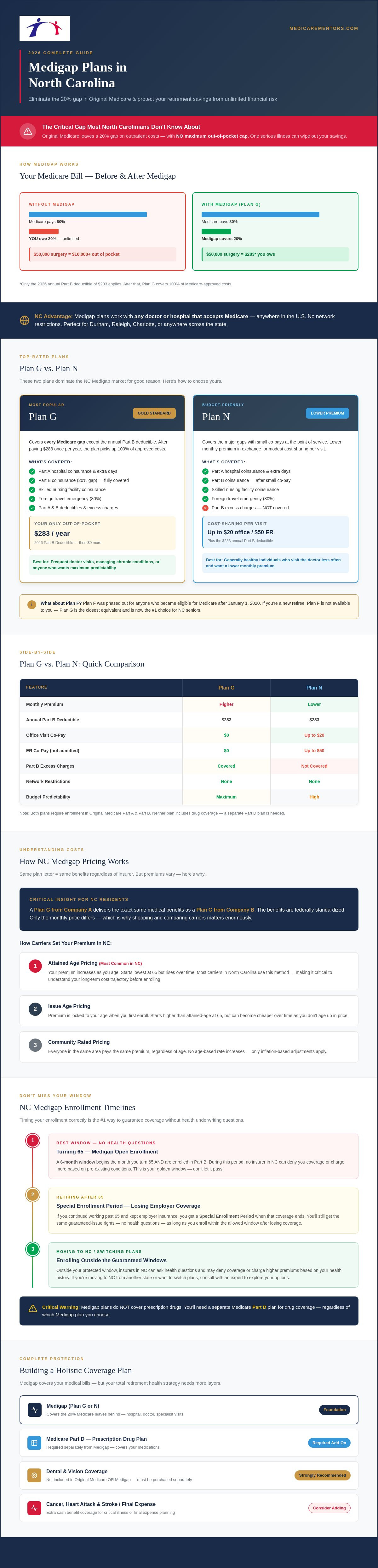
Many North Carolinians assume that once they enroll in Medicare Part A and Part B, their healthcare costs are fully covered. Unfortunately, that isn't the case. While Original Medicare pays for a large portion of your medical bills, it leaves behind a significant 20% gap for outpatient services. This gap has no cap. There is no limit to how much you could owe if you face a serious illness or injury. That is where Medigap (also called Medicare supplement insurance) comes in to protect your savings.
Think of these plans as a financial safety net. They are private insurance policies designed to pay after Medicare pays its share. One of the biggest advantages for residents here is the freedom of choice. With medigap plans in north carolina, you aren't restricted to a specific network of doctors or hospitals. You can visit any provider in the state, or across the country, as long as they accept Medicare patients. This is especially vital for those moving to the Research Triangle or retiring near our top-tier hospital systems like Duke or UNC.
To better understand how these options work for local residents, watch this helpful video breakdown:
The Core Benefits of Supplemental Coverage in NC
Supplemental coverage focuses on the most expensive parts of your care. It covers your Part A hospital coinsurance and provides additional days of hospital stays that Original Medicare doesn't offer. It also shields you from the 20% coinsurance for doctor visits, lab work, and physical therapy. By choosing the right plan, you can effectively eliminate the need for co-pays every time you visit your primary care physician or a specialist. This creates a predictable monthly budget that protects you from the shock of high medical bills during a health crisis.
Medigap vs. Original Medicare: A Necessary Partnership
Medigap isn't a standalone product. It requires you to be enrolled in Original Medicare Part A and Part B to function. Remember that these plans don't work with Medicare Advantage; you choose one path or the other based on your needs for flexibility and cost. While the federal government standardizes the benefits for each plan letter, private companies in North Carolina set the monthly prices. This means a Plan G from one carrier offers the exact same medical benefits as a Plan G from another, even if the monthly cost is different. For a deeper look at how these specific plan letters differ, check out our Medicare Supplement Insurance: The Complete 2026 Guide to Medigap.
We often see folks moving to North Carolina who are surprised by how many options are available here. Whether you are turning 65 or losing employer coverage, finding the right partnership between your federal benefits and private insurance is the key to a stress-free retirement. If you are starting your journey, our medicare planning resources can help you map out your next steps. Choosing from the available medigap plans in north carolina is about more than just insurance; it's about securing your peace of mind for the years ahead.
Comparing the Top North Carolina Medigap Plans: Plan G vs. Plan N
When you sit down to look at medigap plans in north carolina, you'll quickly notice that two options stand out above the rest. Before we dive into those, it's helpful to clear up some confusion about Plan F. If you became eligible for Medicare after January 1, 2020, Plan F isn't available to you. Congress phased it out to encourage more cost-sharing, which is why Plan G has stepped up to take its place as the premier choice for new retirees in the state.
Plan G: The Comprehensive Choice for NC Seniors
Plan G is often called the "Gold Standard" because of its sheer simplicity. It covers every single gap in Original Medicare except for the annual Part B deductible, which is $283 in 2026. Once you pay that small amount at the start of the year, your plan takes over 100% of your Medicare-covered expenses. This level of protection is why so many residents in Charlotte and Raleigh choose it; it turns your healthcare into a predictable monthly subscription rather than a series of surprise bills. If you want the lowest possible out-of-pocket risk, Plan G is your strongest ally.
Plan N: Balancing Lower Premiums with Small Co-pays
If you don't mind a little bit of "skin in the game" to keep your monthly costs down, Plan N is an excellent alternative. You'll still get comprehensive coverage, but you agree to pay small co-pays: up to $20 for some doctor visits and up to $50 for emergency room visits that don't result in an admission. According to the North Carolina Department of Insurance, all Medigap plans are standardized, but Plan N includes a unique feature called "excess charges."
Excess charges happen when a doctor charges more than the Medicare-approved amount. While some states see these often, they are quite rare in North Carolina because most of our major hospital systems and specialists accept "assignment," meaning they agree to Medicare's set prices. For a healthy individual who doesn't visit the doctor frequently, the premium savings on Plan N can often outweigh the cost of a few $20 co-pays throughout the year. It's a smart way to maintain high-quality coverage while keeping more money in your pocket.
For those who want the lowest possible monthly premium and are comfortable with a higher initial cost for major events, High-Deductible Plan G is also available. In 2026, this plan has a $2,950 deductible. It's a great "safety net" for people who primarily want to protect against a catastrophic health event. If you're feeling stuck between these choices, we can help you run the math through our medicare planning sessions to see which logic fits your lifestyle best.
How Medigap Premiums Work in North Carolina
One of the most confusing parts of shopping for insurance is seeing different prices for the exact same thing. Because Medicare Supplement benefits are standardized by the federal government, a Plan G from one company provides the same medical coverage as a Plan G from another. However, the premiums for medigap plans in north carolina vary wildly between carriers. This happens because each insurance company has its own "claims experience" and administrative costs. The North Carolina Department of Insurance regulates these rates, but they don't set them. This leaves you with the task of finding the best value for your specific situation.
Attained Age vs. Issue Age Ratings in NC
Understanding how your price is calculated is vital for your long term retirement budget. Most insurance companies in North Carolina use "Attained Age" rating. This means your premium is based on your current age and will likely increase as you have birthdays. It often starts out as the most affordable option when you are 65, but you should plan for those gradual increases over time. A few companies might offer "Issue Age" ratings, where the premium is based on the age you were when you first bought the policy. While these might start higher, they don't increase just because you get older. Comparing these two models is a key part of any smart medicare planning strategy.
Factors That Influence Your NC Medigap Quote
Your personal details play a huge role in the quote you receive. Insurance companies look at several data points to determine your monthly cost:
- Zip Code: Living in a high cost area like Wilmington or Charlotte might result in higher premiums than living in a more rural part of the state. Costs of medical care in your specific region impact what the insurer charges.
- Tobacco Use: If you use tobacco, expect to pay significantly more. In North Carolina, tobacco rates can sometimes be 10% to 30% higher than non-tobacco rates.
- Gender: Statistically, women in North Carolina often see slightly lower premiums than men because of longer life expectancies and different healthcare utilization patterns.
- Household Discounts: Many NC carriers offer a discount if two people in the same house have policies with them. This "spousal discount" can save you anywhere from 5% to 12% off your monthly bill.
It's also important to remember medical underwriting. If you apply for medigap plans in north carolina during your initial six month enrollment window, companies cannot ask you health questions. If you try to switch plans later, you might have to answer questions about your health history. This could lead to higher rates or even a denial of coverage, which is why getting it right the first time is so important for your financial peace of mind.
When to Enroll: Navigating NC Medigap Timelines
Timing isn't just about dates on a calendar; it's about protecting your legal rights to healthcare. When you're looking for medigap plans in north carolina, your first and best opportunity to enroll is during the Medigap Open Enrollment Period. Think of this as your one-time "get in free" card. During this window, insurance companies are legally required to sell you any plan they offer at the best available rate, regardless of your medical history. If you miss this specific window, you might find yourself facing medical underwriting, where companies can look at your health records to decide if they'll cover you or how much they'll charge.
To help you stay ahead of these deadlines, we've put together The Complete 2026 Medicare Enrollment Guide. Understanding these phases helps you avoid the anxiety of late-enrollment penalties or, worse, being denied the coverage you need later in life.
Turning 65: The Best Time to Act
Your personal Medigap Open Enrollment Period lasts for exactly six months. It begins on the first day of the month you are both 65 or older and enrolled in Medicare Part B. During these six months, you have "guaranteed issue" rights. This means you can't be denied coverage or charged more for pre-existing conditions like diabetes or heart disease. We recommend you start shopping at least three months before your 65th birthday. This gives you plenty of time to compare rates without feeling rushed by the effective date of your coverage.
Retiring After 65 and Moving to North Carolina
Many people in North Carolina choose to work well past their 65th birthday. If you've delayed Part B because you had employer-sponsored coverage, your six-month window doesn't start until you actually sign up for Part B. However, there's another safety net called "Guaranteed Issue" rights. If you lose your employer-provided "creditable" coverage or if your COBRA benefits end, you typically have a 63-day window to secure a Medigap plan without answering health questions.
If you're moving to North Carolina from another state, your current Medigap plan generally stays with you because these are national plans. However, you should still review the local rates for medigap plans in north carolina. Premiums vary by zip code, and you might find a better value by switching to a local carrier once you've settled into your new home. Whether you're retiring from a local hub like the Research Triangle or moving to the coast, we can help you schedule a personalized planning session to ensure your transition is seamless and your coverage remains uninterrupted.
Building a Holistic Plan: Dental, Vision, and Beyond
Choosing one of the medigap plans in north carolina is a vital first step, but it's only one piece of your retirement puzzle. While Medigap is excellent for hospital stays and doctor visits, it has a well-known blind spot. Original Medicare doesn't cover routine dental work, vision exams, or hearing aids. This means your Medigap plan won't cover them either. If you want a plan that handles everything from root canals to new glasses, you need to look at your coverage as a multi-piece construction project where Medigap serves as your foundation.
Many people are tempted by Medicare Advantage because those plans often bundle "extras" like dental and vision. However, you don't have to give up the freedom of Medigap to get those benefits. We help our clients build their own "Advantage-style" bundle by pairing a strong Medigap base with separate ancillary policies. This approach often gives you more control over which dentists you see and provides higher coverage limits for expensive procedures. It's about getting the network freedom of a supplement with the comprehensive perks of an all-in-one plan.
Why Ancillary Coverage is the 'Missing Piece' in NC
In 2026, the costs for dental implants and high-tech hearing aids continue to rise, making standalone protection more important than ever. You can learn more about these specific options in The Complete Guide to Dental Vision and Hearing Insurance for Seniors (2026). A separate dental policy usually offers much better coverage than the limited allowances found in other plan types, ensuring you aren't stuck with a massive bill for a surprise crown or bridge. These policies allow you to choose your own providers, which is a major advantage for North Carolinians who have long-standing relationships with their local dentists.
How a Medicare Broker Simplifies the NC Market
Navigating these choices is much easier when you have a patient educator by your side. At Medicare Mentors, Dave and Michele Johnson focus on a teacher-student dynamic. We want you to feel empowered by your education rather than pressured by a sales pitch. Because we are an independent brokerage, we aren't tied to a single insurance company. This independence allows us to objectively compare every option in the North Carolina market to find the one that fits your unique needs.
Your peace of mind is our priority. We are here to help you assemble all the pieces of your healthcare strategy, from your Medigap plan to your prescription drug coverage and beyond. If you're ready to move forward with confidence, you can schedule your medicare planning session with us at no cost. Let's work together to build a plan that protects your health and your financial future while giving you the freedom to see any doctor you choose.
Securing Your Health and Financial Future in North Carolina
Since 2011, Medicare Mentors has served as an independent North Carolina brokerage dedicated to providing expert advice at zero cost to you. We've helped thousands of residents in Raleigh, Charlotte, and across the state move through these complex decisions with confidence. Our teacher-student approach is designed to lower your anxiety and help you find the best value for your unique needs. Schedule your free 2026 Medicare consultation with our Raleigh-based experts today and let us help you build a plan that fits your life. You've worked hard for your retirement; let's make sure your healthcare works just as hard for you.
Common Questions About North Carolina Medigap
What is the most popular Medigap plan in North Carolina for 2026?
Plan G is the most popular choice for new enrollees in 2026 because it offers the most comprehensive coverage. It handles every cost except for the $283 Part B deductible. While Plan G is the leader, Plan N is also gaining popularity among North Carolinians who want to trade slightly higher out-of-pocket co-pays for lower monthly premiums.
Can I switch from Medicare Advantage to a Medigap plan in NC at any time?
You cannot switch from Medicare Advantage to a Medigap plan whenever you like. You generally must wait for the Annual Enrollment Period that runs from October 15 to December 7 each year. It is also important to remember that you may have to answer health questions to qualify for medigap plans in north carolina if you are switching after your initial trial period has ended.
Do North Carolina Medigap plans cover prescription drugs?
No Medigap plans sold today include coverage for prescription drugs. To get help with your medication costs, you will need to enroll in a standalone Medicare Part D plan. We recommend coordinating your Medigap and Part D enrollment at the same time to ensure you have a complete and seamless coverage strategy.
How much do Medigap plans cost in North Carolina on average?
Monthly premiums for medigap plans in north carolina are expected to range from $86 to $301 or higher in 2026. Your actual cost will depend on several personal factors, including your age, tobacco use, and the specific plan letter you choose. Because these benefits are standardized, the main difference between companies is the price they charge for that same coverage.
What is the Blue-to-Blue rule in North Carolina for Medicare Supplement plans?
The Blue-to-Blue rule is a special provision that allows current Blue Cross and Blue Shield of North Carolina members to switch between different Medicare Supplement plans without medical underwriting. This usually happens during a specific annual window, often in May. It is a helpful way for residents to adjust their coverage levels as their health or budget needs change over time.
Is there a 'waiting period' for pre-existing conditions on NC Medigap policies?
There is no waiting period if you enroll during your six-month Medigap Open Enrollment Period. However, if you apply outside of a guaranteed window and haven't had "creditable" health coverage for the previous 63 days, a company could potentially make you wait up to six months for coverage related to a specific condition. Acting during your initial window is the best way to avoid this delay.
Does North Carolina offer any financial assistance for Medigap premiums?
North Carolina does not have a program that directly pays for Medigap premiums, but you may qualify for other forms of help. Programs like the Medicare Savings Program can help lower-income seniors pay for their Part B premiums and other costs. While this doesn't reduce the Medigap bill itself, it can free up significant room in your monthly budget to afford supplemental coverage.
How do I contact SHIIP in North Carolina for Medigap help?
You can contact the Seniors' Health Insurance Information Program (SHIIP) by calling 1-855-408-1212. This is a free counseling service provided by the North Carolina Department of Insurance. Their team offers unbiased information to help you understand your options, which can be a great starting point before you speak with an independent broker to finalize your plan choice.