
Blog
Medigap Underwriting Questions: What to Expect and How to Prepare in 2026
By Medicare Mentors ·

What if the health questions on an insurance application weren't actually a "rejection machine" designed to lock you out of coverage? It's completely normal to feel a spike of anxiety when you hear the term medical underwriting, especially if you're managing a chronic condition or have a surgery in your past. You likely worry that one "yes" answer to certain medigap underwriting questions will result in an immediate denial or a premium you can't afford.
We believe that education is the best cure for that uncertainty. In this guide, we'll show you exactly which health questions insurance companies typically ask in 2026 and, more importantly, when you have the legal right to skip them entirely. We'll walk through "Guaranteed Issue" triggers specific to North Carolina and explain how to protect your options if you're considering a move from Medicare Advantage back to a Supplement plan. By the time you finish reading, you'll have a clear strategy to find a plan that respects your health history and your budget. Our goal is to help you move forward with the confidence that your coverage is secure.
Key Takeaways
- Understand that medical underwriting is simply a risk assessment tool, helping you view the application as a professional conversation rather than a hurdle to your care.
- Identify the three main categories of health queries, including "knock-out" conditions that might lead to an automatic denial if you aren't prepared.
- Learn how to navigate specific medigap underwriting questions by using a pre-screen strategy to find carriers that are more lenient with your health history.
- Discover the "Guaranteed Issue" triggers, such as moving to North Carolina or losing employer coverage, that allow you to skip the health questionnaire entirely.
- Find out why honesty and accuracy on your application are your best tools for protecting your long-term coverage and avoiding plan cancellations.
What is Medigap Medical Underwriting and Why Does it Exist?
Medical underwriting is simply the process where private insurance carriers review your health history to determine if they can offer you a policy and at what cost. Think of Medigap (also called Medicare supplement insurance) as a protective layer that sits on top of your Original Medicare. Because these plans cover costs that Medicare leaves behind, carriers use underwriting to ensure they can maintain stable premiums for everyone in the pool. It is a tool for predictability, not a system designed to keep you from getting the care you need.
At Medicare Mentors, we like to view this as a teacher-student dynamic. The carrier isn't judging your lifestyle or health choices; they're simply looking at the math of risk. In 2026, this process is becoming more precise. Most companies now use digital health records and prescription drug databases to get a real-time snapshot of your medical history. This means the medigap underwriting questions you answer are often verified instantly, making the approval process faster and more transparent than it was a decade ago.
You'll also encounter different pricing structures during this process. Some plans are community-rated, where everyone in a specific area pays the same regardless of health status. Others use attained-age pricing, where premiums are lower when you're younger but increase as you age. Understanding these distinctions is a vital part of your medicare planning strategy, as it helps you see the long-term cost of your coverage.
To better understand how these health questions work in practice, watch this helpful video:
The Open Enrollment Shield
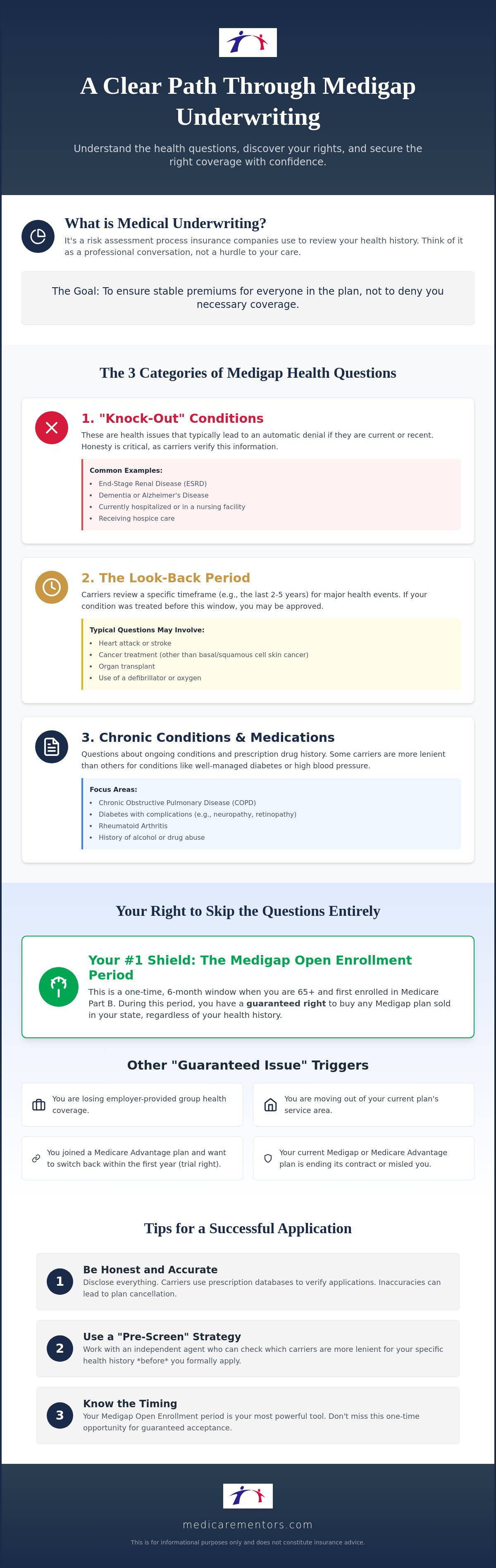
Your most powerful protection is the Medigap Open Enrollment Period. This is a one-time, six-month window that starts the month you are 65 or older and enrolled in Part B. During this time, you have a "free pass." Carriers cannot ask any medigap underwriting questions or deny you for pre-existing conditions. Don't let "internet mulch" myths fool you into thinking you can wait; once this window closes, the rules change significantly. For a deeper look at how these plans function, see our Medicare Supplement Insurance: The Complete 2026 Guide to Medigap.
When Underwriting Becomes Unavoidable
There are times when answering health questions is necessary. If you want to switch from a Plan G to a lower-premium Plan N after your initial window, you'll likely go through underwriting. The same applies if you're moving from a Medicare Advantage plan back to Original Medicare after your one-year "trial right" has expired. Viewing your health coverage as a multi-piece construction task helps simplify these complex decisions. For those moving to North Carolina, underwriting rules can vary by carrier, making it essential to know which companies are more lenient with specific health histories.
The 3 Categories of Medigap Underwriting Questions
When you sit down to fill out an application, the medigap underwriting questions you encounter usually fall into three distinct buckets. Understanding these categories ahead of time helps lower the "test anxiety" many of our clients feel. Carriers aren't looking for a reason to say no; they're simply trying to understand the current state of your health to ensure they can provide stable coverage for the long term.
The first category involves "Knock-Out" conditions. These are health issues that typically result in an automatic denial if they are currently active. Common examples include End-Stage Renal Disease (ESRD), dementia, or being currently hospitalized or in a nursing home. The second category is the Look-Back Period. A Look-Back Period is the specific timeframe a carrier reviews for past medical treatments. For instance, a company might ask if you've had heart surgery or a stroke within the last two or five years. If you've passed that window without new issues, you're often in the clear.
The third category is medication screening. In 2026, carriers use pharmacy databases as a "truth serum" to verify the health history you've provided. If you list your health as "excellent" but are taking a medication typically prescribed for a chronic condition, it will trigger a follow-up. This is why we always recommend having your current list of prescriptions ready before we start the medicare planning process together.
Common Health Questions You Will Face
In North Carolina, height and weight (BMI) are standard questions. Some carriers in our state may charge a slightly higher premium if your BMI falls outside their preferred range, while others are more lenient. Tobacco usage is another big one. In 2026, many insurers have updated their questions to distinguish between traditional smoking and vaping. If you've used any nicotine products in the last 12 months, you'll likely be rated as a tobacco user. Finally, carriers look closely at chronic management. They generally view well-controlled diabetes with a single oral medication much more favorably than insulin-dependent cases with complications.
The Medication "Red Flags"
Certain medications act as "red flags" because they are often tied to high-risk conditions. For example, blood thinners used for atrial fibrillation or biologics for autoimmune disorders will almost always trigger a manual review by an underwriter. To make the process smoother, keep a "Med List" that includes the dosage and the reason you take each drug. This avoids confusion during the phone interview and helps us identify which carriers will be the most welcoming to your specific history. Remember, if you have Guaranteed issue rights, you can often bypass these medication checks entirely. If you're feeling unsure about how your prescriptions might impact your application, our mentors are here to help you pre-screen your options at no cost.
Guaranteed Issue Rights: Skipping the Questions Entirely
Imagine the relief of looking at a long list of medigap underwriting questions and realizing you don't have to answer a single one. This is the reality for those who possess Guaranteed Issue (GI) rights. We see these rights as a protective shield for our clients during major life transitions. If you qualify, an insurance company cannot refuse to sell you a policy or charge you more based on your health history. It's a legal "free pass" that ensures your access to care remains uninterrupted regardless of your medical background.
To secure this protection, follow these four steps:
- Step 1: Identify your trigger. The most common situations include losing employer-provided health coverage, your current plan leaving the Medicare program, or moving out of your plan's service area.
- Step 2: Gather your evidence. You'll need a "Notice of Termination" (often called a letter of creditable coverage) from your previous insurer or a "Proof of Residency" if you've recently moved to North Carolina.
- Step 3: Watch the calendar. You generally have a 63-day window from the date your old coverage ends to apply for a Medigap plan under GI rights. Missing this window can mean the difference between an automatic approval and a medical review.
- Step 4: Select your plan. Federal law guarantees access to specific plans like A, B, C, F, K, or L. However, depending on when you became eligible for Medicare, your choices might be even broader.
The "Trial Right" for Medicare Advantage
If you're trying a Medicare Advantage plan for the first time, you have a unique safety net known as a "Trial Right." This rule allows you to disenroll from the Advantage plan within the first 12 months and return to Original Medicare with a Medigap policy. It's a low-pressure way to see if an Advantage plan fits your lifestyle without losing the ability to switch back later. For a full comparison of how these options work, read The Ultimate Guide to Medicare Advantage Plans in 2026.
Moving to Raleigh, NC: Special Considerations
Moving to our neck of the woods in Raleigh often creates a new opportunity for coverage. A move into North Carolina from another state is a qualifying event that can trigger a Guaranteed Issue window. Additionally, North Carolina has specific "Blue to Blue" rules. These allow residents to switch between certain plans offered by the same carrier without answering medigap underwriting questions. We always suggest reviewing your GI status with a mentor before you start any application. This simple check ensures you don't reveal medical data unnecessarily. If you're planning a move, our medicare planning services can help you map out your transition effectively.
Practical Tips for a Successful Medigap Application
Approaching an insurance application can feel like walking into a high-stakes exam, but it doesn't have to be that way. We use a "Pre-Screen" strategy to remove the guesswork before you even sign your name. By checking carrier-specific underwriting guides, we can often predict how a company will react to your health history. This proactive approach turns a stressful process into a methodical, predictable one. An independent broker can anonymously check your health status with multiple carriers to find the best fit without leaving a "paper trail" of denials on your record.
When you're answering medigap underwriting questions, the most important rule is to be accurate rather than modest. Many people try to downplay a past health event because they feel fine now, but this can lead to a "material misrepresentation" denial. If a carrier's digital records show a treatment or diagnosis you didn't mention, they may cancel the policy or deny the application entirely. It's much better to be transparent from the start so we can find a carrier that accepts your history as it is.
If the carrier requires a phone interview, remember to stay calm and keep your answers factual and brief. You aren't required to offer a life story; simply answer "yes" or "no" as requested. Providing exactly what is asked helps the underwriter process your file without unnecessary delays. If you're ready to start this process with a steady hand guiding you, our medicare planning services are designed to take the weight off your shoulders.
Gathering Your Medical Evidence
Success starts with organization. Before you apply, create a list that includes your doctors' names, your specific dosages, and the dates of any recent treatments or hospitalizations. Be aware that "pending surgeries" are a significant hurdle. Almost every Medigap carrier will require you to wait until a surgery is completed and you've been released from follow-up care before they will approve an application. Additionally, if you have discontinued a medication recently, ensure your doctor has updated your records. Pharmacy reports often show drugs you haven't taken in months, and having a clear explanation ready prevents the underwriter from assuming you still have an active condition.
The Power of the Independent Advocate
Calling a single insurance carrier directly might seem simple, but it limits your options to their specific rules. If that one company has a strict stance on your particular health history, you're stuck. At Medicare Mentors, Dave and Michele act as your protective allies. Because we are independent, we represent you, not the insurance company. We know which North Carolina carriers are more lenient with certain conditions and which ones are likely to offer the best long-term premium stability. To understand more about how this partnership protects your interests, take a look at Why Use a Medicare Broker?. Our advocacy means we fight for your acceptance while ensuring the plan you choose fits into your overall retirement strategy.
Next Steps: Securing Your Retirement Health in North Carolina
We view your retirement healthcare as a multi-piece construction task where every component must fit together perfectly. While a Supplement plan provides a sturdy foundation, it's only one part of the total picture. Most Medigap plans don't include coverage for routine visits to the dentist or eye doctor, which can lead to unexpected bills later on. To ensure your safety net is truly complete, we recommend exploring Dental, Vision, and Hearing Insurance as part of your overall strategy.
Our Raleigh-based team understands the local nuances of North Carolina carriers and how they handle medigap underwriting questions. Whether you're moving to the Triangle from out of state or have lived here your entire life, we help you understand how state-specific rules impact your choices. You can schedule a personalized, no-pressure session at our office or connect with us via a simple phone call. Our goal isn't to sell you a policy; it's to provide the education you need to make a choice that feels right for your future.
Preparing for Life Transitions
If you're retiring soon or continuing to work past 65, your timeline is unique. Transitioning from employer-provided coverage requires careful coordination to avoid any gaps in your care. We help you identify the exact moment your "Guaranteed Issue" window opens so you don't have to worry about medical history affecting your approval. For a roadmap tailored to your specific situation, visit our Medicare Planning page. Having a plan in place early prevents the stress of last-minute decisions and ensures you're always in control of your coverage.
The Medicare Mentors Difference
Integrity is the bedrock of everything we do at Medicare Mentors. Because we're an independent brokerage, our loyalty remains with you, not the insurance companies. We provide unbiased education on every carrier in North Carolina at no cost to you. If you're concerned that a chronic condition might make you "uninsurable," don't lose heart. We specialize in finding paths forward even when medigap underwriting questions feel like a barrier. Your health history is just one part of your story; we're here to help you write the rest with confidence and peace of mind.
Move Forward with Confidence and Clarity
You now have the tools to approach your health application with a clear strategy rather than a sense of dread. It's helpful to remember that medigap underwriting questions are simply part of a risk-assessment conversation, not a machine designed to reject you. Whether you're managing a chronic condition or identifying a "Guaranteed Issue" window that lets you skip the health questionnaire entirely, you don't have to navigate these complex rules alone. By organizing your medical records and understanding the 2026 landscape, you've already taken the most difficult step toward securing your future.
As an independent, Raleigh-based brokerage, Medicare Mentors represents all major North Carolina carriers. Our no-cost, teacher-student approach ensures you receive unbiased advice that puts your needs first. We take pride in acting as your protective ally, helping you find a plan that respects both your health history and your retirement budget. If you're ready to see which options are available for your specific situation, we are here to guide you through every detail at your own pace.
Get Your Free, No-Pressure Medigap Consultation. Your peace of mind is worth the conversation, and we're here to help you build a health plan you can rely on for years to come.
Frequently Asked Questions
Can I be denied a Medigap policy because of my health?
Yes, insurance companies can deny your application based on your health history if you apply outside of a protected enrollment period. This typically happens when you try to switch plans years after first enrolling in Medicare Part B. However, having a chronic condition doesn't always lead to a denial. Many carriers accept well-managed issues like high blood pressure or controlled diabetes as long as they are stable.
What are the most common "knock-out" conditions for Medigap underwriting?
Conditions like End-Stage Renal Disease (ESRD), dementia, active cancer, or a current residency in a nursing home are the most frequent reasons for an automatic denial. These are often called "knock-out" conditions because they represent a high immediate risk to the insurer. If you are currently receiving treatment for these, it's vital to check if you qualify for a Guaranteed Issue right before you submit an application.
How far back do Medigap companies look at your medical records?
Most insurance carriers review your medical history for a period of two to five years, depending on the specific condition. This timeframe is known as the "look-back period." For instance, a company might ask if you've had a heart attack or major surgery within the last 24 months. If your health event happened outside that specific window, it often won't impact your eligibility for new coverage options.
Does every Medigap plan require medical underwriting?
No, medical underwriting is not required if you apply during your initial six-month Medigap Open Enrollment Period or if you have a Guaranteed Issue right. During these specific windows, carriers must accept your application regardless of your health. It's only when you try to change plans or enroll later in life without a qualifying event that you'll face medigap underwriting questions to determine your eligibility.
What happens if I lie on my Medigap application health questions?
Providing false information on your application can lead to an immediate denial or a future cancellation of your policy for "material misrepresentation." Carriers verify your answers against digital health records and pharmacy databases. If they discover a discrepancy, they may refuse to pay your medical claims or terminate your coverage entirely. It's always best to be accurate so we can find a carrier that accepts your true history.
Can I switch Medigap plans if I have a pre-existing condition?
You can switch plans with a pre-existing condition, but you will likely need to pass medical underwriting unless you have a specific legal right to skip it. In North Carolina, some carriers offer "Blue to Blue" rules that allow certain switches without any health questions. If you don't have that option, we can help you pre-screen carriers to find one with more lenient guidelines for your condition.
Is there a height and weight chart for Medigap insurance?
Yes, almost every Medigap carrier uses a height and weight chart to determine your Body Mass Index (BMI). If your weight falls outside their "standard" range, you might face a higher monthly premium or a denial. However, every company has different limits and some are much more forgiving than others. We can look at multiple carriers to find the one with the most flexible chart for you.
Do Medigap companies check my prescription drug history?
Yes, insurance companies almost always review your prescription drug history through third-party digital databases. They look at the medications you've filled over the last few years to verify the health status you reported on your medigap underwriting questions. Certain "red flag" drugs, such as biologics or strong blood thinners, may trigger a request for more medical records or a brief phone interview with an underwriter.