
What if Medicare covers the care you need, but you still owe more than you expected? That can happen because Medicare Coverage depends on your coverage path, plan rules, and share of the costs. If you’re turning 65, retiring, working past 65, or adjusting after a move, it’s understandable to wonder where to start.
This guide explains what Medicare generally covers, how Original Medicare differs from Medicare Advantage, and what to check before receiving care. You’ll also learn how to look up a service or item, review possible out-of-pocket costs, and compare options in Raleigh.
The Annual Enrollment Period runs from October 15 through December 7, 2026. During that period, you can review your coverage and make changes for 2027. As you consider your options, compare providers, services, prescription coverage, and costs. The goal is to help you feel prepared before making a decision or scheduling care.
Key Takeaways
- Medicare Coverage follows specific rules, so a recommended service isn’t automatically covered in every situation.
- Parts A and B cover different types of care. Understanding their broad roles helps you know what to check next.
- Compare how Original Medicare and Medicare Advantage organize coverage before deciding which path fits your needs.
- Before planned care, identify the exact service, why it’s recommended, whether it’s covered, and what you may owe.
- If you’re turning 65, retiring, working past 65, or moving to North Carolina, review current options for your location and circumstances.
What Medicare Coverage Means Before You Choose a Plan
Medicare terms can feel confusing when you’re arranging care and trying to understand a bill at the same time. Start by separating two questions: Is this service covered under my Medicare arrangement, and what might I have to pay? Those questions are related, but they don’t have the same answer. Knowing the difference gives you a clearer starting point before choosing a plan or receiving care.
Medicare coverage is the care or services Medicare pays for under its rules, though you may still owe part of the cost. A covered service isn’t automatically free.
What does Medicare coverage include at a high level?
Medicare is federal health insurance for eligible people. Original Medicare consists of Part A, which generally relates to hospital care, and Part B, which generally relates to medical care. Broad examples include inpatient hospital services, clinician visits, certain tests, and preventive services. These examples are a starting point, not a promise that every instance or setting is covered.
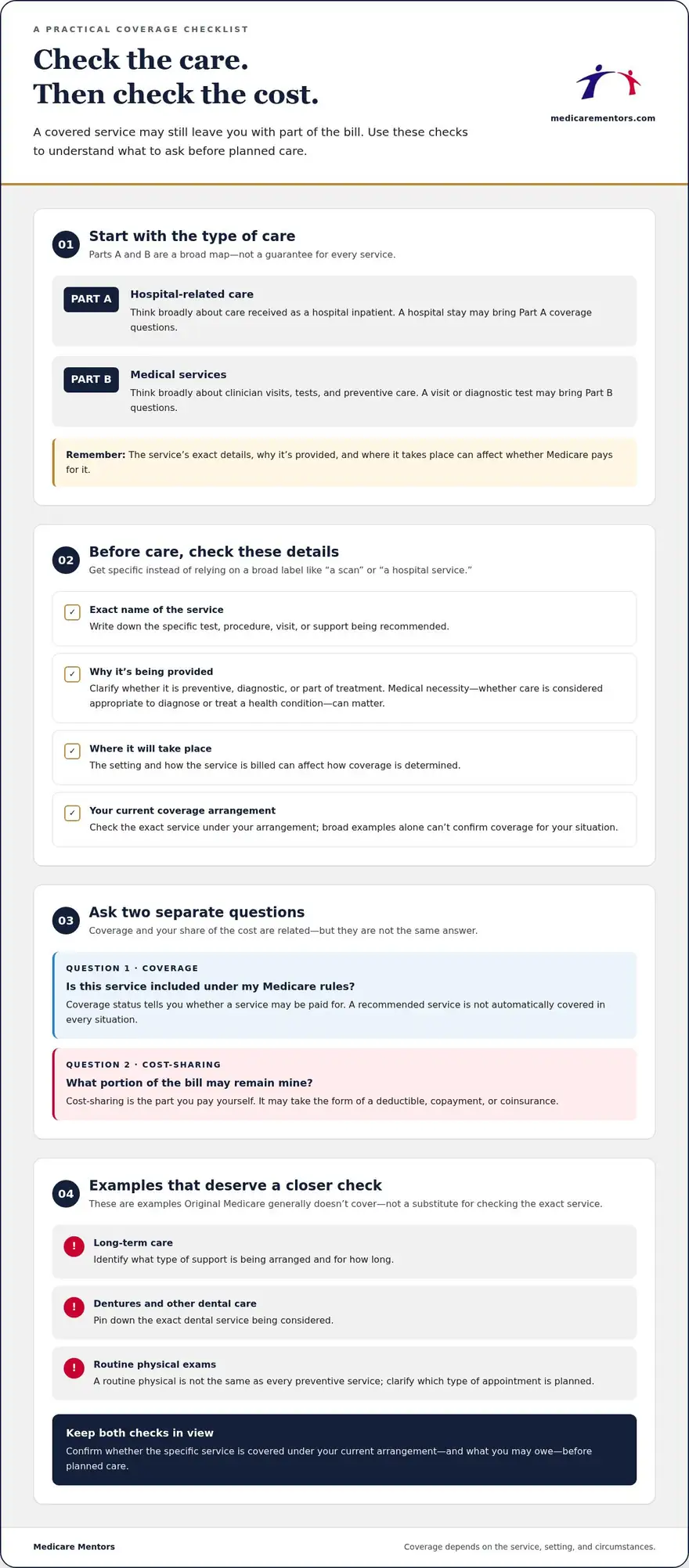
- Part A: Think broadly about hospital-related care.
- Part B: Think broadly about clinician services, tests, and preventive care.
For a specific service, the details matter. The type of care, where it takes place, and how it’s billed can affect whether Medicare pays for it. A test, for example, may need to meet Medicare’s rules for your situation. For a broader overview of Medicare’s parts and background, see the Medicare (United States) Wikipedia article.
Why covered care and out-of-pocket costs are different
Coverage answers whether a service is included under the applicable rules. It doesn’t tell you the exact amount you’ll owe. Your share may depend on your coverage path and the details of the service. Cost-sharing is the portion you pay yourself, which may take the form of a deductible, copayment, or coinsurance. In plain language, it’s the part of the bill that your coverage doesn’t pay.
Coverage status tells you whether a service may be paid for; cost-sharing tells you what portion of the bill may remain yours. Keep both questions in view, especially before a test, procedure, or other planned service.
Before care, write down the service’s exact name and why it’s recommended. Then check whether it’s covered under your current arrangement and what you may owe. If you’re comparing options, review how each handles the care you expect to use. Medicare Mentors’ Medicare planning guidance can help you understand coverage paths and compare them without rushing into a decision.
What Medicare Parts A and B Cover, and Where Questions Remain
Parts A and B offer a useful starting map, but they don’t answer every question about a particular appointment, test, or service. The category of care matters, as can the reason it’s provided, where it takes place, and the details of your situation. Use the examples below to orient yourself, then check the exact service before assuming it’s covered.
Part A and Part B in everyday terms
Part A is hospital insurance; Part B is medical insurance. In everyday terms, Part A generally relates to care received as a hospital inpatient, while Part B generally relates to medical services such as clinician visits, tests, and preventive care. These are broad descriptions, not guarantees that every service in a category will be covered.
For example, a hospital stay may bring Part A questions, while a clinician visit or diagnostic test may bring Part B questions. But the label alone isn’t enough to settle coverage. The specific service, why it’s being provided, and the setting can all matter. Medicare.gov’s Official Medicare.gov guide to Medicare basics offers an overview of the different parts and how they fit into Medicare.
If a clinician recommends a service, note its exact name and why it’s needed. That gives you something specific to check instead of relying on a broad phrase like “a scan” or “a hospital service.” It can also help clarify whether the proposed service is preventive, diagnostic, or part of treatment.
What Original Medicare may not cover
Some familiar needs don’t generally fall under Original Medicare’s coverage. Medicare.gov lists long-term care, dentures, and routine physical exams as examples of services Original Medicare doesn’t cover. “Routine physical exam” is worth distinguishing from preventive services that may be covered under different rules. Don’t assume every visit described as preventive or routine receives the same coverage treatment.
- Long-term care: Identify what type of support is being arranged and for how long.
- Dental care: Identify the exact service, such as dentures or another dental procedure.
- Physical exam: Clarify whether the appointment is a routine physical or a different preventive service.
Medicare coverage can depend on the item or service, why it’s needed, and the circumstances in which it’s provided. An example of a service that’s often excluded isn’t a substitute for checking the exact care you’re considering. Coverage decisions can hinge on details, including medical necessity, meaning whether the care is considered appropriate for diagnosing or treating a health condition.
Before scheduling, write down the proposed service as precisely as you can and check how its coverage will be determined. If you’re also considering how Parts A and B fit with other coverage, Medicare planning guidance can help you understand the available paths.
Original Medicare vs. Medicare Advantage: Two Coverage Paths
Once you understand the basic roles of Parts A and B, the next question is how you want your Medicare Coverage organized. Original Medicare and Medicare Advantage are two different paths. Neither is automatically the right fit for everyone; the better choice depends on the coverage details and care priorities that matter to you.
How the two main coverage paths differ
| Coverage path | How it’s organized | What to consider |
|---|---|---|
| Original Medicare | Uses Part A and Part B. You can add separate coverage, such as a Part D prescription drug plan or Medigap. | Consider how you want to arrange medical, prescription, and supplemental coverage. |
| Medicare Advantage | An alternative to Original Medicare offered through private plans. These plans provide a way to receive Medicare benefits through a plan. | Plan benefits and rules vary. Review the specific plan details and how they fit your needs. |
Think of Original Medicare as a foundation made up of Parts A and B, with the option to pair it with other coverage. Medicare Advantage organizes coverage through a private plan instead. That structural difference can shape what you’ll need to review, but it doesn’t determine which option is best for you. Specific plan features and rules vary, so don’t rely on general descriptions alone.
Before comparing these paths, jot down what you want to understand: how your current care needs fit, what prescription coverage you may need, and whether you want supplemental coverage alongside Parts A and B. For a closer look at the private-plan path, read the Medicare Advantage guide. If you’re learning about supplemental coverage, the Medigap guide explains that option in more detail.
Where Part D and Medigap fit
Prescription drug coverage is a separate piece to consider. Part D refers to prescription drug coverage, which may be arranged differently depending on your overall coverage path. Compare the plan information that applies to your situation, especially if you take regular medications. The 2026 Part D guide covers prescription coverage in greater depth.
Medigap, also called Medicare Supplement insurance, is supplemental coverage associated with Original Medicare. It is distinct from Medicare Advantage, not another name for it. As you compare options, keep the pieces separate: first identify your main coverage path, then see how prescription drug or supplemental coverage fits. This makes it easier to ask focused questions without assuming every plan works the same way.
How to Check Whether Medicare Covers a Service
A few focused questions can make a coverage check clearer. Before agreeing to a test, treatment, item, or supply, find out exactly what’s being recommended and how your coverage applies. Keep notes as you go. That way, you can distinguish whether Medicare covers the service from how much you may owe.
Questions to ask before receiving care
Use this three-step check for planned care:
- Identify the exact service. Write down the name of the test, procedure, item, or supply, and why it’s recommended. If the description is unfamiliar, look for a plain-language explanation.
- Review coverage and possible costs. Find out whether Medicare is expected to cover the specific service in your circumstances and what costs could remain. Check whether the answer could change based on where the service takes place or who provides it.
- Verify with the appropriate source. Check the relevant Medicare information or contact your plan if you have one. Keep a note of the source and the details you used, so you can refer back to them.
Costs can depend on details beyond the service itself. These may include other insurance you have, the provider’s charges, whether the provider accepts Medicare assignment, and the facility and location involved. Assignment means the provider agrees to accept the Medicare-approved amount for a covered service. Check these details rather than assuming the same service will lead to the same bill in every setting.
Write down the answers, including the source you consulted and any terms you need explained. A direct question like “What might I owe, and what could change that amount?” can uncover details a yes-or-no coverage answer won’t address.
What to do when coverage or a bill is unclear
If you receive an unexpected bill, first identify what’s unclear: Was the service covered, or is the amount being charged the concern? Review the bill alongside any coverage information or explanation you received. Then contact the plan responsible for the service, if applicable, with the exact date, service name, and question. Ask for the decision or charge to be explained in plain language. Don’t assume a bill alone tells you why a service was treated a certain way.
Coverage can turn on details that are easy to miss, so keep related paperwork together and note the answers you receive. Medicare Mentors’ Medicare planning guidance can help you understand how your coverage path affects the questions to consider. If you’d like help making sense of your options, talk with Medicare Mentors.
Medicare Coverage Next Steps for North Carolina Residents
Your next step depends on what’s changing in your life. If you’re turning 65, retiring, continuing to work, or moving to North Carolina, review how your current or upcoming coverage fits your situation. A move can mean new local plan options, and plan details may vary by location. Check information for the county where you live rather than assuming a plan or benefit works the same way everywhere.
Before comparing options, make a short list of what matters to you: the care you expect to use, the prescriptions you take, and any doctors or hospitals you want to keep seeing. If you’re still working or preparing to leave employer coverage, include that change in your review. Whether you live in Raleigh, Durham, Chapel Hill, Greensboro, Fayetteville, Wilmington, Charlotte, Winston-Salem, High Point, or Greenville, compare options for your address. Clear priorities turn a broad Medicare Coverage question into practical points to review.
When a coverage review may be useful
Life changes can affect whether your current coverage still fits. Consider a review when you retire, move, notice a change in your health needs, or start taking new prescriptions. Include those details in your review, along with questions about providers and costs. For help understanding enrollment timing and next steps, see the 2026 Medicare enrollment guide.
Use a review to check what matters now, not just the choices you made before. Your priorities may have changed since your last comparison, and current local options should be reviewed for your location.
How independent guidance can make decisions clearer
Medicare Mentors is an independent brokerage, not tied to a single insurance carrier. We explain and compare coverage paths with an education-first approach, helping you understand the differences before you decide. Our client services are provided at no cost to you. We also offer continuing support through annual reviews and questions about billing or claims as your circumstances change.
Bring your questions, even if you’re not sure which coverage term to use. A conversation can start with a simple concern, such as whether a prescription change affects your options or what to revisit after moving. You can take time to understand the choices and decide what makes sense for you.
If you’d like to talk through your situation, schedule a Medicare conversation. Bring questions about timing, location, prescriptions, or changes in care, and we’ll help you make sense of the options at your pace.
Take Your Next Step With Confidence
You don’t have to solve every Medicare question today. Choose one decision that’s coming up, such as reviewing a plan before retirement or understanding how a move could affect your options. Write down what you need to know and what matters most to you. A clear starting point can make the next conversation feel more manageable.
Medicare choices can shift as your life and health needs change. Give yourself room to ask questions, compare what matters, and decide at a pace that feels right. You deserve to understand your options before choosing a direction.
Schedule a no-cost conversation and move forward with more clarity. Take the next step when you’re ready, and approach your Medicare Coverage decisions with greater confidence.
Frequently Asked Questions
Is Medicare coverage automatic when I turn 65?
Not always. If you already receive Social Security retirement benefits when you become eligible, you may be enrolled in Parts A and B automatically; otherwise, you may need to sign up yourself. Check your Social Security account or contact Social Security well before your birthday month to confirm what will happen. Don’t assume Medicare Coverage starts automatically, especially if you’re still working or delaying retirement benefits.
Can I keep employer health insurance after Medicare starts?
Often, yes, but how the coverage works alongside Medicare depends on your employment situation and the employer plan. Ask your benefits administrator whether the plan is based on your or your spouse’s active employment, how it coordinates with Medicare, and what happens when employment ends. Before declining Medicare or dropping workplace coverage, get clear answers about enrollment timing and any effects on your prescriptions or dependents.
Can I change Medicare coverage after moving to North Carolina?
A move may give you an opportunity to change plans, particularly if your current plan doesn’t serve your new address. Check your plan’s service area and the timing rules that apply before making a change. Options can differ by county, whether you move to Raleigh, Durham, Chapel Hill, Greensboro, Fayetteville, Wilmington, Charlotte, Winston-Salem, High Point, or Greenville. Compare plans available at your new address.
Does Medicare cover routine dental care or hearing aids?
Original Medicare generally doesn’t cover routine dental care or hearing aids. Some Medicare Advantage plans may include dental or hearing benefits, but services, limits, and costs depend on the plan. Before scheduling care or buying a hearing device, review the plan’s current documents for the specific service or item. Don’t assume that coverage for one dental procedure means other routine dental care is included.
Does Medicare cover long-term care in a nursing home?
Medicare generally doesn’t pay for ongoing, long-term help with daily activities in a nursing home. That kind of custodial care is different from skilled nursing care provided for a medical need, which may be covered in certain circumstances. When personal assistance is needed at home, families often look to private providers like Life's Angel Home Care for custodial support. Review which services are considered skilled care and which are custodial, then confirm how your coverage applies before relying on an estimate.
Can I have Medicare Advantage and Medigap at the same time?
Medigap is designed to supplement Original Medicare, not a Medicare Advantage plan, so it won’t pay Medicare Advantage cost-sharing. If you’re considering a switch between these coverage paths, review the timing and any rules that apply to getting a Medigap policy in your situation. Don’t keep paying for supplemental coverage assuming it will fill gaps in an Advantage plan; check what each policy actually covers.
Can a family member help me understand my Medicare coverage options?
Yes. A family member can help you organize questions, take notes, and compare plan information with you. You can invite them to a conversation or review documents together, especially if you’re managing new prescriptions or a move. If you want someone to discuss personal account details on your behalf, ask Medicare or your plan what permission or authorization is needed. You remain in control of your decisions.