
Blog
What Is a Medsup Plan? Complete 2026 Guide to Medicare Supplement Insurance
By Medicare Mentors ·
Original Medicare covers a substantial amount of healthcare, but it leaves behind an unlimited twenty percent coinsurance that can quietly dismantle a comfortable retirement. That potential coverage gap is why securing the right Medsup plan is one of the most important steps you can take. If your mailbox is currently stuffed with glossy marketing flyers, you aren't alone in feeling exhausted by aggressive sales tactics.
Trying to tell the difference between Medsup, Medigap, and Medicare Advantage often feels confusing, especially when you are worried about unexpected hospital bills down the road. You deserve calm, objective education rather than a high-pressure sales pitch. In this guide, you will discover how Medsup policies wrap around Original Medicare to provide predictable costs, see how popular options like Plan G and Plan N compare, and identify your exact enrollment window so you can lock in coverage without medical underwriting or costly penalties.
Here is everything you need to know to take charge of your healthcare decisions with total confidence for 2026.
Key Takeaways
- Discover why a Medsup plan is simply another term for Medigap, and how it works alongside Original Medicare to protect your retirement savings from unlimited coinsurance costs.
- Learn how the automatic claims crossover process coordinates between Medicare and your supplemental insurer so you never have to file paperwork manually.
- Compare the crucial differences between Plan G and Plan N, focusing on doctor copayments and Part B excess charges to find the best fit for your budget.
- Identify your one-time Medigap Open Enrollment Period to guarantee your right to buy any policy without medical underwriting or health-based denials.
- Understand carrier pricing methods and why a company's rate increase stability matters far more than an attractive introductory monthly premium.
What Is a Medsup Plan? Understanding Medicare Supplement Insurance Basics
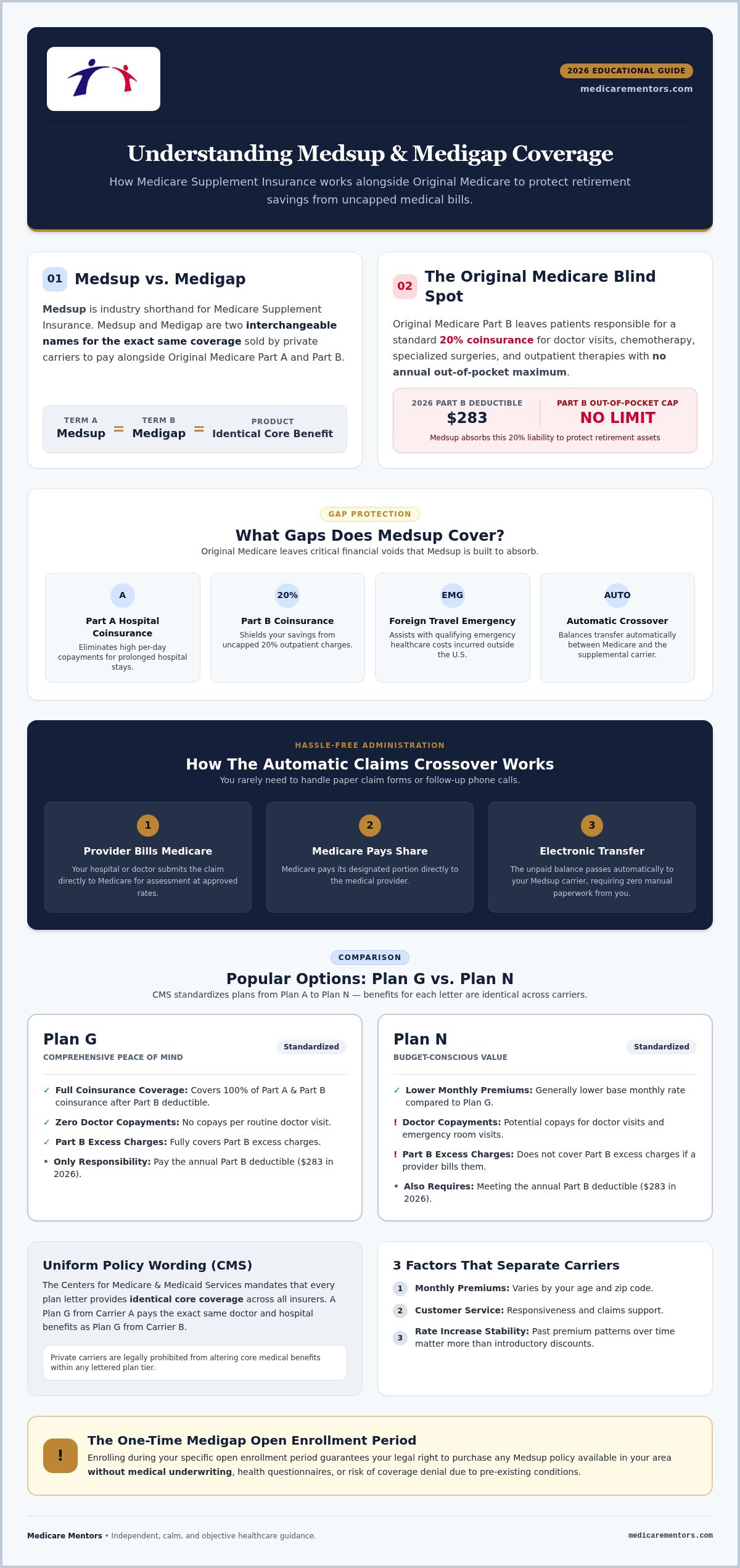
When searching for healthcare answers in retirement, you might notice that search results occasionally confuse medical supply distributors with insurance coverage. To clear up any confusion: a Medsup plan is an insurance policy designed to protect your wallet. Medsup is the common industry shorthand for Medicare Supplement Insurance, which is private health coverage that pays directly alongside Original Medicare Part A (hospital insurance) and Part B (medical insurance).
Because Original Medicare was never created to pay for everything, it leaves critical gaps in coverage. These include hospital coinsurance, daily copayments for prolonged care, and the standard twenty percent coinsurance for doctor visits and outpatient therapies. Without additional protection, there is no annual ceiling on what you could owe out of pocket. To help simplify how these policies fit into your overall healthcare strategy, exploring the fundamentals of medicare planning can show you how to guard against unforeseen medical expenses, including foreign travel emergency care.
To better understand how supplemental coverage compares to all-in-one alternatives, watch this helpful breakdown:
Medsup vs. Medigap: Is There Any Difference?
The short answer is no. If you find yourself asking What Is a Medsup Plan?, remember that Medsup and Medigap are two interchangeable names for the exact same product. Private insurance carriers sell these policies, and consumer guides alternate between both terms freely. Whether a pamphlet labels it Medigap or Medsup, both refer to state-approved supplemental coverage that fills the financial voids in traditional Medicare.
Standardized Benefits: Why Plan Letters Mean Identical Core Coverage
The Centers for Medicare & Medicaid Services (CMS) strictly standardizes these policies into lettered plans, running from Plan A through Plan N. Each specific letter offers identical core medical benefits across every insurance carrier. For example, a Plan G from Carrier A pays for the exact same doctor visits and hospital charges as a Plan G from Carrier B.
Because the government mandates uniform policy wording, private insurance carriers cannot alter your basic medical benefits. That standardization shifts your buying decision to three critical factors:
- Monthly premium rates for your specific age and zip code.
- Customer service quality and responsiveness.
- Historical rate stability and premium increase patterns over time.
How Medsup Works with Original Medicare to Eliminate Cost Surprises
Managing healthcare bills should never feel like a second career. When you visit a clinic or hospital, your provider bills Medicare directly. Medicare assesses the approved rate, pays its designated share, and automatically passes the remaining unpaid balance to your supplemental carrier through an electronic crossover system. Understanding the official guidelines for How Medsup Works with Original Medicare reveals just how simple this coordination is: you rarely need to handle paper claim forms or make follow-up phone calls.
Eliminating the 20% Outpatient Coinsurance Risk
Original Medicare provides essential foundation coverage, yet Part B contains an enormous financial blind spot: it has no annual out-of-pocket maximum. Once you meet the annual Part B deductible ($283 in 2026), you remain responsible for twenty percent of all outpatient medical expenses indefinitely.
Consider the real-world impact if you face a serious medical diagnosis requiring chemotherapy, specialized surgery, or extended physical therapy. An uncapped twenty percent coinsurance can easily result in tens of thousands of dollars in personal liability. A Medsup policy acts as a financial shield, absorbing that twenty percent cost so your retirement savings remain safe from sudden depletion.
Freedom from Doctor Networks and Prior Authorization Hurdles
Network restrictions can create unnecessary roadblocks when you need specialized care. Unlike the narrow HMO or PPO networks common in many medicare advantage plans, supplemental insurance gives you unrestricted access to any doctor or hospital across the country that accepts Original Medicare. Key advantages include:
- Zero network boundary restrictions when traveling outside your home state.
- Direct access to specialists without waiting for a primary care doctor referral.
- Treatment choices determined entirely between you and your physician rather than an insurance claims adjuster.
You never have to worry about whether a preferred medical center is in-network or if an emergency while visiting family will trigger surprise bills. If you want an objective evaluation of your options to keep your care completely unrestricted, partnering with an independent guide like Medicare Mentors provides clear direction at zero cost to you.
Comparing the Most Popular Medsup Options: Plan G vs. Plan N
For decades, Plan F served as the default standard for comprehensive coverage. Federal legislation closed Plan F to anyone newly eligible for Medicare on or after January 1, 2020, shifting consumer focus to the two modern leaders: Plan G and Plan N. Both standardized Medsup options deliver outstanding protection against high medical bills, but they manage monthly premiums and out-of-pocket costs in distinct ways.
Medsup Plan G: Maximum Financial Predictability
Plan G represents the most comprehensive coverage available to newly eligible beneficiaries. After paying the annual Part B deductible ($283 in 2026), your policy covers 100 percent of all remaining Medicare-approved services. This includes the Part A hospital deductible ($1,736), daily hospital coinsurance, skilled nursing facility cost-sharing, and Part B excess charges. If you prefer paying a predictable rate each month and never worrying about variable bills after doctor appointments, Plan G delivers absolute peace of mind.
Medsup Plan N: Lower Premium Strategy with Small Copays
Plan N takes a cost-sharing approach, offering lower monthly premiums in exchange for small, predictable copayments. Under Plan N, you are responsible for:
- The annual Medicare Part B deductible.
- Copayments of up to $20 for specific doctor and specialist visits.
- Copayments of up to $50 for emergency room visits that do not lead to an inpatient admission.
Plan N does not cover Part B excess charges, which happen when a doctor bills up to 15 percent above Medicare's approved rate. Because the vast majority of physicians across North Carolina accept Medicare assignment directly, these excess charges remain remarkably rare, making Plan N an attractive value for healthy retirees.
Key Differences: Medsup Versus Medicare Advantage
Deciding between supplemental insurance and an all-in-one alternative comes down to how you prefer to budget. Medsup relies on an upfront premium structure that grants complete physician freedom nationwide, while Medicare Advantage relies on pay-as-you-go copayments tied to local doctor networks in areas like Raleigh, Durham, or Charlotte. As you research trusted guidance on When to Enroll in a Medsup Plan, scheduling personalized medicare planning allows you to evaluate your prescription needs, preferred doctors, and travel habits before making a lasting commitment.
When to Enroll: Timing Medsup to Avoid Underwriting
Timing dictates everything when securing supplemental coverage. Enrolling at the proper moment gives you guaranteed access to coverage, while waiting too long exposes you to medical underwriting that can result in rejected applications or steep price hikes.
The 6-Month Medigap Open Enrollment Golden Window
Your primary enrollment window begins the first day of the month you are both age 65 or older and enrolled in Part B. For six consecutive months, you hold federally protected guaranteed issue rights. During this golden window, private insurance companies cannot review your medical history, deny your application, or charge higher premiums due to pre-existing health conditions.
Following a step-by-step medicare enrollment guide months ahead of your 65th birthday gives you ample runway to evaluate your choices calmly. Once this window closes, switching your Medsup policy in North Carolina requires answering detailed health questionnaires, meaning a future diagnosis could lock you into your current plan.
Retiring Past 65 or Relocating to North Carolina
If you continue working past 65 with active group health insurance through an employer, your six-month Medigap window pauses until that employer coverage ends. Leaving creditable group coverage triggers a Special Enrollment Period, allowing you to activate Part B and pick a supplemental policy without answering medical questions.
Relocating across state lines to communities like Greensboro, Wilmington, or Fayetteville also requires careful planning. While your standardized benefits travel with you, local carrier pricing and plan options vary by county. Setting up your transition ahead of time ensures you avoid sudden gaps in coverage during your move.
Filling the Missing Pieces: Prescription, Dental, and Vision Coverage
A supplemental plan is a foundational tool, but it does not cover every expense. Federal regulations prohibit modern supplement policies from including retail prescription drug coverage. To avoid lifetime late enrollment penalties, pairing your supplement with standalone medicare part d plans is essential during your transition into Medicare.
Original Medicare and supplemental policies also exclude routine dental visits, eye exams, hearing aids, and final expense costs. Completing your healthcare puzzle often means adding standalone dental, vision, and hearing protection alongside your primary insurance. To review your specific timeline and piece together the right coverage, connect with the team at Medicare Mentors for clear, carrier-neutral guidance.
How to Choose the Right Medsup Policy with Independent Guidance
Because all Medsup policies with the same letter offer identical core benefits, picking a plan comes down to carrier reliability and premium pricing models. Many retirees fall into the trap of choosing the cheapest policy on paper, only to face steep rate hikes in subsequent years.
Evaluating Premium Rating Methods and Rate Stability
Carriers calculate your monthly costs using three primary structures: community-rated, issue-age-rated, or attained-age-rated. Attained-age policies base your pricing on your current age, which means your rates climb automatically as your birthdays pass, alongside general healthcare inflation. In contrast, issue-age policies base your rate on how old you are when you enroll, offering greater pricing stability over time.
Evaluating rate trends before committing to a Medsup plan protects your long-term budget. An enticing, low introductory price often belongs to an aggressive carrier that later issues double-digit rate hikes to balance its books. Checking carrier financial strength ratings helps ensure your insurer has the financial backing to pay claims reliably.
The Advantage of Working with a Local Independent Broker
Captive agents work directly for a single insurance company, which limits their recommendations to a single menu of products. An independent brokerage works directly for you, comparing multiple top-rated carriers side by side without sales quotas or corporate bias.
Because independent guidance comes at zero cost to the client, you receive objective advice without paying broker fees. Reading more about why use a medicare broker reveals how having an advocate simplifies your initial enrollment and provides ongoing support whenever annual rate increases or billing questions emerge.
Your Next Steps Toward Confident Medicare Coverage
Making a confident choice starts with compiling your basic information: your targeted retirement date, your list of medications, and your preferred physicians. With those pieces in hand, collaborating with a patient educator removes the guesswork.
Dave and Michele Johnson founded Medicare Mentors in 2011 to guide retirees through complex healthcare choices with clarity and respect. Backed by nearly 300 five-star client reviews, their independent, family-run team acts as your dedicated partner through every phase of retirement. Schedule your free consultation with Medicare Mentors today to compare your options and secure the ideal coverage for your needs.
Secure Your Healthcare Confidence for 2026 and Beyond
Navigating retirement healthcare doesn't have to feel overwhelming or solitary. Securing a reliable Medsup plan protects your hard-earned savings from uncapped twenty percent outpatient coinsurance, grants you complete freedom to visit any doctor nationwide, and locks in predictable expenses. Whether Plan G matches your desire for zero surprise bills or Plan N offers the right balance of lower premiums and modest copayments, timing your enrollment properly ensures guaranteed acceptance without health screenings.
You don't have to sort through confusing marketing mailers by yourself. As an independent, family-run agency led by Dave and Michele Johnson, Medicare Mentors delivers completely free, objective plan comparisons across top-rated carriers. With nearly 300 five-star reviews from satisfied clients, our team serves as your ongoing advocate, helping you evaluate rate changes and claims year after year.
Ready to put all the pieces of your healthcare coverage together? Take the next step and schedule your no-cost consultation with Medicare Mentors. Friendly, expert guidance is just a conversation away, giving you the clarity to enjoy retirement with total peace of mind.
Frequently Asked Questions
What is the difference between Medsup and Medigap insurance?
There is no difference between the two terms. Medsup is simply informal shorthand for Medicare Supplement Insurance, while Medigap is the federally recognized industry name. Both terms refer to the exact same private health insurance policies designed to pay the cost-sharing gaps left by Original Medicare. Whether an agent in Raleigh calls it Medigap or Medsup, the underlying policy rules, lettered benefits, and consumer protections remain identical.
Does a Medsup plan cover prescription drugs from a pharmacy?
No, Medsup plans do not cover retail medications picked up at a pharmacy. Federal regulations discontinued prescription drug benefits from modern supplement policies in 2006. To secure medication coverage and avoid lifetime late enrollment penalties, you must enroll in a standalone Medicare Part D prescription drug plan alongside your supplement. An independent broker can review your current medications to pair your coverage with an appropriate prescription plan.
Can an insurance carrier drop my Medsup coverage if I develop health issues?
No, an insurance company cannot cancel your policy simply because you develop new health conditions. Supplemental policies are guaranteed renewable under federal law. As long as you pay your monthly premiums on time and made truthful statements on your initial application, the insurer must continue your coverage. You cannot be singled out for plan cancellation or charged individual rate hikes due to serious diagnoses or high medical bills.
How much does a Medsup policy typically cost per month?
Monthly costs vary based on your age, location, gender, tobacco use, and the specific plan letter you select. Insurance carriers evaluate these personal details alongside their rating structure, such as issue-age or attained-age pricing, to set their rates. Beneficiaries across North Carolina, from Charlotte to Greensboro, will find varying rates among competing carriers. Working with an independent broker lets you compare pricing across multiple companies without extra fees.
Can I use my Medsup policy at any hospital or doctor in the country?
Yes, you can use your coverage at any healthcare provider across the United States that accepts Original Medicare. Supplemental plans do not restrict you to local HMO or PPO provider networks. Whether you visit a doctor down the street in Durham or seek specialized medical care at a hospital across the country, your benefits travel with you seamlessly without requiring prior out-of-network approvals.
What happens if I miss my six-month Medigap Open Enrollment Period?
Missing your initial enrollment window means you lose your guaranteed right to purchase a policy without health questions. Insurance companies in North Carolina can then require medical underwriting, reviewing your complete medical background. Carriers can legally charge higher monthly premiums or deny your application entirely based on past conditions. However, qualifying life events, such as losing employer group coverage, may trigger a special enrollment right.
Do I need a referral to see a specialist with a Medsup plan?
No, you never need a referral from a primary care doctor to consult a specialist. Supplemental coverage follows Original Medicare rules, which bypass the gatekeeper requirements typical of managed care plans. If you need to see a cardiologist, oncologist, or orthopedic surgeon who participates in Medicare anywhere from Wilmington to Winston-Salem, you can simply call their office and book your appointment directly.