
Blog
Medicare 101 Seminars in Charlotte, NC: Free Learning Options
By Medicare Mentors ·
A Medicare seminar should leave you clearer, not pressured. A Medicare 101 seminar in Charlotte, NC, can be a free way to learn how coverage options fit together, with no sales presentation or obligation to enroll.
It’s understandable if the choices feel like a lot: Original Medicare, Medicare Advantage, Medicare Supplement coverage, and prescription drug plans each play a different role. A seminar can help you sort out the basics, but a general class won’t necessarily tell you which plan fits your doctors, prescriptions, and budget.
Here, you’ll learn what to expect at a seminar, how to find free Medicare learning sessions around Charlotte, and what questions to bring with you. We’ll also explain how the main coverage options work together, so you can leave with a clearer sense of what you’ve learned and what decisions may still be ahead.
Key Takeaways
- Learn how to tell an educational session from a sales seminar, and what to ask about enrollment or follow-up.
- Use the listed North Carolina classes and Charlotte events to identify the right type of Medicare learning session for your needs.
- See how Parts A and B, Medicare Advantage, Supplement coverage, and Part D fit together before comparing options.
- Bring a list of your prescriptions, doctors, and coverage questions so you can make better use of a seminar.
- Find out when one-on-one guidance from Medicare Mentors may help you compare coverage choices after the class.
What can people expect by attending a Medicare sales seminar or an educational seminar?
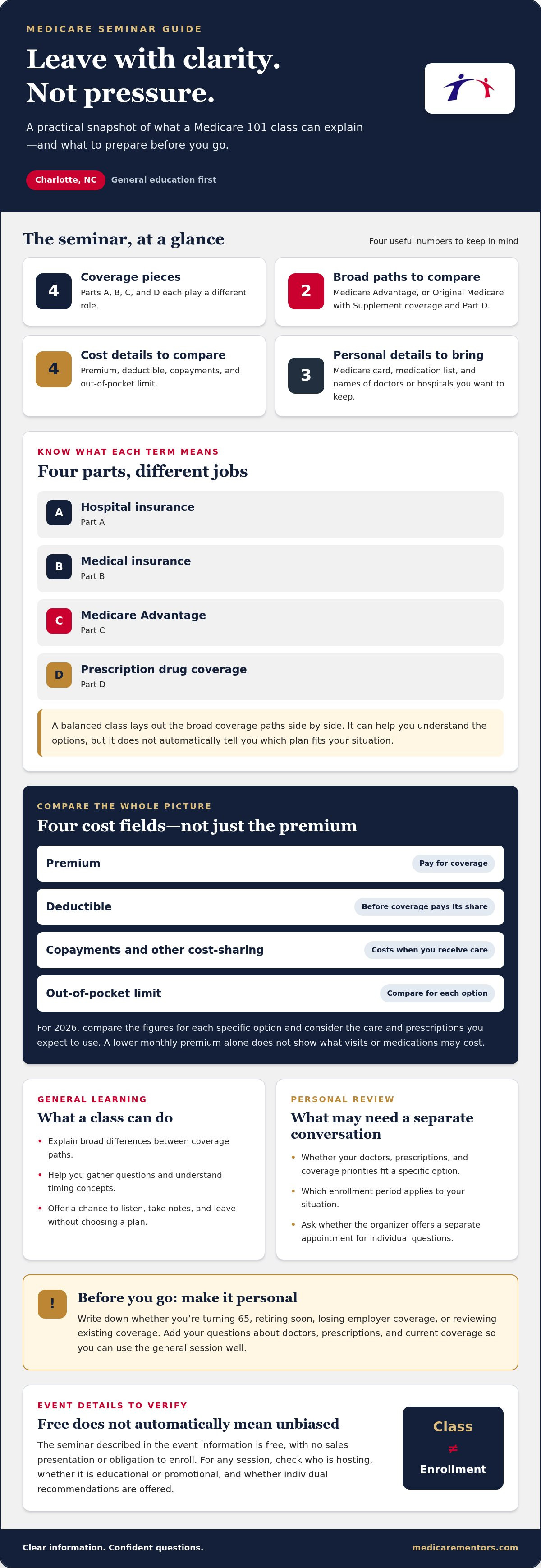
A Medicare seminar can explain coverage choices without requiring you to enroll. The 2026 premiums, deductibles, and out-of-pocket costs depend on the coverage option and care you use, so compare those figures for each specific plan.
Enrollment Choices and Follow-Up
Expect an educational session to explain how Medicare Advantage and Original Medicare with Supplement coverage and Part D differ. A balanced Medicare 101 class presents those paths side by side, helping you understand what each combines or covers. The class does not provide individual plan recommendations.
Bring a short list of questions about your doctors, prescriptions, and current coverage. Ask whether the organizer offers a separate appointment to discuss your situation. Use that conversation to clarify which enrollment options fit your priorities, rather than treating a general presentation as a personal plan review.
Seminar Costs and Enrollment Obligations
The Medicare seminar described in the event information is free to attend, with no sales presentation or obligation to enroll. You can listen, take notes, and leave without choosing a plan. Attending a class and enrolling in coverage are separate steps.
Before making an enrollment decision, find out what the session covers and whether it includes individual recommendations. A class can explain broad differences, while a separate appointment may address your doctors, prescriptions, and coverage needs. Keep those purposes distinct, especially when a presentation discusses specific plan options.
Enrollment Periods and Timing
Your timing questions may differ if you’re turning 65, retiring soon, losing employer coverage, or reviewing existing coverage. Ask which enrollment period applies to your situation and what decisions belong within it. A seminar can explain timing concepts, but its general discussion may not settle your personal enrollment questions.
Charlotte’s South County Regional Library listed an Annual Enrollment Period workshop for September 22, 2026, from 6:00pm to 7:00pm. It was scheduled at 5801 Rea Road, Charlotte, NC 28277. Use an Annual Enrollment workshop to learn what plan changes to compare and what information to gather before making a decision.
Premiums, Deductibles, and Out-of-Pocket Costs
For 2026, compare the premium, deductible, copayments, and out-of-pocket limit associated with each option. A premium is what you pay for coverage; a deductible is an amount you pay toward covered services before coverage pays its share. Copayments and other cost-sharing can affect what you spend when receiving care.
Ask how costs apply to the services you expect to use, including prescriptions. Don’t compare premiums alone. A lower monthly premium, for example, doesn’t tell you what visits or medications may cost. Write down each figure for the specific option discussed, then compare the overall costs.
Free Medicare education seminars in North Carolina and online
Charlotte-area Medicare sessions have been listed at University City Regional Library and South County Regional Library. North Carolina classes have also appeared at senior centers, including the Anne Gordon Center for Active Adults in Raleigh. A venue alone doesn’t tell you whether a presenter is unbiased, so read the event description for the host, sales content, and whether individual recommendations are offered.
Free seminars can provide general Medicare education without requiring enrollment. The seminar described in the event information is free, with no sales presentation or obligation to enroll. Sessions can differ, though. Before attending, note whether the meeting covers Medicare basics, specific plans, or individual counseling.
Who hosts Medicare education seminars in Charlotte, and are they unbiased? Local venues include University City Regional Library and South County Regional Library, but the presenter may vary by event. Ask who leads the session and whether it is educational or promotional. A public location alone doesn’t establish neutrality.
Where can Charlotte residents get free, unbiased Medicare counseling? Public classes can offer general education, but a class may not provide personal plan recommendations. One listed Medicare 101 class explicitly states that it does not provide individual recommendations. Separate general learning from a personal review of your doctors, prescriptions, and coverage priorities.
Prepare a few useful details before attending. Bring your Medicare card if you have one, a current medication list, and the names of doctors or hospitals you want to keep. Write down whether you’re turning 65, retiring, losing employer coverage, or moving to North Carolina. Those details help you ask focused questions during the meeting.
North Carolina listings included a Medicare drug plans workshop at University City Regional Library in Charlotte on September 23, 2026, from 1:00pm to 2:30pm. An additional Medicare 101 class was listed at Anne Gordon Center for Active Adults in Raleigh on September 22, 2026, from 10:00am to 11:30am. These dates have passed, but they illustrate the range of local class formats.
For an online meeting, review the event description before joining. Look for the topic, presenter, format, and whether questions are welcome. Keep your medication list and coverage questions nearby, as you would at an in-person session. If the meeting discusses plans, distinguish general education from a personal review of your situation.
How Original Medicare, Medicare Advantage, Medicare Supplement coverage, and Part D fit together
Think of Medicare coverage as a set of choices, not one interchangeable package. Part A is hospital insurance, Part B is medical insurance, Part C is Medicare Advantage, and Part D provides prescription drug coverage. A seminar should explain how these parts fit together and compare the main coverage paths side by side.
Start with Original Medicare
Original Medicare means Parts A and B. Part A covers hospital services, while Part B covers medical services. Under the 2025 figures presented, Part B covers 80% after deductibles, and the beneficiary pays 20%. That cost-sharing is one reason to ask how a plan handles your expected care.
Original Medicare does not cover prescription drugs, routine dental, vision, or hearing care, or long-term care. If you take a regular prescription or need routine dental care, ask how those needs fit into your overall coverage. Don’t assume that Parts A and B include every service or medication.
Compare Advantage with Supplement and Part D
Part C is Medicare Advantage. A Medicare 101 seminar should present Medicare Advantage beside the Original Medicare path, rather than treating either as the default. Ask how each option fits your doctors, hospitals, medicines, and preferred way of receiving care. Those details make the comparison practical.
If you’re considering Original Medicare, ask how Medicare Supplement coverage and Part D fit alongside Parts A and B. Supplement coverage and Part D address different needs, so review each separately. Compare the plan details that affect your doctors and prescriptions, then write down any questions that remain.
Bring questions about your care and other coverage
Before a meeting, list your doctors, preferred hospitals, and prescriptions. Ask whether your doctors participate in the option being discussed and whether your medicines are covered. If a doctor or hospital network has changed, ask how that affects your choice. For a higher-cost prescription, ask which plan details determine your share.
Work status matters, too. If you’re still working past 65, retiring soon, or losing employer coverage, tell the educator before discussing enrollment. Ask how your current insurance coordinates with Medicare and what timing considerations apply to your situation. A move to North Carolina is another useful detail to mention, especially if you’re reviewing providers or prescriptions.
Use this simple checklist during the seminar: identify your care needs, compare the two main coverage paths, and note which questions need an individual review. A clear comparison of Parts A, B, C, and D, plus Supplement coverage, can help you see which options address your priorities.
In-person Medicare seminars in Charlotte
An in-person session can make Medicare easier to discuss. Arrive with a clear question and aim to leave with specific next steps.
Benefits of Attending in Person
A face-to-face meeting lets you hear an explanation, take notes, and ask for unfamiliar terms to be clarified. If Medicare language feels unfamiliar, pause and ask the presenter to explain it in everyday words. Note which answers apply generally and which depend on your own coverage.
Prepare a short list of questions before leaving home. For example, ask how to compare a doctor’s participation, prescription coverage, or the way two plan types address your priorities. If you’re retiring or losing employer coverage, include that change in your questions. Specific prompts help keep the discussion focused on what matters to you.
Bring a notebook and write down unfamiliar terms instead of trying to remember every detail. After the presentation, sort your notes into two groups: points you understand and questions that still need an individual review. This gives you a practical way to keep learning without making a decision during the meeting.
Use the session to understand your choices, not to rush into one. A broad explanation can help you identify details that deserve closer attention. If a topic isn’t covered, record it and ask whether there is time for questions or a separate follow-up. You’ll leave with a clear list of what remains unresolved.
Workshop Locations and Event Schedule
For a future Charlotte workshop, use the event notice to confirm the venue, full street address, start time, topic, and registration instructions. Keep those details together in your calendar or notes. This simple step helps prevent confusion between events with similar Medicare titles.
Match the session topic to the question you want answered. A workshop focused on prescription coverage may be more useful for a medication concern than a broad Medicare overview. If your main concern is a change in doctors, look for a session that explains plan comparisons or provider access.
Before traveling, review the event notice again and confirm the location and date. If the listing gives registration instructions, follow them before setting out. Keep the event title with your notes so you can connect what you hear to the session’s purpose afterward.
After a Charlotte seminar, revisit your notes while the discussion is fresh. Mark any point that affects your decision and identify what information you still need. That follow-through makes an in-person meeting a useful step in your Medicare planning, rather than a one-time presentation.
Medicare events in Charlotte
A local event listing is useful when it helps you decide whether a meeting fits your question. Read the full description, not just the title. Look for the subject, intended audience, presenter, format, and instructions for attending.
Start with your immediate need. If you’re approaching 65, identify whether the session explains Medicare basics or focuses on a specific coverage decision. If you’re retiring or losing employer coverage, write down that change and look for a meeting that addresses enrollment timing.
Prescription concerns call for a specific focus. If medication costs have changed, note whether the event description mentions drug coverage. Before attending, list your prescriptions and prepare a question about comparing coverage details. The topic can help guide your choice, while your medication list makes your question specific.
Check practical details in the listing, too. Confirm the address, date, start time, registration instructions, and whether the event is in person or online. Save the notice or add its details to your calendar so you have the information together when it’s time to attend.
Use the description to understand what the session will and won’t address. A general overview may explain terms, while a focused workshop may spend more time on one subject. Note whether the listing says the meeting offers individual recommendations or only general education.
Before you go, prepare a short list of questions and bring notes about any coverage change you’re facing. Afterward, mark which questions were answered and which still need personal attention. This simple follow-through helps make the event a useful part of your Medicare decision process.
If a listing doesn’t answer a practical question about attending, use the contact method in that event notice. Keep the event title nearby so your question is clear. Then use what you learn to identify your next decision, rather than feeling you must settle every coverage question at one meeting.
Once you have the event information and your questions organized, you can continue comparing the choices that matter to you. Explore Medicare planning options as a next step in that process.
Medicare Mentors: Medicare Advantage (Part C) Plans
Medicare Mentors can help you compare Medicare Advantage options after a seminar clarifies the basics. If you’re weighing provider access, prescription coverage, or how Medicare Supplement coverage differs, personalized guidance can help connect those questions to your needs. Medicare Mentors is an independent brokerage offering unbiased advice on Medicare Advantage, Medicare Supplement, and Medicare Part D Prescription Drug Plans.
Consider a one-on-one conversation if you’re turning 65, retiring, losing employer coverage, moving to North Carolina, or reviewing a change in doctors or prescription costs. Bring your medication list, preferred doctors, and notes from the seminar. That gives you a practical starting point for comparing coverage options without treating a general class as a personal recommendation.
Contact Medicare Mentors to continue your Medicare coverage discussion.
Make Your Next Medicare Decision With Clarity
A seminar can give you a helpful starting point, but your next step is personal: connect what you learned to the doctors, prescriptions, and coverage you need. After a Medicare 101 seminar in Charlotte, NC, write down any questions that still affect your decision, especially if you’re approaching 65, leaving employer coverage, or reviewing a change in care.
Medicare Mentors can help you compare Medicare Advantage (Part C), Medicare Supplement (Medigap), and Medicare Part D Prescription Drug Plans. A one-on-one conversation can turn broad seminar information into a clearer comparison of options. Take your time and bring the questions that matter to you.
Contact Medicare Mentors to discuss your Medicare coverage questions and consider your next step with confidence.
Frequently Asked Questions
Where are Medicare 101 seminars held in Charlotte NC?
Charlotte-area sessions may use community venues such as libraries or senior centers. To find a suitable class, search local event calendars for the topic you need, then check the notice for the full address and access details. If you’re traveling across Charlotte, compare the venue with your route and save the event information before leaving. Don’t rely on an old calendar entry as a current listing.
Are Medicare seminars in Charlotte NC free or paid?
Event terms can vary, so look for attendance costs in the specific listing before registering. The Medicare seminar information in this article describes free attendance, but that doesn’t establish the terms for every event. Check whether registration is required and whether the session is educational or sales-focused. Attending a seminar is separate from making a plan decision or enrolling.
How do I register for a Medicare 101 seminar in Charlotte NC?
Follow the registration method in the event notice. It may provide a phone number or other instructions; keep the event title handy so you select the right session. Check whether registration is required, and save any confirmation details with the event date and location. If the listing changes, use its latest version rather than relying on saved details alone.
What topics do Medicare 101 seminars cover, including Parts A, B, C, and D?
Seminars may explain the roles of Parts A, B, C, and D and how the coverage choices relate. To make the lesson relevant, bring a specific question, such as how to compare prescription plans or what to consider when choosing between coverage paths. Ask the presenter to distinguish general education from personal plan recommendations, then note any terms you want explained further.
What are the Medicare eligibility rules and enrollment deadlines?
Eligibility and enrollment timing depend on your circumstances, so a general seminar can’t establish your individual dates by itself. Before attending, write down whether you’re approaching 65, still working, retiring, or losing employer coverage. Ask which timing factors apply to that situation and what information you need to make the next enrollment decision. Avoid relying on another person’s timeline as a substitute for your own.
How do Original Medicare, Medicare Advantage, and Medigap compare?
Compare options by looking at how each addresses your doctors, prescriptions, and expected care. For a practical discussion, bring the names of providers you want to keep and a current medication list. Ask how those details affect each path, and record any questions the general explanation cannot resolve. This turns a broad comparison into a checklist for reviewing your priorities.
Medicare 101 seminars in Charlotte NC upcoming dates and times
The scheduled sessions were the Annual Enrollment Period workshop on September 22, 2026, from 6:00pm to 7:00pm, the Medicare drug plans workshop on September 23, 2026, from 1:00pm to 2:30pm, and a Medicare drug plans and more event on October 13, 2026, from 10:30am to 11:30am; all have passed.