
Blog
Should You Keep Your Employer Plan or Switch to Medicare? Compare coverage and costs
By Medicare Mentors ·
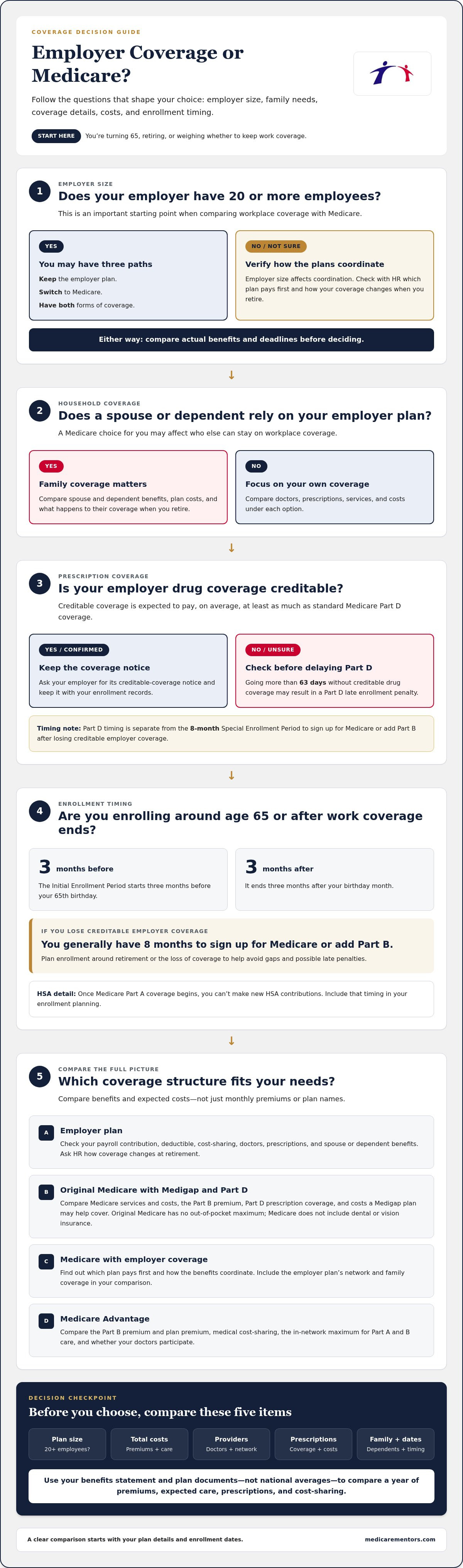
If you’re deciding whether you should keep your employer plan or switch to Medicare, the right choice depends on your employer’s size, what you pay for coverage, and whether family members rely on your plan. With coverage through an employer with 20 or more employees, you may be able to keep the plan, switch to Medicare, or have both. According to the Centers for Medicare & Medicaid Services, you generally have 8 months after losing creditable employer coverage to sign up for Medicare or add Part B.
It’s understandable to assume that keeping familiar workplace coverage is simpler, or that Medicare will automatically cost less. But premiums are only part of the comparison: deductibles, provider access, prescription coverage, and coverage for a spouse or other dependents can all affect the decision.
This guide compares employer coverage with Medicare, including how Original Medicare can be paired with Medigap and Part D. You’ll learn how costs and payer coordination differ, when enrollment timing matters, and which questions can help you choose coverage that fits your needs.
Key Takeaways
- Compare your employer’s size, plan costs, provider access, and dependent coverage before deciding whether to keep workplace insurance.
- Look beyond premiums: deductibles, out-of-pocket limits, prescription coverage, and possible income-related charges all affect total costs.
- Find out which plan pays first while you’re working, since coordination can affect what your employer plan covers.
- Plan your Medicare enrollment around retirement or loss of employer coverage to avoid gaps and possible late penalties.
- Compare employer coverage with Original Medicare plus Medigap and Part D, as well as Medicare Advantage, to see which structure fits your needs.
Is Medicare’s coverage as good as my employer-sponsored insurance?
Most people in the United States become eligible for Medicare when they turn 65, according to the Centers for Medicare & Medicaid Services. Whether its coverage compares well with your employer plan depends on costs, doctors, prescriptions, and whether your spouse or dependents need coverage.
Start by checking enrollment dates and what each plan actually covers. This video offers a brief comparison to help frame your decision:
You can enroll during your Initial Enrollment Period, which starts three months before your 65th birthday and ends three months after your birthday month, according to the Centers for Medicare & Medicaid Services. If you keep employer coverage, compare the employer’s size and drug benefits before deciding whether to delay Medicare.
Prescription Drug Coverage and Part D Penalties
Creditable prescription drug coverage is coverage expected to pay, on average, at least as much as standard Medicare Part D coverage. Ask your employer plan for its creditable-coverage notice and keep it with your enrollment records. According to the Centers for Medicare & Medicaid Services, you may owe a Part D late enrollment penalty if you go more than 63 days without creditable drug coverage. Part D timing is separate from the 8-month Part B enrollment period.
Original Medicare Gaps and Supplemental Coverage
Original Medicare covers a range of medical services, but it has no out-of-pocket maximum. A Medicare Supplement plan, also called Medigap, can help pay certain costs left by Original Medicare. Medicare doesn’t include dental or vision insurance, while an employer health plan may include those benefits. Compare covered services, doctors, and family coverage, not just plan names, before weighing possible savings.
Delaying Medicare Under a Large Employer Plan
If you’re covered through an employer with 20 or more employees, you may delay Medicare, switch to Medicare, or keep both forms of coverage. The Centers for Medicare & Medicaid Services says people who lose creditable employer coverage have an 8-month Special Enrollment Period to sign up for Medicare or add Part B. A spouse’s coverage may also affect your choice, especially if they need to remain on the employer plan.
Can you contribute to an HSA if you enroll in Medicare? No. Once Medicare Part A coverage begins, you can’t make new HSA contributions. Include that timing in your enrollment plan.
What steps should you take? Ask your employer’s HR department about plan size, prescription drug coverage, dependents, and when coverage ends. Then compare benefits and enrollment dates before deciding whether to keep the employer plan or enroll in Medicare.
| Option | Coverage to compare | Timing point |
|---|---|---|
| Employer plan | Doctors, prescriptions, spouse and dependent benefits | Ask HR how coverage changes at retirement |
| Original Medicare with Medigap | Medicare services and costs Medigap may help cover | Consider Part B and Part D enrollment dates |
| Medicare with employer coverage | Which plan pays first and how benefits coordinate | Employer size affects coordination |
Compare the actual benefits, your family’s needs, and enrollment deadlines side by side.
Medicare and employer plan deductibles and out-of-pocket costs
Compare what comes out of each paycheck with what you may pay when you receive care. Include premiums, deductibles, copays, prescription costs, and limits on your medical spending.
Employer Plan and Medicare Costs
Your payroll contribution and deductible may differ, so use your benefits statement rather than national averages. Compare those figures with Medicare premiums and any separate plan costs before deciding whether to enroll in Medicare or delay enrollment.
Premiums, Deductibles, and Out-of-Pocket Costs
Part A typically has no premium for people whose work history, or their spouse’s work history, includes Medicare taxes.
Medicare Advantage adds another cost comparison. Original Medicare has no out-of-pocket maximum, so compare its cost-sharing with your employer plan’s deductible and spending limit.
| Option | Premium comparison | Deductible or spending exposure | Network consideration |
|---|---|---|---|
| Employer plan | Use your payroll deduction | Review the plan deductible and cost-sharing | Check whether your doctors participate |
| Original Medicare | Include the Part B premium | No overall out-of-pocket maximum | Compare access with your current plan |
| Medicare Advantage | Include Part B and the plan premium | Medical maximum applies to in-network Part A and B care | Some employer-sponsored plans have limited networks |
Prescription coverage needs a separate comparison. List your prescriptions, then compare each plan’s coverage and cost-sharing alongside your medical expenses.
For a fair comparison, total a year of premiums, expected care, prescriptions, and likely cost-sharing under each option. If you’re weighing whether to delay Medicare, include the employer plan’s family benefits and network in that calculation. A Medicare coverage comparison can help you organize those choices.
Employer plan coordination with Medicare
When you have both Medicare and job-based health insurance, coordination of benefits determines which plan pays first. The primary plan processes the claim before the secondary plan considers remaining eligible costs. Your employer’s size and your eligibility status are key factors, so confirm them before assuming both plans will contribute.
Which plan pays first?
If you’re eligible for Medicare and covered by a plan from an employer with fewer than 20 employees, Medicare usually pays first. With an employer that has 20 or more employees, the employer plan usually pays first. These rules concern active employer coverage, not simply the name on your insurance card.
For example, if you work at a company with 18 employees, Medicare is generally primary. At a company with 25 employees, the employer plan is usually primary. If you’re under 65 and qualify for Medicare because of a disability, Medicare is generally primary only when the employer has fewer than 100 employees. The applicable rule can change whether a claim is paid as expected.
How employer benefits coordinate
Coordination can affect medical claims, deductibles, and prescription drug benefits. A job-based plan may not pay for services if you’re eligible for Medicare but haven’t enrolled in Part A and Part B. That makes your enrollment status important even if you intend to keep employer insurance. Before receiving care, confirm which plan is primary and give both insurers accurate coverage information.
Use these practical steps with your employer’s HR department and each plan:
- Ask HR for the employer’s employee count and the plan’s coordination-of-benefits rules.
- Tell the health insurers that you have both Medicare and employer coverage.
- Check whether your doctors and prescriptions are handled under the primary plan.
- Review claim explanations from both plans to see how deductibles and remaining costs were processed.
These steps help you understand how the plans interact instead of treating them as separate policies. Social Security status does not establish which plan pays first. Confirm your enrollment status and whether your workplace coverage is based on active employment.
What changes when work ends?
COBRA is not the same as active employer coverage for Medicare coordination. For people enrolled in Medicare, COBRA generally pays after Medicare, except in cases involving End-Stage Renal Disease. Leaving work can therefore change the payment order, even if the employer plan continues temporarily.
Ask HR how retirement affects medical, dental, and vision benefits, and when active coverage ends. Compare that date with your Medicare enrollment and coverage start dates. If you’re already eligible, don’t assume COBRA replaces Medicare as your primary coverage. Clear dates and payer order can help prevent unpaid claims and unexpected deductibles.
Delaying Medicare Part A and Part B
Delaying Medicare can make sense if you’re still working and have qualifying employer health coverage. The key is knowing which part you’re delaying, when workplace coverage ends, and whether an enrollment penalty could apply. Medicare Part A may be premium-free for many people, but enrolling can affect HSA contributions.
Check your HSA plans before enrolling. Once Medicare Part A coverage begins, you can’t make new HSA contributions. Part A may begin retroactively for up to six months when you enroll after turning 65. To avoid a tax penalty, you and your employer should stop HSA contributions six months before retirement or before applying for Social Security or Railroad Retirement Board benefits.
Part B timing depends on your employer coverage and Social Security status. People with job-based insurance may wait until they or their spouse stop working or lose that insurance without a Part B late enrollment penalty. If you’re not receiving Social Security at 65, you aren’t automatically enrolled in Medicare Part A or Part B. If you’re already receiving Social Security, contact the Social Security Administration before delaying Part B.
Keep the Part B penalty in view. The penalty is a 10% increase in your Part B premium for each additional 12-month period you delay, and it remains for as long as you have Part B coverage. People with no health insurance who are still working should generally enroll in Part A and Part B when first eligible, usually at 65, to avoid a possible penalty.
- Ask HR to document when your active employer coverage begins and ends.
- Confirm whether your employer plan qualifies you to delay Part B.
- Record your Medicare enrollment date before changing HSA contributions.
- If you delayed Part B after turning 65, submit a Request for Employment Information form with your Part B application.
That form helps document employer coverage when you apply after delaying enrollment. Don’t treat COBRA as an extension of active employer coverage: it doesn’t extend the limited time to sign up for Part B. When workplace coverage ends, use the Special Enrollment Period that follows loss of employer coverage and coordinate your application with HR.
Before choosing a start date, compare it with your retirement date, employer coverage end date, and HSA contribution schedule. Part A can reach back six months after a later enrollment, so the timing may affect contributions made during that period. A written timeline helps you avoid a gap in health insurance and reduce the risk of penalties.
Original Medicare with Medigap and Part D
Original Medicare is not a single all-in-one policy. It combines Part A hospital coverage and Part B outpatient coverage, while Part D covers prescription drugs. Medigap is separate supplemental insurance that helps pay certain costs left by Original Medicare. Compare this three-part arrangement with employer coverage, since it separates medical, prescription, and supplemental benefits.
How the three parts work together
Part A covers inpatient care, including hospital stays, skilled nursing facility care, and some home health services. Part B covers outpatient care, such as doctor visits, preventive services, and medical equipment. Part D can provide coverage for prescription drugs through a separate plan. Compare the drug plan’s covered medications and cost-sharing separately from hospital and outpatient benefits.
That limit applies to covered prescription spending, not every medical expense under Original Medicare. List your medications, then compare each drug’s coverage and cost-sharing across available Part D options. Include prescriptions that matter to your retirement budget in the comparison rather than treating them as an afterthought.
What Medigap adds
Medigap can help pay certain costs that Original Medicare leaves to you, such as eligible cost-sharing. It does not replace Parts A or B, and it is not prescription drug coverage. You would still need to consider Part D for medications. Think of the arrangement as separate pieces: Original Medicare for covered medical care, Medigap for certain gaps, and Part D for prescriptions.
This structure differs from an employer plan that may package medical and drug benefits together. Compare the benefits you use, including hospital care, outpatient visits, and recurring prescriptions. Then look at premiums and expected expenses across all required coverage, rather than comparing one employer premium with one Medicare premium.
Compare the whole arrangement before retirement
Before ending employer coverage, write down when it stops, your doctors, your prescriptions, and the services you expect to use. Compare those details with Original Medicare, Medigap, and Part D. If you’re considering Medicare Advantage instead, remember that Medigap cannot cover additional costs while you’re enrolled in Medicare Advantage. These are different coverage paths, not layers to combine.
A useful decision is the one that accounts for both care and timing. Review your enrollment period, the benefits your employer plan provides, and the separate roles of Parts A, B, D, and Medigap. For help comparing those pieces with your current coverage, explore Medicare planning options.
Medicare Mentors: Medicare Advantage (Part C) Plans
Medicare Mentors can help you compare Medicare Advantage, Medicare Supplement, and Part D options when you’re moving from employer coverage or preparing for retirement. The right path depends on how you use care, which doctors you want to see, your prescription needs, and whether you prefer one plan structure over another.
Medicare Advantage provides Medicare-covered hospital and medical benefits through a private plan, while Original Medicare with Medigap and Part D separates medical, supplemental, and prescription coverage. Comparing these approaches can help you see how provider access, drug coverage, and potential out-of-pocket expenses fit together. Dental, Vision, and Hearing Plans can also be considered for separate coverage needs.
If you’d like help reviewing your Medicare options, contact Medicare Mentors or visit medicarementors.com.
Make Your Next Medicare Decision With Confidence
Before making a change, turn your notes into a simple action plan. Write down when you expect to retire or lose workplace coverage, the questions still unanswered, and the person or department responsible for each next step. This gives you a clear sequence to follow instead of trying to resolve every coverage detail at once.
If you’re still weighing whether to keep your employer plan or switch to Medicare, focus on what matters most to you and your household. A careful review of your priorities can help you move forward with greater clarity.
For help thinking through your next step, contact Medicare Mentors. Take the decision at your pace and choose the path that best fits your needs.
Frequently Asked Questions
Medicare Eligibility: Who Qualifies And When?
Medicare eligibility depends on age or qualifying circumstances, while your enrollment path depends on your situation. To prepare, note your birthday month, whether you’re still working, whether you receive Social Security, and who is covered by your health plan. These details can help you determine whether you need to take action and which coverage questions to resolve before making a change.
What happens to my spouse’s coverage if I switch to Medicare?
Your spouse’s next step depends on the employer plan’s rules, not your Medicare selection alone. Ask HR whether your spouse can stay enrolled, when that coverage would end, and how the premium changes if you leave the policy. If you live in Durham or Greensboro, compare your spouse’s doctors and prescriptions with options available through their own coverage before setting your Medicare start date.
Will Medicare cost less than my employer plan?
There isn’t one answer for every household. Your employer may contribute toward the premium, and your total can change if you cover a spouse or use care frequently. To make the comparison useful, estimate a lower-use year and a year with more doctor visits or prescription needs. This can show whether a lower monthly deduction still works for your likely expenses.
Can I delay Medicare without penalties?
You may be able to delay some Medicare enrollment while covered by qualifying active employer insurance, but the details differ by coverage type. Before deciding, ask HR for the plan’s creditable prescription drug coverage notice and note when active coverage ends. Keep those records with your enrollment paperwork. This helps you track medical and drug coverage as your work or retirement plans change.
Do I need to sign up for Medicare when I turn 65?
Not everyone needs to submit an application at that time. First determine whether Social Security will enroll you automatically or whether you must apply. Then check how your current employer plan affects your decision about each part of Medicare. If you’re still working, write down coverage dates and enrollment actions so you don’t confuse becoming eligible with needing to change plans immediately.
How does employer size affect Medicare as primary or secondary insurance?
Employer size helps establish which insurer processes a claim first, but your active employment status also matters. Ask HR to explain the coordination rules for your specific coverage, then ask your insurer how it handles claims when Medicare is listed. Keep the answers with your benefits documents. This can help you understand how to submit and review a bill.
Should I keep employer coverage or switch to Medicare at age 65?
Choose based on the coverage you need and the trade-offs you can accept. Write down the doctors you want to keep, your prescription needs, and any family members who rely on your plan. Then compare those needs with the available Medicare paths. For North Carolina residents, including people in Chapel Hill, reviewing local provider access can be more useful than relying on a plan’s name alone.
How do employer plan premiums and out-of-pocket costs compare with Medicare?
Use your actual benefits statement and recent medical claims to build a household comparison. Separate fixed payments from costs that arise when you receive care, and note whether prescription expenses are handled under the same plan or separately. Consider how your total could change if your care needs differ from last year. This gives you a more personal comparison than relying on a single average.